The secret to safely enjoying India’s festivals isn’t avoiding the chaos, but mastering its unspoken rules.
- Effective safety comes from strategic participation and cultural adaptation, not fearful observation.
- Managing your sensory input and projecting confidence are more critical than any generic “dress modestly” advice.
Recommendation: Ditch the tourist mindset. Adopt the proactive strategies of a seasoned traveler to transform overwhelming experiences into unforgettable adventures.
The thought of diving into an Indian festival as a solo female traveller is a mix of exhilarating and terrifying. You’ve seen the photos: explosions of colour at Holi, rivers of light at Diwali, seas of humanity at the Kumbh Mela. You want that experience, that vibrant, life-affirming chaos. But every well-meaning friend, blog, and travel forum offers the same cautious advice: “be careful,” “dress modestly,” “avoid crowds.” While born from a good place, this advice is fundamentally flawed because it asks you to avoid the very thing you came to see.
Let’s be clear: navigating these festivals requires more than just caution. It requires a strategy. The generic tips often fail to address the specifics. They don’t explain why certain clothes invite the wrong kind of attention while others grant you respectful passage, nor do they teach you how to manage the sheer sensory overload that can turn excitement into anxiety within minutes. The real danger isn’t always physical; it’s the mental exhaustion from constantly being on guard, which leads to poor decisions.
But what if the key wasn’t about building higher walls of defense, but about learning the local environmental code? This guide is different. It’s built on years of firsthand experience, of making mistakes so you don’t have to. We’re moving beyond the platitudes to give you a playbook for strategic participation. You will learn not just how to survive, but how to read the environment, manage your space, and engage with confidence, turning potential chaos into the adventure of a lifetime.
This article provides a detailed roadmap, breaking down the specific challenges you’ll face and offering practical, field-tested solutions. From what to wear (and what not to) at Holi, to securing a safe vantage point for Diwali’s fireworks, we’ll cover the essential tactics that transform a potentially overwhelming trip into a deeply rewarding one.
Summary: Your Strategic Guide to India’s Festivals
- Why Wearing Expensive Designer Clothes to Holi Is a £200 Mistake?
- How to Secure a Safe Balcony View for Diwali Without Overpaying?
- Pushkar Camel Fair or Kumbh Mela: Which Is Safer for Beginners?
- The Street Food Error That Ruins 80% of Festival Experiences
- How to Protect Your DSLR Camera From Coloured Powder and Water?
- Why Sensory Overload in Asian Markets Triggers Extreme Travel Anxiety?
- Why Wearing Yoga Pants in Traditional Markets Attracts Aggressive Harassment?
- Thriving in Foreign Environments: How to Beat Culture Shock in 48 Hours?
Why Wearing Expensive Designer Clothes to Holi Is a £200 Mistake?
Holi, the festival of colours, is an exercise in joyful, organised chaos. The number one rule of participation is accepting that you will get messy. Everything you wear will be a canvas for coloured powder (gulal), water balloons, and buckets of dyed water. Thinking you can “just be careful” is the first mistake. The second, and more costly one, is wearing anything you have an emotional or financial attachment to. That £200 designer top or your favourite pair of white trainers will be ruined beyond recognition within minutes. The synthetic dyes and sometimes chemical-laced powders are designed to stain, and no amount of washing will bring them back.
The goal is not to stay clean, but to embrace the mess strategically. The local approach is brilliant in its simplicity: wear clothes that are bought specifically for this one-day sacrifice. Just before the festival, markets are flooded with cheap, plain white cotton outfits (kurta and pyjamas) for this exact purpose. For a mere £5-10, you can get a complete outfit that serves as the perfect canvas for the day’s festivities. This isn’t just about saving money; it’s about cultural integration. Wearing the “Holi uniform” signals that you understand the event and are there to participate respectfully, not just be a spectator.
Beyond the clothes themselves, a little preparation goes a long way. Applying a thick layer of coconut oil to your skin and hair creates a barrier that makes washing the colour off much easier later. Think of your clothing choice not as a fashion statement, but as a practical tool for enjoyment. It’s your ticket to participating fully and without worry.
How to Secure a Safe Balcony View for Diwali Without Overpaying?
Diwali, the festival of lights, transforms India’s cities into a breathtaking spectacle of lamps and fireworks. For a solo female traveller, experiencing this from a safe, comfortable vantage point is key. The street-level celebrations can be intense, with loud firecrackers and dense crowds. The dream scenario is a rooftop or balcony view, watching the magic unfold from above. However, securing this without getting scammed or overpaying requires forward planning, especially in popular tourist hubs.
The common mistake is to arrive on the day of Diwali and expect to find a spot. By then, rooftop restaurants will be fully booked or charging exorbitant prices for a mediocre view. The strategic approach is to think like a local, not a tourist. Instead of staying in chaotic tourist ghettos like Paharganj in Delhi, opt for quieter, more residential areas like South Delhi. Here, family-run guesthouses offer a more authentic and safer experience. Booking your stay 2-3 weeks in advance and building a friendly rapport with the owners can often lead to an invitation to their private family rooftop celebration—an invaluable and authentic experience that money can’t buy.
If you prefer a more independent option, scout the area a couple of days before Diwali. Identify rooftop restaurants with good potential views and book a dinner table for the main evening. This secures your spot. Another excellent tactic is to join local expat Facebook groups for the city you’re in. Travellers and residents often organise private rooftop gatherings, which are a great way to meet people and enjoy the festival in a secure and friendly environment. Your safety lies in your preparation.
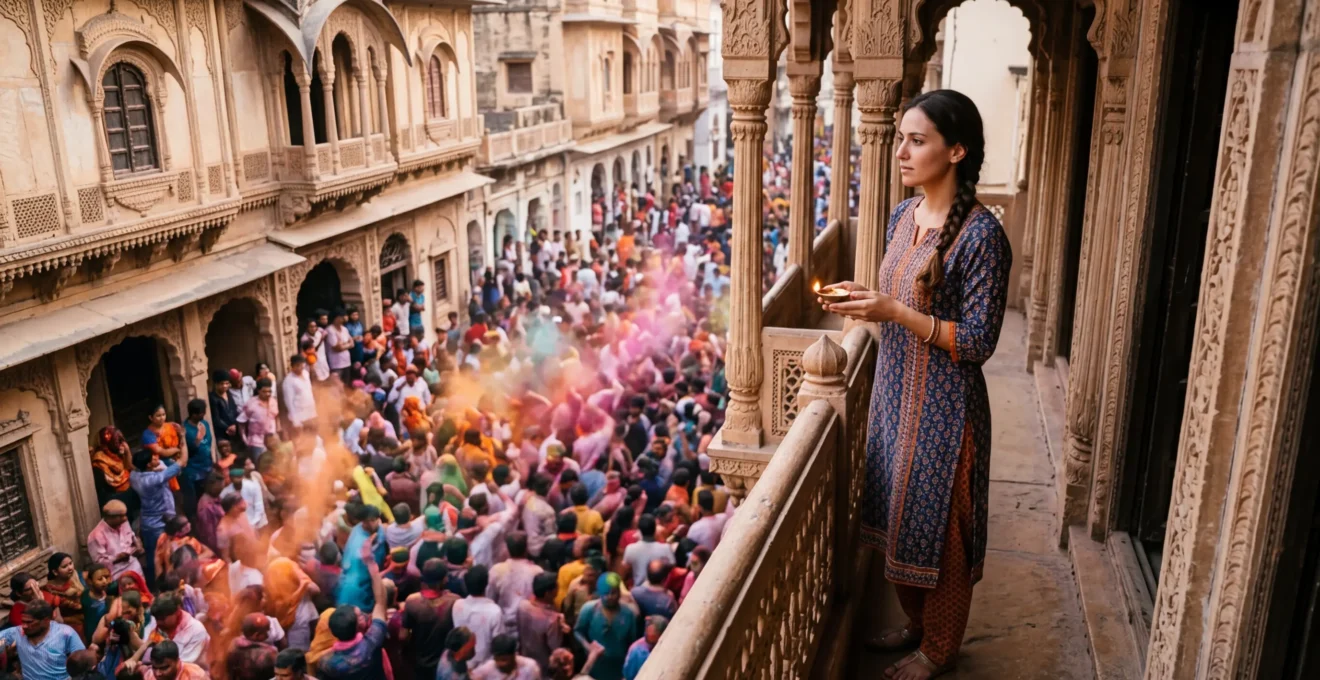
This photo captures the essence of the proactive mindset needed—taking a moment to ensure your chosen vantage point is secure before the festivities begin, allowing you to relax and enjoy the spectacle fully.
By focusing on finding your “safe vantage point” ahead of time, you shift from being a reactive tourist caught in the chaos to a proactive traveller in control of her experience. It’s about creating a personal sanctuary from which to appreciate the overwhelming beauty of the festival.
Pushkar Camel Fair or Kumbh Mela: Which Is Safer for Beginners?
Choosing your first major Indian festival is a critical decision. The scale and intensity vary wildly, and what might be a fantastic experience for a seasoned traveller can be a dangerously overwhelming one for a newcomer. Two famous examples are the Pushkar Camel Fair and the Kumbh Mela. While both are incredible cultural spectacles, they present vastly different challenges, especially for a solo woman.
The Pushkar Camel Fair, held annually in the small Rajasthani town of Pushkar, is an ideal entry point. While busy, the scale is manageable. The town is small and walkable, and it has a well-established tourist infrastructure with plenty of guesthouses, cafes, and shops. Crucially, the ratio of foreign tourists is high, meaning you won’t be the only non-Indian face in the crowd. This shared experience creates a sense of camaraderie and a more relaxed atmosphere. The primary risks are more conventional tourist issues like pickpocketing or minor scams, which are easier to manage. For many, a place like Rishikesh offers an even gentler introduction to India. As Rose Miller of the Where Goes Rose travel blog notes after her travels, Rishikesh is one of the easiest destinations for solo travel, making it a great place to acclimatise before tackling a big festival.
The Kumbh Mela, on the other hand, is the largest peaceful gathering of humanity on Earth, with tens of millions of pilgrims. It is an entire temporary city built on faith and logistical miracles. For a first-timer, and particularly a solo female, this is the deep end. The sheer density of the crowd is a safety risk in itself, with the potential for stampedes or simply getting lost being very real. The infrastructure is temporary and constantly shifting, and the foreign tourist presence is minimal. Navigating this environment requires a level of experience, cultural understanding, and mental resilience that most beginners simply don’t have. It is an awe-inspiring event, but one best attempted after you have several smaller, less intense Indian experiences under your belt.
The following table breaks down the key differences, making the choice clear for a first-time festival-goer.
| Safety Factor | Pushkar Camel Fair | Kumbh Mela |
|---|---|---|
| Crowd Density | Moderate (manageable) | Extreme (millions) |
| Foreign Tourist Ratio | High (30-40%) | Very Low (<5%) |
| Infrastructure | Established tourist facilities | Temporary mega-city setup |
| Ease of Exit | Small town, walkable | Complex, shifting logistics |
| Primary Risk | Tourist scams, pickpockets | Stampede risk, getting lost |
| Solo Female Friendly | Yes – many solo travelers | Challenging – intense crowds |
The Street Food Error That Ruins 80% of Festival Experiences
One of the great joys of travel in India is the street food. During a festival, the air is thick with the scent of sizzling snacks and sweet chai. However, a bout of “Delhi belly” is the quickest way to ruin your entire experience, confining you to your hotel room. The common wisdom is to “be careful what you eat,” but the real error isn’t just about choosing the wrong stall; it’s about timing and hydration.
The single biggest mistake is eating a heavy meal right before wading into a dense festival crowd. Your body is already under stress from the heat, noise, and constant movement. Diverting energy to digest a large meal can leave you feeling sluggish, nauseous, and vulnerable. The strategic move is to eat a substantial, safe meal about two hours before you plan to enter the festival. During the event itself, stick to light, dry snacks. More importantly, trust your senses over social proof. A long queue is usually a good sign, but if the oil smells rancid or the hygiene looks questionable, walk away. Learning a firm but polite refusal script like “Nahi, shukriya” (No, thank you) is essential for turning down unwanted offerings.
However, the most overlooked culprit of travel illness isn’t always the food. As health experts confirm, bad water causes more Delhi belly cases than food poisoning. Never accept drinks with ice from street vendors. The block ice used is often made from non-potable water and can be contaminated. Stick to bottled water (and check that the seal is intact) or hot drinks like chai. A particularly infamous festival-specific risk is Bhang, a cannabis-laced drink popular during Holi.
Bhang thandai is a popular Holi drink that is laced with cannabis paste. Travelers should avoid drinking it or only drink it in moderation to ensure they don’t get overwhelmed or anxious during the festivities.
This is not a recreational drug to be taken lightly in an already overwhelming environment. For your safety, it’s best to politely decline.
How to Protect Your DSLR Camera From Coloured Powder and Water?
For any photographer, Holi is a dream subject. The vibrant colours, expressive faces, and dynamic action are irresistible. However, for your expensive DSLR camera, it’s a nightmare. The fine, abrasive coloured powder and relentless jets of water can infiltrate every crack and crevice, destroying electronics and scratching lenses. Many travellers have returned from Holi with a great memory card and a £1000 paperweight. Protecting your gear requires a proactive, almost paranoid, level of preparation.
The first strategic question is: do you really need your DSLR? The risk of damage, and also of being targeted for theft, is high. A cheaper compact camera or a GoPro, which is designed for action and is often waterproof, is a much smarter choice. If you must bring your DSLR, then you need to treat it like you’re heading into a warzone. Forget expensive rain covers; simple, cheap, and effective DIY solutions are the way to go. A sacrificial UV filter costing a few pounds is non-negotiable; it will protect your actual lens glass from scratches. A cheap filter is better than a ruined lens.
The core of the strategy is sealing every possible point of entry. Use gaffer tape (which doesn’t leave sticky residue like duct tape) to seal the lens mount, the battery door, the memory card slot, and any other buttons or dials you don’t absolutely need to access. A simple plastic bag or even cling film wrapped around the camera body and lens, secured with rubber bands, provides an excellent, cheap waterproof shield. This meticulous preparation allows you to shoot with more confidence, knowing your gear has the best possible chance of survival.
Your Camera Protection Action Plan for Holi
- Consider alternatives: Use a cheaper compact camera or GoPro to avoid making your expensive DSLR a target for theft or damage.
- Install a sacrifice: Fit a cheap, sacrificial UV filter (around £10) to protect the actual lens glass from scratches and stains.
- Seal everything: Use gaffer tape to meticulously seal all openings, including the lens mount, battery door, and memory card slots.
- Diversify your memory: Use multiple small memory cards, swapping them frequently and storing the used ones in a separate, safe, waterproof location.
- Gain a high ground: Shoot from elevated, safe positions like balconies or rooftops rather than from within the dense crowd to minimise direct hits.
- Plan for recovery: Pack several silica gel packets in your camera bag to help absorb any moisture that gets in after the festival is over.
Why Sensory Overload in Asian Markets Triggers Extreme Travel Anxiety?
A stroll through an Indian market is an assault on the senses, in the best and worst ways. The vibrant colours of saris, the pungent aroma of spices, the cacophony of vendors hawking their wares, the constant jostle of the crowd—it’s everything you came to experience. Yet, for many, this intense stimulation can quickly curdle from exciting to overwhelming, triggering what’s known as sensory overload. This isn’t a sign of weakness; it’s a predictable neurological response that can lead to anxiety, irritability, and a desire to retreat to the quiet of your hotel room.
The key to understanding and managing this is to recognise that it’s not just about the noise or the smells. It’s about cognitive load. Your brain is trying to process a million new inputs at once while also performing several critical tasks simultaneously. You’re navigating through a dense crowd, trying to avoid stepping on a stray dog, calculating currency conversions in your head, keeping a watchful eye on your belongings, and attempting to decipher a foreign language and local customs all at the same time. This immense mental multitasking is what leads to a system shutdown.
The feeling of being overwhelmed is your brain’s way of saying it has run out of processing power. When this happens, your ability to make good decisions plummets, your patience evaporates, and your sense of vulnerability skyrockets. This is the point where a simple interaction can feel like a confrontation, and a minor inconvenience can feel like a major disaster. Recognising the onset of these feelings is the first step to managing them. It’s not the market that’s the problem; it’s your brain’s bandwidth.
The ‘Marmite’ Effect: Managing Cognitive Load
Seasoned travellers often refer to India as a ‘marmite’ country—you either love it or you hate it. This extreme reaction is often a direct result of how an individual copes with cognitive load. The sensory overload isn’t just about external stimuli; it’s the internal mental juggling act. The constant need to navigate, calculate prices, watch your bag, and process cultural differences all at once is what leads to mental fatigue and, for some, a complete shutdown. Successfully navigating India is less about a high tolerance for spice and more about a high capacity for managing simultaneous mental tasks.
Why Wearing Yoga Pants in Traditional Markets Attracts Aggressive Harassment?
For many Western travellers, clothing is about comfort and self-expression. Yoga pants or leggings are a travel staple—they’re comfortable for long journeys and easy to pack. However, in the context of a traditional Indian market, they are one of the worst things you can wear. While not overtly revealing, tight-fitting clothes like leggings are seen as highly suggestive in a culture where modesty is prized and female curves are typically concealed by loose, flowing garments. Wearing them is like walking around with a giant flashing sign that says, “I am a foreigner, and I don’t understand the local rules.”
This isn’t a matter of opinion or being “old-fashioned.” It’s about navigating a different social code. While you may see some urban Indian women wearing tighter clothing, they are doing so within their own cultural context, which is different from yours as a foreign visitor. For a solo female traveller, wearing such clothing can unfortunately be interpreted as an invitation for unwanted attention, leading to staring, comments, and in some cases, aggressive harassment. As experienced travelers confirm, women who adopt traditional Indian attire report a significant reduction in this kind of negative interaction. The goal is what can be called “cultural camouflage”—blending in enough to be able to move freely and without hassle.
This doesn’t mean you need to wear a full sari. There are many comfortable, stylish, and culturally appropriate alternatives that are far better suited to the environment. Loose cotton palazzo pants, often called “elephant pants,” are sold cheaply in every market. A salwar kameez (a long tunic over loose trousers) is incredibly comfortable and respectful. Even layering a long tunic (kurti) over jeans strikes a better balance. A simple scarf (dupatta) is the most versatile tool in your arsenal, ready to be draped over your shoulders for instant modesty when entering a temple or a more conservative area. The following advice from a female expat living in India sums it up perfectly:
Clothing adaptation constitutes your first line of defense against harassment. I advise you to dress in light clothing, cover your legs and shoulders, and slip a scarf into your bag. You’ll see, you’ll blend into the crowd and gain serenity.
– Anonymous female expat, NomadSister travel safety guide
Key takeaways
- Your safety strategy should be based on proactive participation and cultural adaptation, not fearful avoidance.
- Managing your internal state—from sensory overload to what you eat—is just as important as managing external threats.
- The right clothing and gear are not fashion choices, but practical tools for safety, respect, and comfort.
Thriving in Foreign Environments: How to Beat Culture Shock in 48 Hours?
Culture shock is real, and in India, it can hit you like a freight train. It’s that moment when the initial excitement wears off and the profound differences in culture, hygiene, poverty, and social norms become overwhelming. It manifests as fatigue, anxiety, and a longing for the familiar. The temptation is to retreat. However, it is possible to move through the most acute phase of culture shock relatively quickly by taking deliberate, proactive steps. The goal is not to eliminate it, but to process it and re-engage with your environment on your own terms.
The first 48 hours in a new, intense place are critical. Instead of trying to do too much, focus on small, manageable victories. Give yourself a simple mission for the first day, like successfully navigating a local bus to a specific landmark or ordering a full meal in the local language. This tiny act of self-sufficiency can do wonders for your confidence. Within the first 24 hours, find your “third place”—a quiet cafe, a peaceful park bench, or a rooftop with a view where you can go to decompress and recharge without having to retreat to your hotel room. This gives you a safe anchor in the chaos.
Reframe the shock. Instead of seeing the confusion and strangeness as threatening, try to adopt the mindset of an anthropologist. You are not a victim of the chaos; you are a researcher collecting data on a fascinating and complex new world. This mental shift turns frustration into curiosity. It’s a perspective shared by many seasoned journalists, like Margot Bigg, who in an interview with National Geographic, notes that while she stays on guard, being a woman also grants her special access to spaces and interactions that male travellers would never have. Embracing this unique position can be empowering.
Finally, create a simple check-in system with someone at home—a quick WhatsApp message every few days. It’s not about being tracked; it’s about having a low-pressure outlet and knowing someone has your back. By combining these small, actionable steps, you can actively manage the initial shock and build the resilience needed not just to survive, but to truly thrive in one of the world’s most rewarding travel destinations.
By now, you have the strategic framework. You understand that safety isn’t a passive state but an active practice. The next step is to take these principles and apply them with confidence to your own journey, transforming yourself from a nervous tourist into a savvy, self-assured traveller.