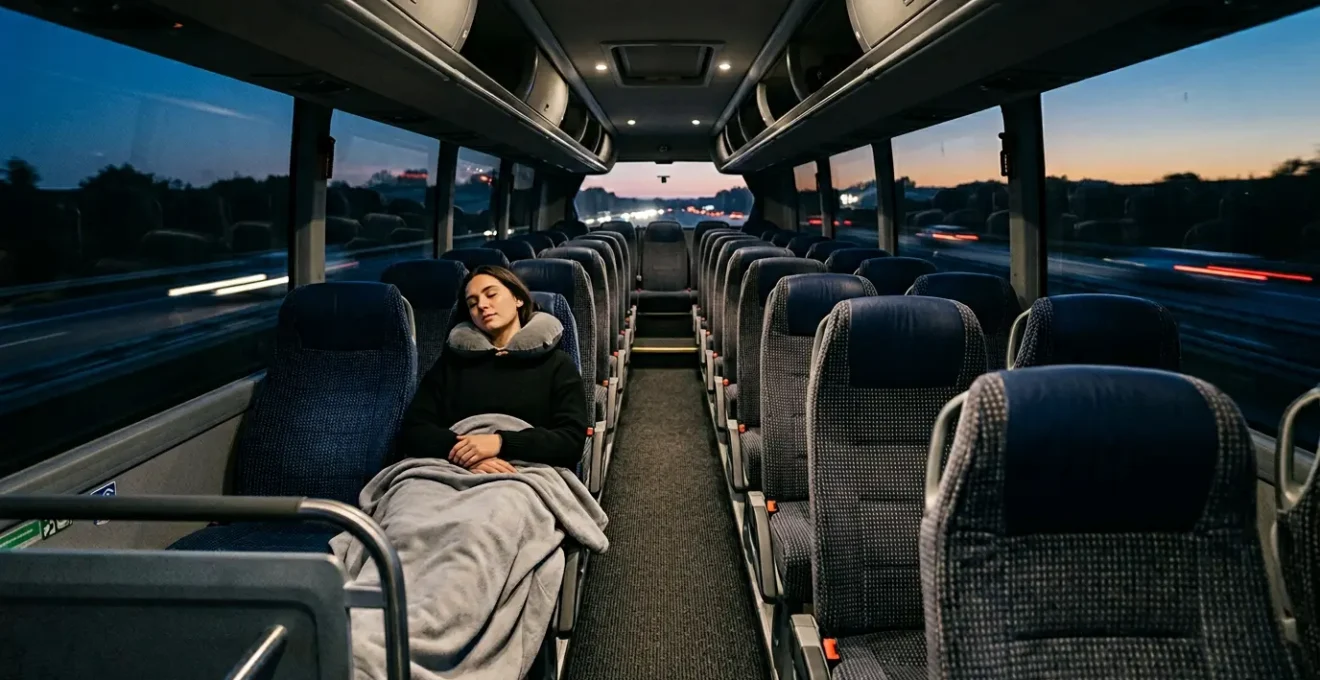
Successfully enduring a 24-hour bus ride isn’t about comfort; it’s a strategic game of managing physics, security, and your personal energy.
- Your seat choice directly impacts motion sickness; physics dictates the front is always more stable than the rear.
- Proactive security, like physically attaching your daypack to your body while sleeping, is non-negotiable to prevent opportunistic theft.
Recommendation: Treat your journey not as a passive endurance test, but as an active challenge. Prioritise strategic decisions about your seat, gear, and recovery time over simply trying to be “comfortable”.
The moment you book that £20, 24-hour bus ticket across a continent, a familiar mix of smug satisfaction and creeping dread sets in. You’ve outsmarted the system, saved a fortune, and bought yourself a story to tell. But the reality of gruelling overland transit looms large. The internet is full of well-meaning but basic advice: pack a neck pillow, wear comfy clothes, bring snacks. While not wrong, this advice barely scratches the surface of what it truly takes to emerge on the other side with your sanity, and all your belongings, intact. It ignores the grim realities of bone-rattling roads, questionable toilet stops, and the constant, low-level hum of security anxiety.
Surviving—and even thriving—on these journeys requires a fundamental shift in mindset. It’s not about recreating the comfort of home. It’s about applying a set of strategic principles, a sort of tactical knowledge learned through hundreds of hours spent on rattling night buses from the Andes to Southeast Asia. This guide moves beyond the platitudes to give you a veteran’s playbook. We’re not just talking about *what* to do, but *why* it works.
The key isn’t a better pillow; it’s a better strategy. It’s about understanding the physics of motion sickness to choose the right seat, creating a personal “security bubble” that makes you an unattractive target for thieves, and mastering your personal “energy economy” to prevent the crippling travel burnout that plagues so many long-term backpackers. We will break down the crucial decisions you’ll face before, during, and after your journey, transforming you from a passive passenger into a savvy overland strategist.
This article provides a complete framework for mastering long-haul bus travel. Below is a summary of the key strategic areas we will cover to ensure you arrive safe, rested, and ready for the next leg of your adventure.
Summary: The Backpacker’s Tactical Guide to Ultra-Long Bus Journeys
- Why Sitting at the Very Back Guarantees Extreme Motion Sickness?
- How to Secure Your Daypack While Sleeping on a Bumpy Transit?
- Cama vs Semi-Cama Seats: Is the £15 Upgrade Worth the Sleep?
- The Under-Seat Bag Mistake That Leads to Stolen Passports Overnight
- When Should You Book Premium Overnight Tickets During National Holidays?
- Why Changing Hostels Every 3 Days Destroys Your Mental Wellbeing?
- The Single-Card Mistake That Leaves You Sleeping in the Airport Terminal
- The Reality for International Travelers: Curing Travel Burnout After 6 Months
Why Sitting at the Very Back Guarantees Extreme Motion Sickness?
The first battle on any long-haul bus is against your own inner ear. Motion sickness can turn a budget-friendly ride into a 24-hour nightmare, and your seat choice is the single most important factor in this fight. The reason the back of the bus is so treacherous comes down to basic physics. A bus acts like a long lever with the wheels as its pivot points. The further you are from the pivot points (the axles), the more exaggerated every bump, sway, and turn becomes. The rear of the bus, sitting far behind the back wheels, experiences the widest arc of movement, like the tip of a whip. This creates intense lateral and vertical motion that your brain struggles to reconcile with what your eyes are seeing.
In fact, the correlation is scientifically proven. Research shows that 28.4% of bus passengers report feeling ill, with the intensity of lateral motion increasing significantly from the front to the rear. To avoid this, you must think like a physicist and choose your seat strategically. The most stable positions are always near the front, directly behind the driver, or over the wheels themselves. A window seat is also crucial, as it allows your eyes to focus on the distant, stable horizon, helping your brain sync the visual information with the motion your body feels. Travelling at night can also help by reducing the amount of conflicting visual input.
Here are the best positions to book to minimise travel-induced nausea:
- Sit in the front row directly behind the driver for the most stable ride.
- Choose seats over the wheels for additional stability and less up-and-down motion.
- Select a window seat facing forward to help you focus on the horizon.
- Unequivocally avoid the rear-most seats where motion is amplified.
Choosing the right seat isn’t about finding a better view; it’s a calculated move to manage the physical forces that can ruin your journey before it’s even halfway through.
How to Secure Your Daypack While Sleeping on a Bumpy Transit?
Once you’ve settled into a motion-sickness-proof seat, the next challenge is getting some sleep without waking up to find your passport, phone, or wallet gone. The overhead rack is not safe. The floor is not safe. The only truly secure place for your daypack—containing all your valuables—is physically attached to you. This is the core principle of creating your personal “security bubble.” Most petty theft on buses is opportunistic; thieves look for the easiest, quietest target. An unattached bag is an open invitation.
Experienced backpackers on notorious routes, like the one from Sihanoukville to Siem Reap, develop a specific sleeping posture. They wear their daypack on their front, often with their arms crossed over it, and curl up around it. This makes it impossible for someone to grab or slash it without waking them. For added security, using small carabiner clips or luggage locks to physically attach your bag’s straps to the seat frame or even to your own belt loops can be an effective deterrent. The goal is to make your bag as difficult and noisy to steal as possible.
This isn’t about paranoia; it’s about strategic discomfort. Sleeping this way might not be as comfortable as stretching out, but it’s infinitely better than the profound discomfort of arriving in a new city with no money or identification. The effectiveness of these measures is significant, as multi-feature anti-theft designs can reduce theft attempts by up to 82%. By making your bag part of your sleeping form, you are employing the most effective anti-theft feature of all: your own presence.
Ultimately, a good night’s sleep on a bus is only possible when your mind is at ease, and that peace of mind comes from knowing your essentials are unquestionably secure.
Cama vs Semi-Cama Seats: Is the £15 Upgrade Worth the Sleep?
In the world of South American bus travel, the terms ‘Semi-Cama’ (half-bed) and ‘Cama’ (bed) represent a critical decision point for any backpacker. The price difference, often around £15, can seem like a significant chunk of a daily budget. The question is: is it a frivolous luxury or a strategic investment in your well-being? The answer lies in your ‘energy economy.’ A sleepless 24-hour journey might save you £15, but it will cost you at least one full day of recovery, effectively wasting time and money at your destination. Arriving exhausted, irritable, and unable to enjoy your first day is a false economy.
The differences between the seat classes are substantial and directly impact your ability to get restorative sleep. It’s not just about a bit more recline; it’s about the entire environment. Cama seats often mean a near-flat bed, more personal space, a privacy curtain, and placement in a quieter, dedicated cabin at the front or on the lower deck of the bus. This isolation from the noise and constant traffic of the main cabin is often worth the price alone. The upgrade is a direct purchase of sleep, privacy, and a positive start to your next stop.
This comparative analysis from a breakdown of bus travel budgeting shows the tangible differences you are paying for:
| Feature | Standard Seat | Semi-Cama | Cama |
|---|---|---|---|
| Recline Angle | 120-130° | 140-160° | 160-180° |
| Legroom | Standard | Extra 4-6 inches | Full extension |
| Seat Width | 17-18 inches | 19-20 inches | 21-22 inches |
| Amenities | Basic | Blanket, pillow | Premium bedding, privacy curtain |
| Price Premium | Base | +£8-12 | +£15-25 |
| Cabin Location | Mixed | Middle section | Separate quiet cabin |
Think of the extra £15 not as an expense, but as the price of an extra functional day on your trip. Viewed this way, it’s one of the best bargains you’ll find.
The Under-Seat Bag Mistake That Leads to Stolen Passports Overnight
A common and dangerous piece of advice is to store your bag under the seat in front of you. This creates a false sense of security. Out of sight does not mean safe; it often means the opposite. A bag on the floor is low down, often in shadow, and can be quietly accessed, slashed, or dragged away by someone in the seat behind or across the aisle while you’re asleep. You won’t feel a thing. This single mistake is responsible for countless stolen passports and wallets on overnight journeys.
The only secure location is within your direct physical control, as discussed previously. This requires a conscious security mindset, something that research suggests varies. For instance, the Summer 2024 Global Rescue survey reveals that 30% of female travelers split their valuables into multiple locations, compared to just 26% of men. This proactive approach of not keeping all your eggs in one basket is a cornerstone of good travel security. Your main backpack may be stowed under the bus, but your daypack—with your passport, phone, cards, and emergency cash—must never leave your person.
Adopting a rigorous security protocol for your valuables is not optional. It’s a core skill for any budget traveler navigating crowded public transport. Following a clear set of steps can mean the difference between a smooth journey and a trip-ending disaster.
Action Plan: Onboard Valuables Security
- Personal attachment: Keep your bag physically attached to your person at all times, ideally worn on your front while sleeping.
- Valuables consolidation: Store all critical items (passport, phone, cards, primary cash) in the daypack attached to you, never in stowed luggage.
- Access denial: Use TSA-approved padlocks on your daypack’s zips to prevent quick, opportunistic pickpocketing attempts.
- Internal layering: Place the most valuable items, like your passport, in the innermost zipped pockets of your bag, making them the hardest to access quickly.
- Redundancy: Keep a backup credit/debit card and some emergency cash in a separate, hidden location completely apart from your main wallet.
Your comfort is secondary to your security. A few hours of cramped legs is a tiny price to pay to ensure you arrive with your most critical possessions.
When Should You Book Premium Overnight Tickets During National Holidays?
Travelling during a national holiday or major festival can be an incredible cultural experience, but it adds a significant layer of complexity to transport. Buses sell out fast, prices skyrocket, and the cheaper seats disappear weeks in advance. If you’re planning to be on the move during these peak periods, booking a premium seat like a Cama isn’t just a good idea—it’s often the only option left. The key is knowing *when* to book.
Bus companies, like airlines, use dynamic pricing. Fares start low and steadily increase as the bus fills up and the departure date gets closer. This effect is massively amplified during holidays. The ’10-Week Rule’ is a solid guideline for savvy travelers. By checking fares 10 to 12 weeks before your travel date, you’ll often find the lowest prices, even for premium seats. Waiting until the last minute during a holiday period guarantees you’ll either pay an exorbitant price for a standard seat or, more likely, be left stranded.
Beyond the 10-week rule, other strategies can help you secure a decent seat without paying peak prices:
- Book far in advance: Aim for that 10-12 week window for the absolute best prices during holiday periods.
- Avoid peak weekend travel: Sunday afternoons are notoriously the most expensive time to travel as locals return home.
- Travel mid-week: Opt for a Tuesday or Wednesday departure, ideally after the morning commute, for the lowest demand and fares.
- Travel against the flow: Consider travelling *into* major cities when everyone else is travelling *out* for the holiday, and vice-versa.
- Choose morning departures: On Sundays, a morning departure is often significantly cheaper than an afternoon or evening one.
During peak season, your ability to plan ahead doesn’t just save you money; it determines whether you travel in relative comfort or don’t travel at all.
Why Changing Hostels Every 3 Days Destroys Your Mental Wellbeing?
The gruelling 24-hour bus journey is often just one link in a longer chain of constant movement. The classic backpacker mistake is trying to see too much, too fast. Moving to a new city and a new hostel every two or three days creates a relentless cycle of packing, transit, unpacking, and navigating. While it looks efficient on an itinerary, this pace is the fastest route to travel burnout. It completely drains your ‘energy economy’ by bombarding you with constant, low-level stress and decision fatigue.
Every hostel change forces you to start from scratch. You have to figure out the new layout, the new social dynamics, the location of the nearest shop, and the best way into town. This constant re-orientation, though seemingly minor, consumes a huge amount of mental energy. You never have time to establish a ‘temporary home base’—a place where you feel comfortable, know your surroundings, and can truly rest. Your brain is always in ‘navigate and assess’ mode, never in ‘relax and recharge’ mode.
This relentless pace also prevents you from forming any meaningful connections, either with other travelers or with the place itself. You’re always on a superficial level, ticking off sights before the next bus. Slowing down and staying in one place for at least four or five nights allows you to move beyond the tourist checklist. It gives you time to find a favourite coffee shop, discover a local market, and actually absorb the rhythm of a place. This is crucial for your mental well-being and for having a genuinely rewarding travel experience.
True long-term travel isn’t about how many places you can visit; it’s about the quality of the time you spend in them. Give yourself permission to slow down.
The Single-Card Mistake That Leaves You Sleeping in the Airport Terminal
You’ve survived the bus ride, secured your gear, and managed your energy. But all that planning can be undone in an instant by a single point of failure: your payment method. Relying on a single debit or credit card is one of the most critical mistakes a traveler can make. Cards get lost, stolen, skimmed, or simply blocked by your bank’s overzealous fraud department at the worst possible moment. Without a backup, you can find yourself unable to pay for a taxi, a hostel, or a meal—effectively stranded.
This is why financial redundancy is a non-negotiable part of any serious traveler’s kit. As security experts at Global Rescue recommend, experienced travelers almost universally carry backup payment methods and split their valuables. This isn’t just about theft; it’s about resilience against a whole range of potential problems. Having multiple cards, stored in different places, creates a firewall that protects your entire trip. If one card is compromised, you can simply switch to another without panic.
A robust payment redundancy strategy is simple to set up but invaluable in a crisis. Here’s a blueprint:
- Primary Card: Carry your main credit or debit card in your wallet for daily use.
- Backup Card: Store a backup debit card (from a different bank account) in a hidden pocket of your main backpack.
- Emergency Cash: Keep an emergency stash of cash (e.g., £100 in USD or Euros) hidden in a deep compartment of your bag, separate from everything else. This is for a taxi and one night’s accommodation in a worst-case scenario.
- Split Cash: Never carry all your daily cash in one place. Split it between your wallet and a separate pocket.
- Digital Copies: As a last resort, have secure digital copies or photos of your cards (front and back) stored in a password-protected cloud service.
Your financial setup should be as resilient as you are. Building in redundancy is the final piece of the puzzle for secure, long-term travel.
Key Takeaways
- Seat selection is a science: Always choose the front or middle of the bus to minimise motion sickness.
- Your body is your best safe: Physically attaching your daypack to yourself while sleeping is the only reliable security method.
- Invest in rest: A Cama seat upgrade on long journeys is a strategic purchase of energy and time, not a luxury.
The Reality for International Travelers: Curing Travel Burnout After 6 Months
After months on the road, the constant cycle of long bus journeys, hostel hopping, and decision-making takes its toll. The initial excitement fades, replaced by a sense of exhaustion and apathy known as travel burnout. It’s the point where even the most stunning temple or beautiful beach fails to inspire you. This isn’t a sign of failure; it’s a predictable consequence of depleting your ‘energy economy’ without adequate time for recovery. Curing it requires a deliberate and conscious decision to stop and recharge.
The single most effective tool against burnout is a non-negotiable recovery ritual after every long-haul journey. The first 24 hours in a new place should be dedicated entirely to rest, not sightseeing. This “3-Day Rule” provides a simple but powerful framework: Day 1 is for recovery, Day 2 is for light re-acclimatisation, and only on Day 3 do you resume normal travel activities. This approach acknowledges that the journey is part of the experience and requires its own recovery time. As travel writer Kassie Duggan wisely puts it in her guide on the subject:
Long-term travel is a marathon, not a sprint. The key is recognizing burnout early and taking steps to recharge and get back to enjoying the journey.
– Kassie Duggan, Travel Burnout: What It Is and How to Fix It
Your post-bus recovery ritual is your primary defence. It should be a simple, repeatable process that signals to your body and mind that it’s time to recharge:
- First 24 Hours: Enforce a strict no-sightseeing rule. This is a mandatory rest period.
- Immediate Arrival: The first thing you do is take a long, hot shower to wash off the grime and stress of the journey.
- Proper Meal: Eat a real, nutritious meal, ideally with fresh vegetables and familiar foods. Avoid instant noodles.
- Real Sleep: Aim for a full 8+ hours of sleep in a proper, stationary bed.
- Day 2: Engage in light, restorative activities only, such as reading, journaling, or a gentle walk around the immediate neighbourhood.
Embrace the art of doing nothing. A day spent deliberately resting is far more productive for your overall journey than a day spent forcing yourself to sightsee while exhausted.