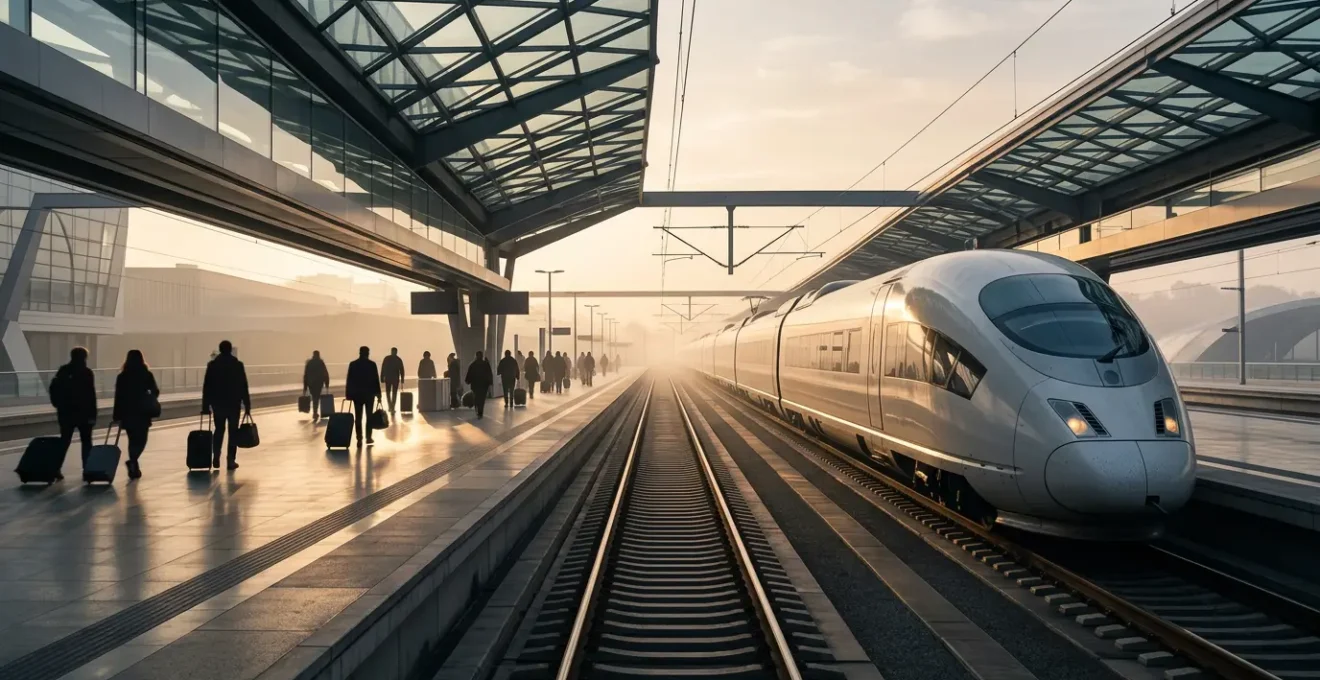
The greatest lie of short-haul travel is that flying is faster; the total journey time, once you factor in the “Airport Tax” of security and transfers, makes high-speed rail the genuinely quicker option.
- A central Paris to Amsterdam journey is 2-3 hours faster by train than by plane, door-to-door.
- Insider knowledge of booking systems and carriage layouts transforms the journey from a simple transit into a luxurious experience.
Recommendation: Ditch the budget airline mindset and embrace European rail as a strategic choice for superior speed, comfort, and sanity on continental trips.
The alarm at 4 AM, the frantic taxi ride to Stansted, the soul-crushing queue that snakes its way towards security. We’ve all been there. We’ve accepted this ritual of stress and discomfort—the so-called “Airport Tax”—as the unavoidable price for a cheap European getaway. We dutifully remove our laptops, decant our liquids into tiny bags, and silently pray our flight isn’t delayed, all for the promise of a one-hour flight that feels anything but fast. This ordeal has become the accepted norm for short-haul travel.
But what if this entire premise is flawed? What if the perceived speed of budget airlines is an illusion, a clever marketing trick that ignores the hours of life wasted in sprawling, out-of-town terminals? The truth is, a revolution in travel has been quietly unfolding across the continent, one that prioritises time-wealth and a civilised journey over the cattle-class chaos of low-cost carriers. This is the world of European high-speed rail, a system designed for genuine efficiency, not just the illusion of it.
This guide is not another list of scenic train rides. It is a manifesto for the discerning British traveller ready to trade the madness of the airport for the simple elegance of the train. We will deconstruct the true cost of flying and demonstrate how, with a little insider knowledge, you can master the rail network to make your journeys faster, cheaper, and infinitely more enjoyable. It’s time to swap EasyJet for effortless travel, reclaiming not just your time, but the very soul of the journey itself.
To help you navigate this superior way of travelling, we’ve broken down the essential strategies and insider secrets. This article covers everything from booking the best seats to avoiding costly rookie mistakes, ensuring your transition to rail is smooth and successful.
Summary: Mastering European Express Trains: Swapping EasyJet for High-Speed Rail Comfort
- Why Airport Security Wait Times Make Short-Haul Flights Slower Than Trains?
- How to Book Interrail Seat Reservations Without Paying Premium Surcharges?
- First Class vs Standard Eurostar: Is the £80 Upgrade Worth It?
- The Platform Validation Error That Incurs a €50 Fine in Italy
- How to Secure Face-to-Face Table Seats for Family Rail Journeys?
- Why Booking on the Wrong Side of the Carriage Ruins the Entire Experience?
- Autoroute vs Route Départementale: Which Suits a 14-Day Slow Travel Itinerary?
- Historic French Byways: Saving €50 on Tolls While Discovering Hidden Châteaux
Why Airport Security Wait Times Make Short-Haul Flights Slower Than Trains?
The core fallacy of short-haul air travel is focusing on flight time alone. A one-hour flight from London to Paris is a lie. The reality is a four-to-six-hour ordeal once you factor in the “Airport Tax”: the journey to an out-of-town airport, the mandatory two-hour pre-flight arrival, security queues, boarding waits, and then ground transport from your destination airport into the city. A direct comparison of a journey from central Paris to central Amsterdam reveals the truth: the high-speed train takes around 3.5 hours, station to station. The equivalent journey by air, despite a shorter flight time, balloons to nearly 6 hours door-to-door.
This is the concept of time-wealth: valuing the quality and control of your time, not just the raw duration. On a train, the two hours you would have spent in an airport security queue are transformed into productive or relaxing time. You can work, read, or simply watch the landscape unfold from your window. You arrive in the heart of the city, calm and ready to explore, not frazzled from the stress of modern air travel. Choosing the train isn’t just about saving time; it’s about investing the time you have more wisely.
And then there’s the undeniable environmental argument. It’s not just a marginal difference; it’s a monumental one. Studies consistently show that flights create at least 6 times the CO2 emissions of similar train journeys. By choosing rail, you are actively participating in a more sustainable and responsible form of tourism, trading a high-carbon headache for a low-impact, high-reward experience. The choice becomes a simple matter of logic and conscience.
How to Book Interrail Seat Reservations Without Paying Premium Surcharges?
The freedom of an Interrail or Eurail pass is intoxicating, but it comes with a common pitfall: the dreaded seat reservation fee. Many high-speed and overnight trains in Europe require pass holders to book a specific seat, and third-party booking sites often add their own significant “premium surcharges” on top of the railway’s fee. This can quickly erode the value of your pass. The secret to system mastery is to bypass these intermediaries entirely.
Your strategy should be to use the official Rail Planner app to *plan* your journey and identify which trains require a reservation, but not always to book through it. Once you’ve chosen your desired train, go directly to the website of the national railway company that operates it. For example, book German ICE train reservations on Deutsche Bahn (DB), French TGV reservations on SNCF Connect, and Italian Frecciarossa reservations on Trenitalia. This direct-booking method almost always offers the lowest possible reservation fee, saving you anywhere from €2 to €10 per journey.
This approach requires a little more effort than a one-click booking on a third-party app, but the savings add up dramatically over a multi-leg trip. Think of it as an essential skill for the savvy rail traveller, separating the novices who pay for convenience from the masters who invest a few minutes to save a significant amount of money. This small shift in booking behaviour is a cornerstone of travelling smart on the European rail network.
As you become more comfortable with this process, you’ll find it second nature to check the national carrier first, treating the Rail Planner app as your invaluable research tool, but not your final booking agent. This is how you unlock the true economic potential of your pass and travel like a pro, not a tourist.
First Class vs Standard Eurostar: Is the £80 Upgrade Worth It?
For British travellers embarking on a European rail adventure, the first decision is often made at St Pancras: is the Eurostar upgrade worth it? The price jump from Standard to Standard Premier or the even more exclusive Business Premier can seem steep. But this isn’t just about a slightly wider seat; it’s a calculated investment in your overall travel experience and time-wealth. To make an informed choice, you must look beyond the price tag and consider the value delivered.
Standard class is perfectly functional, getting you from A to B efficiently. However, moving to Standard Premier, often for around £40-£60 more, introduces a significant leap in comfort. You get a larger seat, more legroom, and a light meal with drinks served at your seat. For a couple starting their holiday, this can transform the journey from simple transit into the first delightful chapter of their trip. Business Premier, with its exclusive lounge access, expedited check-in, and a full three-course meal designed by Raymond Blanc, is a different proposition altogether. It’s a tool for productivity and seamless travel for those whose time is their most valuable asset.
The table below breaks down the tangible differences, allowing you to weigh the cost against the benefits for your specific journey. A solo backpacker might find Standard class perfectly adequate, while a family or a couple celebrating an occasion may find the extra comfort of Standard Premier to be money well spent.
| Feature | Standard Class | Standard Premier | Business Premier |
|---|---|---|---|
| Seat Width | 45cm | 48cm | 53cm |
| Meal Service | Purchase onboard | Light meal included | 3-course meal |
| Lounge Access | No | No | Yes |
| Typical Price Difference | Base fare | +£40-60 | +£80-150 |
| Power Outlets | Shared | At every seat | At every seat |
Ultimately, the question isn’t whether the upgrade is “worth it” in an absolute sense, but whether it’s worth it *for you*. If the added comfort, service, and peace of mind allow you to arrive at your destination more relaxed and refreshed, then that £80 can be one of the best investments you make on your entire trip.
The Platform Validation Error That Incurs a €50 Fine in Italy
Nothing sours a glorious Italian holiday faster than an unexpected €50 fine for a simple misunderstanding. Italy’s regional train system holds a trap for the unwary traveller: the humble paper ticket and the crucial act of validation. While digital tickets with QR codes are conveniently pre-validated, any regional ticket purchased from a machine or ticket office is merely a receipt until it is time-stamped by a specific machine before you board.
These small, often green, ‘convalidatrice’ boxes are located on the platforms. Forgetting to stamp your ticket in one of these before boarding is a costly mistake. Onboard conductors are often powerless to help; their handheld devices are programmed to issue an automatic fine upon scanning an unvalidated ticket. There is no room for discretion, and pleading ignorance as a tourist rarely works. This single, easily avoidable error is a classic example of where a lack of system mastery can directly impact your wallet and your holiday mood.
Fortunately, avoiding this tourist tax is simple once you know the rules. It’s a habit that must be ingrained for any journey on a *regionale* train. The moment you step onto the platform with a paper ticket in hand, your first action should be to locate one of these validation machines. It’s a small step that ensures a smooth, fine-free journey through the beautiful Italian countryside.
Your Action Plan: How to Avoid Italian Train Fines
- Validate paper tickets: Always stamp paper tickets from machines in the green ‘convalidatrice’ boxes on platforms before boarding.
- Check digital tickets: Remember that digital tickets with QR codes from apps or email do not need validation.
- Communicate immediately: If you forget to validate, find the conductor immediately upon boarding to explain—this can sometimes prevent a fine.
- Learn the emergency phrase: Memorise ‘Ho dimenticato di convalidare’ (I forgot to validate) for clear and quick communication.
- Document your validation: Take a quick photo of your validated ticket as time-stamped proof, just in case.
How to Secure Face-to-Face Table Seats for Family Rail Journeys?
For a family travelling by train, securing a block of four seats around a table is the holy grail. It transforms a simple journey into a shared experience, creating a ‘base camp’ for card games, picnics, and excited chatter while the landscape rolls by. However, these coveted ‘carré’ or table seats are limited and often snapped up quickly. Getting them requires a proactive booking strategy, not just luck. This is where strategic seating becomes a crucial part of your planning.
The key is to book as early as possible, as most European rail operators release tickets 90 to 180 days in advance. Don’t just accept the seats the system automatically assigns you. Always look for an option to ‘select seat’ or ‘view seat map’. This is your opportunity to hunt for the table icon or the classic four-seats-facing-each-other configuration. Some systems are more intuitive than others, so it pays to be persistent. A useful trick is to start a ‘mock booking’ without entering payment details just to explore the seat map and see what’s available on different services.
Different countries and train types have their own quirks:
- On German DB trains, look for carriages numbered 21-29, which often have a higher concentration of table seats.
- For French TGV services, specifically requesting ‘carré’ seating during the booking process can help.
- Booking on trains at off-peak times, such as early morning or late evening, can dramatically increase your chances of finding an empty table configuration.
By employing these simple strategies, you move from a passive passenger to an active planner. You are no longer just buying a ticket; you are designing your family’s journey. The reward—hours of connected, happy travel—is well worth the small amount of extra effort during the booking process.
Why Booking on the Wrong Side of the Carriage Ruins the Entire Experience?
There’s a level of rail travel expertise that goes beyond simply getting a seat. It’s the art of strategic seating, and nowhere is its importance more apparent than on Europe’s most famous scenic routes. Booking a seat on the wrong side of the carriage can mean the difference between a jaw-dropping, memorable journey and four hours staring at a rock wall or an unremarkable landscape while the best views unfold unseen on the other side of the aisle.
The quintessential example is the glorious Rhine Valley route in Germany, between Koblenz and Mainz. This journey is famed for its fairy-tale castles, steep vineyards, and the legendary Loreley rock. However, all of these sights are located on the west bank of the river. This means that passengers travelling southbound towards Mainz need to be on the right-hand side of the train, while those travelling northbound to Koblenz must be on the left-hand side to get the panoramic views. Passengers on the wrong side see very little of what makes this route iconic.
This isn’t a rare occurrence. The same principle applies to many coastal routes in Italy, mountain passes in Switzerland, and fjord-side journeys in Norway. A few minutes of research before booking can make all the difference. Websites like Seat61.com and various travel forums are invaluable resources where experienced travellers share this crucial directional advice. Mastering this aspect of train travel elevates you from a mere tourist to a connoisseur of the journey, ensuring you always have the best possible view.
Key Takeaways
- The “Airport Tax” in wasted time and stress makes door-to-door train travel faster than flying for many short-haul European routes.
- True system mastery involves booking reservations directly with national carriers to avoid surcharges and learning local rules to prevent fines.
- Strategic seating—choosing the right class, seat type, and even side of the carriage—is not a luxury but a crucial element that can define the entire journey.
Autoroute vs Route Départementale: Which Suits a 14-Day Slow Travel Itinerary?
True European travel mastery involves knowing when to embrace speed and when to embrace the slow road. While high-speed trains are unbeatable for long-distance city-to-city hops, the real soul of a region like France is often found on its smaller roads. The choice between the efficient, toll-heavy Autoroute (A-roads) and the meandering, picturesque Route Départementale (D-roads) defines your travel philosophy. For a 14-day slow travel itinerary, a hybrid approach is often the most rewarding.
The strategy is simple: use the TGV (Train à Grande Vitesse) for the long hauls and a rental car for regional deep dives. For example, a 14-day trip to France could involve taking the TGV from Paris to Lyon in a swift two hours. From there, you rent a car not to race down the Autoroute to Provence, but to spend five days leisurely exploring the D-roads of Burgundy, discovering wine villages and local markets. Afterwards, you can return the car, take a one-hour TGV to Avignon, and pick up another rental for a five-day exploration of Provence’s back roads, before a final TGV back to Paris.
This hybrid model offers the best of both worlds. You get the time-saving efficiency of the train for covering vast distances, and the freedom of the car for intimate, slow-paced discovery. Crucially, by sticking to the D-roads, you also avoid the hefty French autoroute tolls. The typical toll charges demonstrate that a drive from Paris to Nice can cost over €50, money that could be better spent on a memorable meal. This approach saves hundreds of euros in tolls over a two-week trip, while maximising both efficiency and serendipitous discovery.
Historic French Byways: Saving €50 on Tolls While Discovering Hidden Châteaux
Embracing the slow travel philosophy in France is as much a financial decision as it is a stylistic one. By consciously shunning the monotonous, expensive Autoroutes, you not only save a significant amount of money but also open your journey up to the hidden treasures of the French countryside. This is the ultimate expression of “the journey as the destination,” where the drive itself becomes a highlight of the trip, not a chore to be endured.
The toll-free national (N) and departmental (D) roads often run parallel to the major motorways, but they wind through charming villages, past local producers, and offer spontaneous views that the hermetically sealed Autoroute experience can never provide. For every major toll route in France, there is a beautiful, free alternative waiting to be discovered by the patient traveller. This isn’t about being cheap; it’s about being smart and enriching your travel experience.
Here are a few classic examples of trading tolls for treasures:
- Paris to the Loire Valley: Instead of the A10, take the N152, which follows the graceful curves of the Loire River itself, offering impromptu glimpses of magnificent châteaux long before you reach your destination.
- Lyon to Provence: Ditch the notoriously busy A7 Autoroute du Soleil and take the D538 through the rolling hills and lavender fields of the Drôme Provençale.
- Bordeaux to Toulouse: Follow the D-roads through the heart of Armagnac country, a journey that saves you around €25 in tolls and rewards you with opportunities to sample the local brandy.
- Reims to Strasbourg: The A4 is efficient, but taking the scenic Route du Vin through the storybook villages of Alsace is an unforgettable experience in itself.
Start planning your own flight-free European adventure today. By embracing these strategies, you’re not just choosing a different mode of transport; you’re choosing a smarter, richer, and more rewarding way to explore the continent.