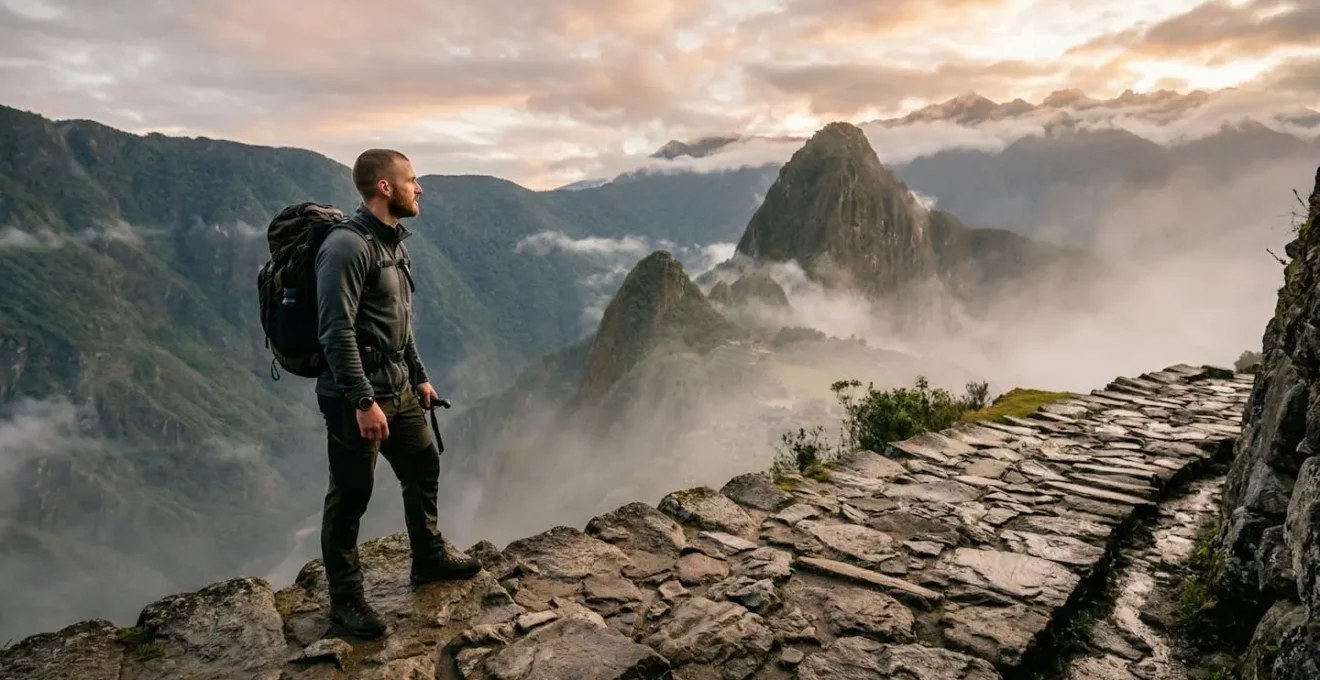
Your extensive UK hiking experience is a poor predictor of success in the Andes; physiological humility and disciplined acclimatisation are what will prevent severe altitude sickness on your Inca Trail trek.
- Altitude sickness risk is determined by genetics and acclimatisation speed, not sea-level fitness. The air at 3,600m has 40% less oxygen.
- A critical error is staying in high-altitude Cusco (3,400m). Immediately descend to the Sacred Valley (approx. 2,800m) for the first two nights.
Recommendation: Book your Inca Trail permit at least six months in advance and schedule a minimum of three full days for deliberate, slow-paced acclimatisation before starting your trek.
If you’ve conquered Scafell Pike in the rain and navigated the Cairngorms in a whiteout, the thought of a Peruvian trek to Machu Picchu likely feels like the next logical challenge. You’re active, you’re over 40, and your hiking boots have seen more miles than your car. This is precisely why you are at a higher risk. The common advice to “get fit” doesn’t apply; you’re already fit. The real danger lies in a misplaced confidence that your excellent physical condition at sea level will protect you from the debilitating effects of altitude. It won’t.
This guide is not another generic list of tips. It is a strategic manual from a mountain guide who has seen countless seasoned British hikers, confident in their abilities, brought to their knees by Acute Mountain Sickness (AMS). The issue isn’t your strength or stamina; it’s a fundamental misunderstanding of high-altitude physiology. In the Andes, the game changes. Success isn’t about pushing harder; it’s about mastering the art of acclimatisation discipline and embracing a sense of physiological humility. Forget everything you think you know about your body’s limits based on your experiences in the Peak District or Snowdonia.
We will deconstruct the common mistakes, starting with why your fitness is a blind spot. We’ll then cover the non-negotiable logistics of securing a permit, help you choose the right trail for your body, and detail a precise acclimatisation protocol. We will also address practicalities like pack weight and layering, all through the lens of conserving energy and oxygen in a hypoxic environment. This is your paradigm shift from being a British hiker to becoming a successful Andean trekker.
This comprehensive guide is structured to walk you through every critical stage of your preparation, from logistical planning to on-the-ground acclimatisation and gear strategy. The following sections will provide the detailed knowledge you need to trek safely and enjoyably.
Summary: Your Expert Guide to a Successful High-Altitude Peruvian Trek
- Why Your Peak District Fitness Won’t Prevent Andean Altitude Sickness?
- How to Secure Your Inca Trail Permit 6 Months Before Departure?
- Salkantay vs Classic Inca: Which Route Suits Over-50s Better?
- The Acclimatisation Error That Ruins 30% of Peruvian Treks
- How to Reduce Heavy Backpack Weight by 3kg for Steep Ascents?
- How to Layer Merino Wool Clothing for Sub-Zero Mountain Mornings?
- How to Read a Physical OS Map When GPS Fails Completely?
- Hiking the Rugged Patagonian Andes: Surviving 100mph Winds and Freezing Nights
Why Your Peak District Fitness Won’t Prevent Andean Altitude Sickness?
The single most dangerous assumption a fit British hiker can make is that their physical prowess will protect them from altitude sickness. It’s a fallacy. Acute Mountain Sickness (AMS) is a neurological and physiological response to a lower partial pressure of oxygen (hypoxia); it is not a measure of your cardiovascular fitness. An Olympic athlete is just as susceptible as a casual walker if they ascend too quickly. The critical factor is your body’s individual genetic ability to adapt to less oxygen, and how much time you give it to do so.
At Cusco’s altitude of 3,400 metres, you are already dealing with a significant oxygen deficit. Research on barometric pressure shows there is 40% less oxygen per breath at 3,600m compared to sea level. Your body, accustomed to the oxygen-rich air of the UK, must work much harder just to function at rest. Pushing yourself with a heavy pack, assuming your “hill fitness” will carry you through, is a direct path to headaches, nausea, and potentially life-threatening conditions like High-Altitude Pulmonary Edema (HAPE) or High-Altitude Cerebral Edema (HACE).
This is not a theoretical risk. It’s a stark reality that has had tragic consequences even for young, fit travellers.
Case Study: The Tragic Death of a UK Backpacker
In January 2013, Adam Savory, a 25-year-old backpacker from the UK, tragically died from complications of altitude sickness. After taking a bus directly from the coast to the high-altitude city of Cusco, he complained of feeling tired and unwell, attributing it to “feeling the altitude” but not considering it serious. Within two days, his condition deteriorated drastically, and despite receiving medical care, he passed away. His case is a devastating reminder that AMS can escalate rapidly and must be treated with the utmost seriousness, regardless of age or perceived fitness.
Your fitness is an asset for endurance on the trail itself, but it does not grant you a passport through the acclimatisation process. The key is physiological humility: respecting the altitude and listening to your body, not your ego.
How to Secure Your Inca Trail Permit 6 Months Before Departure?
Unlike a spontaneous weekend hike in the Brecon Beacons, the Classic Inca Trail operates under a strict and limited permit system. This is not a matter of simply showing up; access is tightly controlled to preserve the ancient trail. The Peruvian government releases a fixed number of permits for the entire year, and they sell out astonishingly quickly, especially for the peak season from April to September. Planning is not just recommended; it is mandatory.
The numbers are stark: of the 500 total permits issued each day, a large portion is allocated to the essential support crew of guides, porters, and cooks. This means that official government data confirms that only 200 permits are allocated for travellers daily. With thousands of people worldwide vying for these limited spots, booking at least six months in advance is the absolute minimum standard. For popular months like May or June, booking 8 to 10 months ahead is a safer strategy.
Permits are tied to an individual’s passport number and are non-transferable and non-refundable. You cannot buy them independently; they must be secured through a licensed tour operator. The process generally involves checking availability with an agency, providing your personal details exactly as they appear on your passport, and making a deposit. Be meticulous with this information, as any discrepancy between your permit and your passport at the trailhead checkpoint will result in you being denied entry.
Given the high demand, it’s wise to have flexible dates in mind. If your primary dates are sold out, a good operator can suggest alternative start dates or, as we’ll discuss next, an equally spectacular alternative trek that doesn’t require the same permit lottery.
Salkantay vs Classic Inca: Which Route Suits Over-50s Better?
For many, the “Classic Inca Trail” is the only route they consider. However, its relentless stone steps and crowded nature aren’t the only way to reach Machu Picchu. The Salkantay Trek offers a wilder, more challenging, and often more rewarding alternative, particularly for experienced hikers who prefer dramatic landscapes over historical ruins. For the over-50s hiker, the choice between these two routes depends on a frank assessment of your priorities: history versus raw nature, and your body’s response to different types of physical strain.
The Classic Inca Trail is shorter but arguably more punishing on the knees due to thousands of uneven, ancient stone steps. The Salkantay is longer and reaches a higher altitude, but the terrain consists mainly of dirt paths, which can be more forgiving. Here is a direct comparison of what to expect.
As this table shows, the Salkantay Pass is significantly higher than the Inca Trail’s Dead Woman’s Pass, demanding robust acclimatisation. However, the lack of a permit requirement offers invaluable flexibility, and the varied scenery from alpine peaks to cloud forests is spectacular. For a hiker whose joints protest against endless jarring descents, Salkantay’s smoother paths might be a better fit, despite the greater distance.
| Trek Feature | Classic Inca Trail | Salkantay Trek |
|---|---|---|
| Highest Pass | Dead Woman’s Pass – 13,828 feet (4,215 meters) | Salkantay Pass – 15,213 feet (4,638 meters) |
| Terrain Type | Thousands of uneven stone steps | Mostly dirt paths |
| Total Distance | 42 km (26 miles) | 74 km (46 miles) |
| Permit Required | Yes – limited availability | No – more flexible |
Ultimately, age is not a barrier to either trek. As the team at Adios Adventure Travel rightly points out in their guide:
If you are over 50 and regularly participate in physical activities, there’s no reason why you can’t hike the Inca Trail. We have organized hikes for people in their 70’s. If you are out of shape, reserving a hike is a great motivator to get back on track with your fitness goals.
– Adios Adventure Travel, Complete Idiot’s Guide to Hiking the Inca Trail
The Acclimatisation Error That Ruins 30% of Peruvian Treks
This is the single most important piece of advice in this entire guide. The most common and damaging mistake trekkers make is what I call the “Cusco Trap.” Most international flights land in Cusco (3,400m / 11,150ft), and the standard tourist advice is to spend two or three days there to “acclimatise.” This is physiologically flawed. You do not effectively acclimatise by staying at a high altitude where your body is already struggling. You acclimatise by sleeping at the lowest possible altitude to allow your body to recover and produce more red blood cells.
The correct strategy is to escape Cusco immediately. Upon arrival at the airport, do not check into a hotel in the city. Instead, take a pre-booked taxi or transfer directly down into the Sacred Valley. Towns like Ollantaytambo (2,792m) or Urubamba (2,871m) are significantly lower. Altitude measurements confirm that Sacred Valley towns are 600+ meters lower than Cusco, and that difference is a lifeline for your body. Spending your first two nights there gives your system a crucial head start in the acclimatisation process.
Your acclimatisation should be an active, disciplined protocol, not a passive wait. The goal is to “hike high, sleep low.” This means undertaking gentle walks to higher altitudes during the day, then returning to the lower elevation of the valley to sleep. This stimulates your body to adapt without pushing it into the red zone. The vast majority of fatigue is normal, but it’s a signal to rest, not to push through. The following schedule is a proven template for success:
- Day 1: Arrive in Cusco, immediately transfer down to your hotel in Ollantaytambo (approx. 90-minute drive). Do nothing more strenuous than a gentle walk around the town. Hydrate relentlessly with water and coca tea.
- Day 2: Explore the Sacred Valley. Take a light day trip to the ruins in Pisac or the salt pans of Maras. You are active and mobile, but you return to sleep at the lower altitude of Ollantaytambo.
- Day 3: You can now ascend back to Cusco to explore the city for a day, or begin your trek from a starting point like a train to Aguas Calientes. Your body is now far better prepared for the altitude ahead.
How to Reduce Heavy Backpack Weight by 3kg for Steep Ascents?
For a seasoned UK hiker, packing is a familiar ritual. But the Andean definition of “lightweight” requires a more ruthless approach. Every extra kilogram you carry at 4,000 metres demands significantly more oxygen and energy from your already-strained body. Achieving metabolic efficiency is the goal, and that means shedding weight you thought was essential. Aiming to cut 3kg from a standard multi-day pack is an achievable and impactful target.
This is not about leaving behind safety gear. It’s about scrutinising every single item through the filter of “function per gram.” This involves multi-purposing items and ditching redundant “comforts.” For example, a single pair of trekking poles can also serve as the support for an ultralight tarp shelter, eliminating the weight of dedicated tent poles. Your insulated water bottle cover? Leave it. The bottle itself is what matters. Every small saving adds up to a significant reduction in metabolic load.
By laying out your gear and questioning every item, you can make substantial gains. The weight of your “big three”—backpack, sleeping system, and shelter—is important, but the aggregation of many small items is where the real savings are found.
Action Plan: Your 3kg Weight Reduction Audit
- Water System Overhaul: Ditch the heavy water bladder with its tubes and bite-valves (approx. 400g). Replace it with two 1-litre Smart Water plastic bottles (approx. 40g each). They are durable, lighter, and their threads are compatible with popular Sawyer water filters.
- Duct Tape Repackaging: Never carry the whole roll. Wrap a few metres of duct tape tightly around your water bottle or trekking pole. This saves the weight and bulk of the cardboard core and makes it instantly accessible for gear repair or blister prevention.
- Luxury Item Cull: Scrutinise items like camp pillows, Kindles, multiple sets of “evening clothes,” and excessive toiletries. Use a dry bag stuffed with your down jacket as a pillow. One set of merino wool base layers is for sleeping in, the other is for hiking.
- Consolidate Electronics: Instead of separate chargers and cables, carry a single high-capacity power bank and one multi-head USB cable capable of charging your phone, headlamp, and camera.
- Rethink Your First-Aid Kit: Many pre-made kits are bloated. Customise your own with just the essentials for trekking: blister treatment (Compeed), antiseptic wipes, pain relief (Ibuprofen), antihistamines, and any personal medications.
How to Layer Merino Wool Clothing for Sub-Zero Mountain Mornings?
Andean weather is notoriously fickle. You can experience all four seasons in a single day, with pre-dawn starts often dropping below freezing, followed by intense solar radiation at midday. The key to managing these extremes is not a single, heavy jacket, but a dynamic and intelligent layering system. Merino wool is the undisputed champion for this environment due to its exceptional thermal regulation, moisture-wicking properties, and natural odour resistance.
Your layering system acts as a toolkit, allowing you to add or remove insulation to precisely match your effort level and the ambient temperature. The goal is to avoid sweating, as damp clothing rapidly chills the body when you stop. The system is built upon three core types of layers:
- Base Layer: This is your second skin. Its job is to wick moisture away from your body. A lightweight or midweight merino wool top is ideal.
- Mid Layer(s): These are your insulation layers. They trap warm air. A fleece jacket or a lightweight synthetic or down vest works perfectly. You might carry one or two of varying weights.
- Outer Shell: This is your weather protection. A waterproof and windproof jacket (like Gore-Tex) protects you from rain, snow, and the biting Andean wind. It should be uninsulated and sized to fit over all your other layers.
The choice of base layer weight is particularly crucial and depends on your personal metabolism and expected pace. As the experts at Aiua Clothing explain, it’s a balance of intensity and conditions:
The challenge: Highly variable intensity. Early morning starts in extreme cold when you’re not yet warm. Long sustained effort. Altitude and exposure. Heavyweight or midweight merino base layer depending on pace. If you’re moving slowly or stopping frequently, go heavier. If you’re fit and maintain steady pace, midweight works.
– Aiua Clothing, Winter Layering with Merino Wool Guide
For a typical Inca Trail day, this means starting the morning with a base layer, a fleece mid-layer, and perhaps even a down jacket on top. As the sun rises and you begin to climb, you’ll strip off the down jacket, then the fleece, often hiking in just your base layer by late morning. The shell jacket stays in your pack, ready to be deployed instantly if the wind picks up or clouds roll in.
How to Read a Physical OS Map When GPS Fails Completely?
In an age of GPS watches and smartphone apps, relying solely on technology for navigation in the Andes is a rookie mistake. Batteries die, especially in the cold. Satellites can be blocked by steep canyon walls. A dead GPS device is a useless piece of plastic; a physical map and a compass are foolproof. While you will be with a guide on the Inca Trail, understanding basic map-reading is a fundamental skill of self-reliance and safety for any serious hiker.
Peruvian trekking maps differ from the Ordnance Survey (OS) maps you’re used to in the UK, but the principles are universal. The most important features to master are the contour lines. These lines connect points of equal elevation. The closer the lines are to each other, the steeper the terrain. Widely spaced lines indicate a gentle slope or flat ground. By reading contours, you can visualise the 3D shape of the landscape directly from your 2D map, identifying ridges, valleys, and saddles (passes).
The second core skill is orienting the map. A map is only useful if it is aligned with the world around you. Place your compass flat on the map, with the edge of the baseplate aligned along one of the map’s north-south grid lines. Then, rotate the map and compass together until the compass needle points to the ‘N’ on the compass dial. Your map is now oriented. Any feature you see on the map will be in the corresponding direction on the ground. This simple action transforms the map from an abstract document into a practical tool.
Finally, practice feature identification. With your map oriented, look for prominent features around you—a river bend, a distinct peak, a junction of trails—and find their corresponding symbols on the map. This confirms your position. Conversely, you can use the map to anticipate what’s coming next: “According to the map, we should be crossing a small stream after climbing this next ridge.” This builds a mental model of the terrain, making you an active participant in the navigation, not just a passive follower.
Key Takeaways
- Your sea-level fitness does not protect you from altitude sickness; disciplined acclimatisation is the only effective preventative measure.
- Book your Inca Trail permit a minimum of six months in advance, as only 200 are available for travellers each day.
- Immediately descend from Cusco to the lower Sacred Valley (e.g., Ollantaytambo) for your first two nights to acclimatise effectively.
- Ruthlessly reduce your pack weight by multi-purposing gear and eliminating non-essentials to lower your body’s oxygen demand.
Hiking the Rugged Patagonian Andes: Surviving 100mph Winds and Freezing Nights
While your immediate goal is Peru, the principles of high-altitude trekking are universal. The skills you hone for the Inca Trail are a foundation for tackling even more formidable environments, such as the rugged Patagonian Andes. Patagonia represents an exponential increase in challenge: the altitudes may be similar, but the weather is far more severe and unpredictable, with infamous 100mph winds and brutal, freezing nights. Surviving there requires the lessons from Peru to be executed with flawless precision.
The acclimatisation discipline you practice in the Sacred Valley becomes even more critical in Patagonia, where medical help is often days, not hours, away. The metabolic efficiency gained from shedding those 3kg from your pack is no longer about comfort, but about survival, as every calorie and every molecule of oxygen counts when battling relentless wind. Your merino layering system is tested to its absolute limit, and your ability to read a map when a GPS fails becomes a life-saving skill, not just a good practice.
Thinking about a Patagonian-level challenge reframes your preparation for Machu Picchu. It encourages you to view your Peruvian trek not as a single holiday, but as a vital step in your development as a serious mountain hiker. Every decision—from choosing the right trek to packing the right gear—should be made with an eye toward building a robust system that can withstand extreme conditions. This mindset transforms your approach from that of a tourist to that of an expeditioner.
By treating the Inca Trail with the seriousness of a Patagonian expedition, you not only guarantee a safer and more enjoyable experience in Peru but also build the skills and resilience for a lifetime of high-altitude adventures.
Now that you are equipped with the right mindset and strategy, the next logical step is to begin the planning process. Start by researching licensed tour operators and checking Inca Trail permit availability for your desired dates.