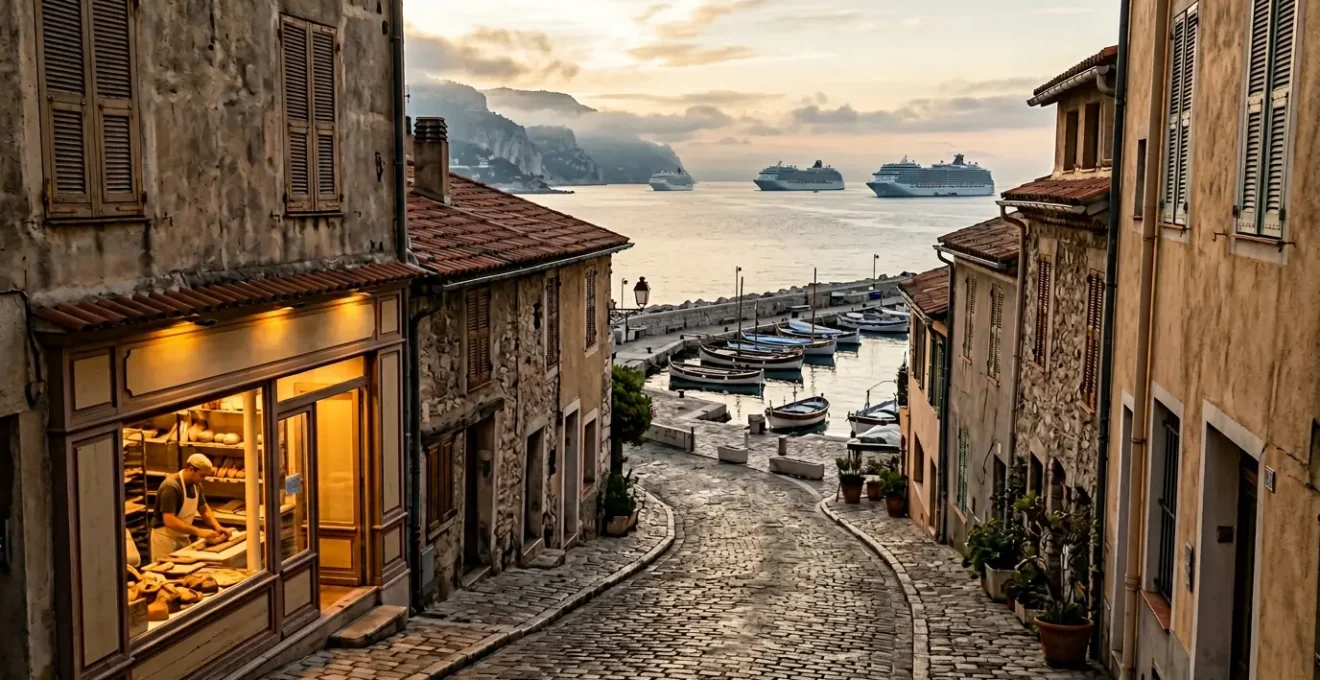
Forget ‘waking up early’—the real secret to beating cruise ship crowds is mastering temporal arbitrage and reversing the tourist flow.
- Use real-time marine tracking to predict precisely when streets will be empty.
- Ditch port-side tourist traps by applying the ’10-minute walk rule’ for authentic food.
- Structure your day by visiting the furthest attractions first and the most popular ones after 3 PM.
Recommendation: Adopt the mindset of a local strategist. Your goal isn’t just to avoid crowds, but to be where they aren’t, precisely when they aren’t.
You’ve seen the pictures: a sun-drenched piazza in Venice, the gleaming stone walls of Dubrovnik, a quiet alley in a Greek island village. This is the Europe you came to see. But the reality is often a slow, suffocating shuffle through a sea of people, a human traffic jam powered by the daily arrival of colossal cruise ships disgorging up to 10,000 passengers into streets not built for a fraction of that number. The magic is lost, replaced by the frustration of overtourism.
The common advice is to travel in the off-season or just wake up early. But what if you’re travelling in July? And what good is being up at 6 AM if you don’t know where to go? As someone who lives in one of these port cities, I can tell you that most advice misses the point. It’s not about just avoiding the crowds; it’s about outsmarting them with a clear strategy. It’s about understanding the rhythm of the port and the predictable patterns of the day-trippers.
The truth is, you don’t need to flee to obscure villages to find an authentic experience. You can stand in the heart of St. Mark’s Square or walk the walls of Dubrovnik in relative peace. But you can’t do it by following the herd. This guide is built on a local’s perspective. It’s a set of tactical principles, from decoding shipping data to reversing the typical tourist itinerary. It’s about learning to use time and space as your allies to reclaim these beautiful cities for yourself.
This article will provide you with a step-by-step strategic framework. We will cover how to predict crowd movements with precision, where to stay for a critical head start, and how to structure your day to move against the human tide. Let’s begin.
Contents: Your strategic guide to outsmarting the crowds
- Why coastal restaurants near the terminal serve the worst overpriced seafood
- How to use the Marine Traffic app to predict empty streets
- Land-based stays vs port moorings: Where to sleep for quiet mornings
- The midday excursion error that traps you in unbearable heat and crowds
- In what order should you visit key sites to beat the gangway rush
- Why midday visits to European cathedrals guarantee peak frustration
- How to secure shaded deck seating on a crowded august crossing
- Island hopping by ferries: Avoiding chaos and delays in the Greek Cyclades
Why coastal restaurants near the terminal serve the worst overpriced seafood
The moment you step off the ship or ferry, you’re in the “kill zone.” This is the 500-metre radius around the terminal where restaurants exist for one reason: to capture the maximum number of tourists in the minimum amount of time. They know you’re new, disoriented, and hungry. Their business model isn’t based on repeat custom from locals, but on a constant, fresh supply of day-trippers. The result is inevitably overpriced, low-quality food, often advertised with glossy, laminated menus in five languages—the cardinal sign of a tourist trap.
The sheer volume of people fuels this ecosystem. The top Mediterranean ports handle a staggering number of visitors; a MedCruise report noted over 2.2 million passenger movements through just four major hubs in a single year. These restaurants are a direct consequence of that volume. To escape this, you must apply the first rule of crowd evasion: walk away from the waterfront. Your goal is to find the places that rely on local, year-round trade. These are the establishments where quality and value matter more than proximity to the gangway.
The strategy is simple but requires a small amount of discipline. Instead of turning towards the most obvious, bustling thoroughfare, you must deliberately walk perpendicular to it, heading inland into the quieter, residential backstreets. This is where the real city lives, and it’s where you’ll find authentic food at a fair price.
Your action plan: The 10-minute rule for authentic dining
- Exit the main cruise terminal and identify the primary tourist thoroughfare leading into town.
- Turn 90 degrees and walk perpendicular to this main route for at least 10 minutes, moving deeper into the city’s neighbourhoods.
- Look for restaurants without picture menus or signs in more than two languages. A handwritten daily menu is an excellent sign.
- Check if local shopkeepers, police officers, or other uniformed workers are dining there. This is a strong indicator of local approval.
- Avoid any establishment with staff standing outside actively trying to solicit your business. A good restaurant doesn’t need to beg.
How to use the Marine Traffic app to predict empty streets
The most powerful tool for avoiding crowds isn’t a guidebook; it’s an app on your phone. To truly outsmart the tourist flow, you need to know where it’s coming from and when it will hit. Free apps like MarineTraffic provide real-time AIS (Automatic Identification System) data for ships worldwide. For a strategist, this is gold. You can see exactly which cruise ships are scheduled to arrive, their passenger capacity, and their real-time position and speed.
This isn’t just about checking a static port schedule. It’s about dynamic prediction. By monitoring an incoming ship’s live position, you can calculate the “first wave” with remarkable accuracy. As a rule of thumb, it takes approximately 90 minutes from the moment a large ship docks for the first significant wave of passengers to clear disembarkation, navigate the terminal, and reach the main square or city centre. A case study of the app’s capabilities shows MarineTraffic processes data from over 800,000 vessels, making this a highly reliable method. If a ship with 5,000 passengers is scheduled for an 8:00 AM arrival, you know the city centre will be manageable until around 9:30 AM, at which point you should be somewhere else entirely.
This data allows you to practice what we locals call temporal arbitrage: using your time advantage to be in the most popular places when they are empty. While thousands of people are stuck in a queue to get off the ship, you’re having a peaceful coffee in a deserted main square, having already enjoyed it at its best. You can also see when ships are preparing to depart. As passengers begin heading back to the ship (usually from 3 PM onwards), the city’s attractions start to empty out, opening another window of opportunity for a peaceful visit.
Land-based stays vs port moorings: Where to sleep for quiet mornings
Your choice of accommodation is a critical strategic decision that dictates your ability to beat the morning rush. Staying in the wrong place can completely neutralise the advantage of being a land-based traveller. A hotel in the immediate port area might seem convenient, but you’ll be woken by the 6 AM noise of the first ships docking and find yourself in the thick of the crowds from the outset. For a quiet morning, your location is everything.
As travel expert Wendy Perrin advises after her experiences in Croatia, the strategy is to be inside the walls before the day-trippers arrive. She notes that Dubrovnik now limits cruise passengers but the magic is still in the early hours:
Stay inside the historic center and wake up to empty streets before the day-trippers arrive. The magic of wandering quiet alleys has been replaced by navigating dense crowds after 10am.
– Wendy Perrin
Renting an apartment within the historic centre or in a quiet neighbourhood just outside the main walls is the superior choice. This allows you to step out of your door at dawn and experience the city as it should be: peaceful, atmospheric, and yours alone. You can visit the most famous landmarks and be back at your apartment for a coffee before the first tour groups have even assembled. This choice provides the essential head start that cruise passengers simply cannot get.
The following table, based on an analysis of accommodation strategies, breaks down the pros and cons of each location type for a crowd-conscious traveller.
| Accommodation Type | Morning Quiet Level | Distance to Attractions | Price Range | Best For |
|---|---|---|---|---|
| Historic Center Apartment | Very Quiet (before 10am) | 0-5 min walk | €€€ | Early risers wanting immediate access |
| Neighborhood Outside Walls | Always Quiet | 10-15 min walk | €€ | Authentic local experience seekers |
| Port Area Hotel | Noisy from 6am | 5-10 min walk | €€ | Late-night arrival convenience |
| Marina/Port Mooring | Very Noisy | On location | €€€€ | Boat owners only |
The midday excursion error that traps you in unbearable heat and crowds
The single biggest mistake independent travellers and cruise passengers alike make is attempting to sightsee between 11 AM and 3 PM. This is the period of peak crowds, peak heat, and peak frustration. The streets are clogged, the queues are at their longest, and the Mediterranean sun is at its most punishing. Many historic cities, overwhelmed by the influx, have been forced to implement crowd control measures, such as the well-documented limit of 8,000 daily cruisers in Santorini, to manage this midday surge.
A savvy local does the opposite. We embrace the tradition of the siesta or midday pause. This is not a time for fighting through crowds; it is a time for a long, leisurely lunch in a quiet, air-conditioned trattoria (found using the 10-minute rule), a visit to a less-crowded museum, or simply a rest back at your apartment. Treat the middle of the day as off-limits for major outdoor attractions. You cede this ground to the temporary invaders and save your energy for when the city is more pleasant.
The real magic happens when the day-trippers leave. As the afternoon wears on, you can feel the city begin to breathe again. Streets empty, the golden light of late afternoon appears, and the atmosphere returns. This is the time to explore. As Sunday Times cruise editor Sue Bryant points out, the evening is a completely different experience:
If your ship overnights in Dubrovnik, go into town at sunset, a magical time, when most day trippers have left.
– Sue Bryant, as quoted by CNN Travel
This principle of temporal arbitrage—trading the worst hours of the day for the best—is fundamental. By avoiding the midday trap, you not only dodge the crowds and the heat but also get to experience the city at its most enchanting.
In what order should you visit key sites to beat the gangway rush
Most tourists follow a predictable path. They disembark and head straight for the most famous attraction closest to the port. This creates a human bottleneck. The local strategist’s approach is to apply the “Reverse Itinerary” principle. Instead of following the herd, you move in the opposite direction, working your way back towards the port throughout the day.
Immediately upon the city opening up (or when you leave your centrally-located apartment), take a taxi, bus, or water taxi to the attraction furthest from the port. While thousands are clustering around the sites near the dock, you will have the more distant landmarks almost to yourself. As you work your way back towards the port, you are constantly moving against the main flow of traffic. By the time you reach the port-adjacent attractions in the late afternoon, the majority of cruise passengers will be heading back to their ships, leaving them clear for you to enjoy.
This requires a small investment in transport at the start of the day, but the payoff in time and sanity is enormous. A case study on Barcelona’s port management highlights this. While many tourists take a slow shuttle to Las Ramblas, a savvy traveller can take the L3 metro from Drassanes and be at a further-away attraction like Park Güell before the crowds even arrive, demonstrating the power of using alternative routes to reverse the flow. In hilly cities like Lisbon or Athens, this also means you tackle the highest viewpoints first, while your energy levels are high.
The key is to save the most famous, centrally-located sites for the “golden hours” of tourism: before 9:30 AM and after 3:30 PM. Use the midday lull for lunch, lesser-known indoor sites, or simply relaxing.
Why midday visits to European cathedrals guarantee peak frustration
Cathedrals and major churches are often seen as a refuge from the midday sun, which is precisely why you should avoid them between 12 PM and 3 PM. They become free, de-facto air-conditioned community centres, packed with tourists seeking shade, not sanctity. The quiet, contemplative atmosphere is shattered, replaced by the noise and shuffle of a dense crowd. You’ll spend more time navigating selfie sticks than appreciating the architecture or art.
The strategic way to visit these spiritual landmarks is to treat them as active places of worship, not just tourist attractions. The best times to visit are during the hours when tour groups are actively discouraged: early morning or during services. Check the cathedral’s official website for its schedule of Mass, Evensong, or other services. Attending a service is a wonderful, crowd-free way to experience the building as it was intended. You will be seated, often accompanied by organ music, and will see the space come alive.
Even if you don’t attend a full service, the hours around them are golden. Many cathedrals open around 7 AM for morning Mass, a time when you’ll share the space only with a handful of local worshippers. Another pro tip is to look for organ or choir rehearsal times. These are often open to the public and offer a sublime, uncrowded experience. While the main nave might be busy during peak hours, remember to explore the side chapels, crypts, and cloisters. These areas often remain peaceful and empty even when the central space is overwhelmed, offering a quiet escape.
By timing your visit to coincide with the cathedral’s true purpose, you bypass the peak tourist frustration and gain a much deeper, more authentic appreciation for these magnificent structures.
How to secure shaded deck seating on a crowded august crossing
Applying strategic thinking isn’t just for cities; it’s essential for the journey between them. On a packed Greek ferry in August, finding a comfortable, shaded seat on an outside deck can feel like winning the lottery. Most people wander aimlessly and take the first available spot, only to find themselves scorched by the sun an hour later. Securing a good spot requires a basic understanding of geography and the sun’s path.
Before you even board, check your route on a map. Are you heading primarily north, south, east, or west? This, combined with the time of day, will tell you where the sun will be and, more importantly, where the shade will be. In the morning, the sun is in the east. If you are travelling north, the port (left) side of the ferry will be in the shade. In the afternoon, the sun is in the west, so the starboard (right) side will be shaded. This simple pre-planning allows you to head directly to the most desirable side of the ship while others are still getting their bearings.
If you can’t get an ideal side-deck spot, look for alternative shaded areas. The covered rear deck area, often near the snack bar, is a good option. The uppermost decks sometimes have awnings, and the interior, air-conditioned lounges are always a reliable, albeit less scenic, fallback. Being strategic about your position can make the difference between a pleasant, scenic journey and a miserable, sunburnt one.
The following table, inspired by advice from experienced travellers in an analysis of on-deck strategies, gives a simple guide for a northbound ferry crossing.
| Time of Day | Sun Direction | Best Deck Side for Shade | Alternative Option |
|---|---|---|---|
| Morning (8-11 AM) | East | Port (left) side | Interior upper deck lounge |
| Midday (11 AM-2 PM) | Overhead | Lower, more covered decks | Air-conditioned lounges |
| Afternoon (2-6 PM) | West | Starboard (right) side | Covered rear deck |
| Evening (6 PM+) | Low West | Port side for sunset views (sun) | Upper deck bar area |
Key takeaways
- The ’90-Minute Rule’: Assume a 90-minute delay between a ship docking and crowds hitting the city centre.
- The Reverse Itinerary: Start your day at the furthest attraction and work backwards towards the port.
- Temporal Arbitrage: Cede the midday hours (11am-3pm) to the crowds and explore during the golden hours (early morning and late afternoon).
- The Hub-and-Spoke Model: For island hopping, base yourself on a major island and take reliable day trips rather than risky one-way journeys.
Island hopping by ferries: Avoiding chaos and delays in the Greek Cyclades
The dream of Greek island hopping—bouncing from one idyllic paradise to the next—can quickly turn into a nightmare of delays, cancellations, and logistical chaos, especially in the high season. The Cyclades are famous for the Meltemi winds, strong northern winds that can whip up in summer with little warning, leading to frequent ferry cancellations, particularly for smaller vessels or less-sheltered routes. A linear A-to-B-to-C itinerary is a high-risk gamble.
A more resilient strategy, as highlighted in travel expert Rick Steves’ analysis of Mediterranean travel, is the “Hub-and-Spoke” model. Instead of a one-way chain, you choose a larger, well-connected island as your base (the “hub”), such as Naxos or Paros. These islands have large ports, are served by bigger, more stable ferries, and have a high frequency of service, making cancellations less likely. From this secure base, you can take shorter, return-journey day trips (the “spokes”) to smaller, more volatile islands like Amorgos or Folegandros. If a return ferry is cancelled due to wind, you are simply delayed, not stranded and forced to abandon your entire forward-planned itinerary and accommodation.
This model also applies to visiting destinations from a cruise ship. Many passengers don’t realise that their ship is often docked far from the headline attraction. For instance, ships visiting Florence actually dock in La Spezia or Livorno, requiring a long, 90-minute-plus transfer by bus or train. The ship is merely a floating “hub.” Understanding this reality allows you to make smarter decisions about how you use your limited time on shore, sometimes opting for a closer, more rewarding “spoke” destination rather than spending half your day in transit.
By adopting a hub-and-spoke mindset, you build resilience and flexibility into your travel plans, reducing stress and increasing the likelihood of a smooth and enjoyable trip, whether you are island hopping for two weeks or exploring for a single day.
Start planning your trips not by what you want to see, but by when you want to see it, and you will reclaim the magic of these historic port cities.