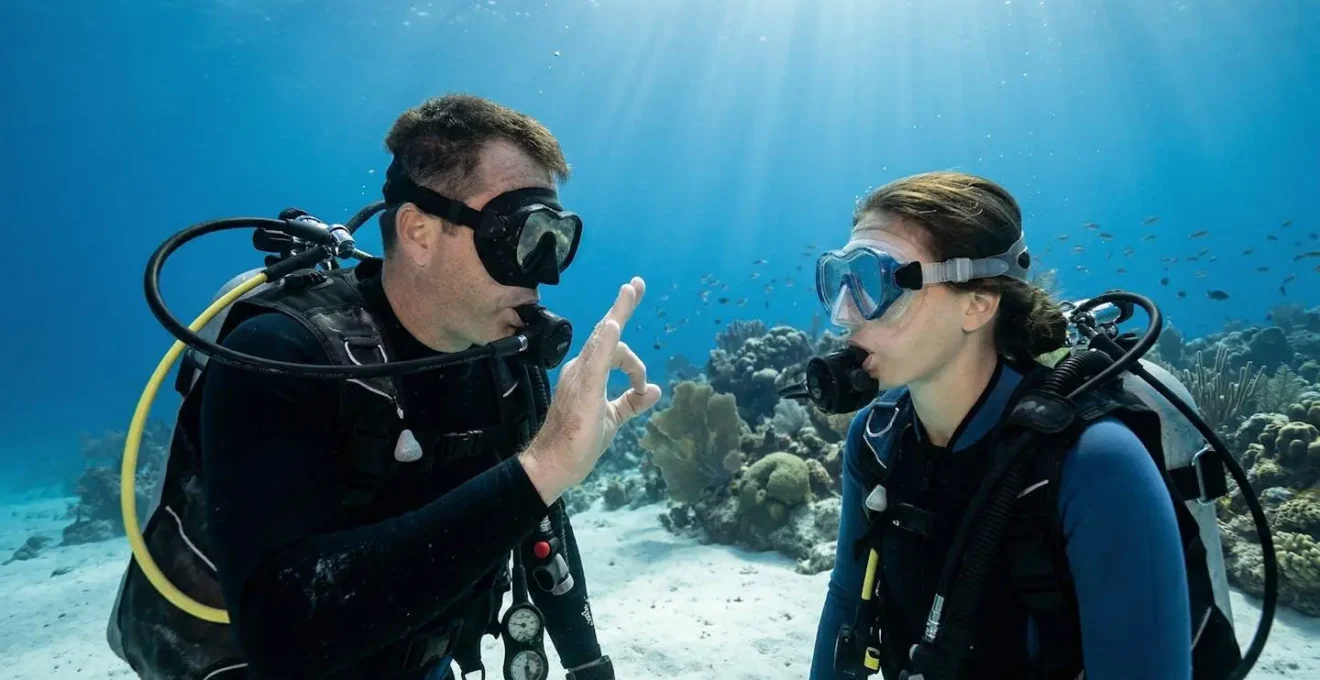
Most advice on choosing a dive school abroad is dangerously superficial; the cheapest price is a direct indicator of compromised safety standards, not a bargain.
- A suspiciously low price is funded by cutting corners on regulator maintenance, instructor experience, and emergency preparedness.
- Verifying an instructor’s status online and asking specific operational questions is more important than checking online reviews.
Recommendation: Treat your certification not as a holiday activity, but as training to use life-support equipment. Use the professional vetting criteria in this guide to assess any dive centre before you pay a single pound.
The image is seductive: crystal-clear turquoise water, a kaleidoscope of tropical fish, and you, weightless and serene, breathing underwater for the first time. Earning your scuba diving certification on holiday seems like the perfect adventure. You’ve probably heard the standard advice: “check the reviews,” “make sure they’re with a major agency,” and “don’t just pick the cheapest.” This is well-intentioned but dangerously inadequate. As a PADI Course Director, I’ve seen the grim consequences of these platitudes. I’ve witnessed the “sausage factory” dive centres in tourist hotspots that prioritise volume over competence, churning out ill-prepared divers with ticking time bombs for equipment.
The truth is that the dive industry, like any other, has operators who engage in a business practice I call the normalisation of deviance. Small safety shortcuts—skipping a pre-dive check, using a slightly worn-out O-ring, rushing a student through a difficult skill—become standard procedure to save time and money. This continues until a catastrophic failure occurs. The problem isn’t the location, whether it’s Thailand, Egypt, or the Caribbean; it’s the operator’s safety culture. This guide is not about finding a bargain. It’s about equipping you with the critical mindset and non-negotiable checklist of a dive professional to distinguish a reputable training facility from a potentially lethal operation.
This article will dissect the specific risks hidden behind a cheap price tag and provide you with concrete, actionable methods to verify the safety and quality of any dive operation abroad. We will cover everything from interrogating an instructor’s credentials to understanding the life-threatening mistakes you can make long after the dive is over.
Summary: Your Guide to a Safe Scuba Certification Abroad
- Why Choosing the Cheapest Dive Centre Often Leads to Faulty Regulators?
- How to Check a Foreign Instructor’s PADI Credentials Before Paying?
- Dry Suits vs Wetsuits: What Do You Need for 15-Degree Waters?
- The Post-Dive Flight Mistake That Triggers Decompression Sickness
- How to Clear Squeeze in Your Ears Without Causing Damage?
- Why Relying on Hand Gestures in a Foreign Pharmacy Can Be Lethal?
- How to Identify a Responsible Wildlife Tour in Southeast Asia?
- Protecting Fragile Marine Ecosystems: The Truth Behind Swimming With Dolphins
Why Choosing the Cheapest Dive Centre Often Leads to Faulty Regulators?
Let’s be blunt: a scuba regulator is not just a piece of kit; it is life-support equipment. Its function is to deliver breathable air in a hostile environment. When you see a dive course advertised for a price that seems too good to be true—say, under £200 for an Open Water certification—you must ask yourself: where are they cutting costs? The first and most common casualty is equipment maintenance. Servicing a single regulator set correctly costs a significant amount in technician time and parts kits. A high-volume, low-cost centre simply cannot afford to follow the manufacturer’s mandatory annual service schedule for its entire fleet of rental gear.
This financial pressure leads directly to faulty equipment. Hoses develop micro-cracks, first-stage seats wear out leading to free-flows, and second-stage components corrode. These are not minor inconveniences; they are emergencies waiting to happen. Analysis of diving accidents confirms that a startling 15% of diving fatality triggers are equipment problems. The ‘bargain’ price you pay upfront is a direct trade-off against the reliability of the gear keeping you alive. A reputable centre, charging a fair price (typically £350-£500), is not ripping you off; they are funding a non-negotiable maintenance schedule. Before you even think about the water, you must adopt a healthy suspicion and inspect the equipment yourself.
Your Pre-Dive Life-Support Equipment Check
- Regulator Inspection: Visually check for any cracks on the body, corrosion on metal parts, or frayed sections on all hoses.
- BCD Check: Fully inflate the Buoyancy Control Device (BCD) and listen carefully for any hissing sounds that indicate a leak.
- Inflator Buttons Test: Press the oral and power inflator buttons. They must operate smoothly and not stick in either position.
- Pressure Gauge (SPG) Test: When the tank is opened, the needle on the SPG should jump to its reading and remain perfectly still. A vibrating needle suggests a problem.
- Contamination Check: Look inside the regulator’s dust cap. Any white powder residue indicates aluminium oxide from a corroded tank, which you do not want to breathe.
- Air Smell Test: Briefly purge the regulator and smell the air. It should be odourless. Any oily or strange smell indicates a problem with the compressor’s filtration system.
How to Check a Foreign Instructor’s PADI Credentials Before Paying?
While faulty equipment is a terrifying prospect, the single biggest factor in diving accidents is the person in charge of you. A damning 2011 workshop by the Divers Alert Network (DAN) found that a staggering 85-90% of diving litigation cases were attributable to diver error. This underscores a critical truth: your instructor is the most important piece of safety equipment you have. They are responsible for building your competence, managing your fears, and making sound judgments on your behalf. A cheap dive centre often employs the cheapest instructors—often newly certified Divemasters or instructors with minimal real-world teaching experience—who are more likely to miss signs of panic or cut corners on skill development.
Do not rely on a friendly smile or a worn-out PADI t-shirt. You have every right to verify their professional status. Ask for their instructor number and check it on the PADI Pro-Check™ tool online. It will confirm their name and, crucially, their teaching status. An “in-status” instructor is renewed, insured, and current with all standards. But this is just the beginning. A truly professional instructor will welcome your questions about safety and teaching philosophy. Their answers will reveal far more than any online review.
Probe them on difficult skills. Ask them, “What is your policy if a student panics during the mask-clearing skill?” or “How do you teach buoyancy control beyond the textbook?” A good instructor will have a thoughtful, patient, and safety-focused answer. A poor one will be dismissive or give a generic reply. Also, ask about group sizes. A maximum of four students per instructor is the gold standard for personalised attention and safety during in-water training. If they take groups of six or eight, you are just a number in their ‘sausage factory’ model, and your safety is compromised.
Dry Suits vs Wetsuits: What Do You Need for 15-Degree Waters?
Your body loses heat 25 times faster in water than in air. Thermal protection is not about comfort; it’s about survival and cognitive function. A common mistake holidaymakers make is underestimating how cold even “tropical” waters can feel after 45 minutes. A dive centre that puts you in a thin, worn-out 3mm wetsuit for a 24°C dive is already showing poor judgment. But when the water temperature drops to around 15°C, as it can in places like the Canary Islands or even deeper Mediterranean sites, the choice between a wetsuit and a dry suit becomes a critical safety decision.
As the Divers Alert Network states, the danger is multifaceted. In their 2019 report, they highlighted a crucial fact:
Cold water severely increases air consumption, impairs cognitive function leading to poor decisions and task fixation, and can increase susceptibility to decompression sickness.
– Divers Alert Network, DAN Annual Diving Report 2019
In 15°C water, a thick 7mm wetsuit offers only moderate protection, keeping you functional for perhaps 30-45 minutes before your body starts burning through your air supply just to stay warm. A dry suit, which keeps you completely dry with insulating undergarments, is the proper tool for the job. However, it requires a separate specialty certification, as managing the air inside the suit introduces new buoyancy and emergency skills. A responsible operator will be honest about these requirements. A negligent one will push you into the water with inadequate protection, risking hypothermia and dangerously impaired judgment.
The differences are stark and have direct safety implications, as this comparative analysis from DAN illustrates.
| Factor | 7mm Wetsuit | Dry Suit |
|---|---|---|
| Thermal Protection at 15°C | Moderate (30-45 min comfort) | Excellent (60+ min comfort) |
| Buoyancy Impact | Significant compression at depth | Requires air management |
| Training Required | Basic OW sufficient | Specialty certification needed |
| Emergency Risk | Hypothermia if extended | Inverted ascent if untrained |
| Air Consumption Impact | +30-40% when cold | +10-15% for suit inflation |
The Post-Dive Flight Mistake That Triggers Decompression Sickness
One of the most insidious risks associated with diving on holiday has nothing to do with what happens in the water. It happens 24 hours later, at 30,000 feet. Decompression Sickness (DCS), or “the bends,” occurs when nitrogen absorbed by the body’s tissues under pressure comes out of solution too quickly, forming bubbles that can cause anything from skin rashes and joint pain to paralysis and death. While rare, it remains a persistent threat, with BSAC’s latest report showing 37 cases of decompression illness reported in 2024 in the UK alone.
The most common trigger for holiday divers is flying too soon after their last dive. The cabin of a commercial airliner is pressurised to an altitude of 6,000-8,000 feet, not sea level. This reduction in ambient pressure is like a rapid ascent, encouraging any residual nitrogen in your system to form dangerous bubbles. Any reputable instructor will drill the “no-fly” time into you, but in the rush to catch a flight home, this critical rule is often forgotten. You must treat these guidelines as absolute.
The Divers Alert Network (DAN) has established clear, research-backed rules that you must follow without exception:
- For a single no-decompression dive: Wait a minimum of 12 hours before flying.
- For multiple dives per day or multiple days of diving: Wait a minimum of 18 hours.
- For dives requiring decompression stops: Wait a minimum of 24 hours.
Furthermore, be aware that it’s not just about flying. Any exposure to lower pressure can be a trigger. This includes driving up a high mountain pass to a viewpoint or taking a scenic cable car ride. After your last dive, your holiday activities must remain at sea level. Do not let the desire to squeeze in one last dive or an early flight home lead to a life-altering medical emergency.
How to Clear Squeeze in Your Ears Without Causing Damage?
During your descent, the pressure of the water around you increases. This pressure pushes on the outside of your eardrum, while the air in your middle ear remains at surface pressure. The resulting pain is called a “squeeze” or barotrauma. If you fail to equalise the pressure, you can easily rupture your eardrum. Yet, the most dangerous response is not the failure to equalise, but the attempt to force it. An aggressive, forceful “blow” can dramatically increase the pressure within your lungs and chest, potentially leading to a devastating pulmonary barotrauma if you were to ascend even slightly. This highlights a core principle: never force anything underwater.
The key to safe equalisation is to be gentle, early, and frequent. You must equalise before you feel pain. Pain is a signal that you have already descended too far without adding air to your middle ear space. A good instructor will teach you several methods, with the Frenzel manoeuvre being one of the most effective and safe. It involves pinching your nose, closing the back of your throat (as if you’re about to lift something heavy), and making a ‘K’ sound. This uses the tongue as a piston to push air gently into your Eustachian tubes, avoiding any pressure on the lungs.
If you cannot equalise, the rule is absolute: stop your descent immediately. Signal the problem to your instructor or buddy, and ascend a few feet until the pressure sensation disappears. Then, and only then, attempt to equalise again. If it still doesn’t work, you must abort the dive. Pushing through the pain is a rookie mistake that can lead to permanent hearing damage or a vertigo attack underwater—a true emergency. Your ears are your personal depth gauge; listen to them.
Why Relying on Hand Gestures in a Foreign Pharmacy Can Be Lethal?
You’ve got a bit of a head cold but don’t want to miss a dive. You pop into a local pharmacy and, through some improvised sign language for a stuffy nose, you’re handed a box of decongestants. This seemingly innocent scenario is one of the most hazardous situations a travelling diver can create. Self-medicating before a dive without understanding the drug’s specific pharmacology is like playing Russian roulette. Many common over-the-counter medications have side effects that are manageable on land but become severely impairing under pressure.
The danger is complex, as explained by diving medicine expert Dr. Michael B. Strauss. Certain drugs can have catastrophic effects specific to the underwater environment:
Decongestants wearing off mid-dive can cause a reverse block, while anti-seasickness pills may cause extreme drowsiness that impairs judgment underwater.
– Dr. Michael B. Strauss, Decompression Science Guide
A “reverse block” is when a decongestant that worked on descent wears off at depth. As you ascend, the expanding air in your sinuses has no way to escape, causing excruciating pain and potential tissue damage. Sedating antihistamines or anti-nausea drugs can amplify the effects of nitrogen narcosis, leading to profound confusion and poor decision-making at depth. You must assume no drug is safe for diving unless cleared by a specialist in dive medicine. Your holiday GP in the UK is likely not qualified to give this advice.
Before you travel, research the generic names of any medications you take and check their contraindications for diving with an organisation like DAN. When abroad, use a translation app to read the ingredients and warnings on any packaging. Never take a medication simply because it looks familiar. Relying on hand gestures is a gamble you cannot afford to take when your life depends on your cognitive clarity underwater.
How to Identify a Responsible Wildlife Tour in Southeast Asia?
The allure of diving in Southeast Asia is often tied to its incredible megafauna: whale sharks, manta rays, and turtles. However, the presence of amazing wildlife has also led to a boom in operators whose practices are not only damaging to the environment but also unsafe for divers. A responsible operator understands that their business depends on a healthy ecosystem and that diver safety is linked to environmental conditions. Their briefings and policies will reflect this deep connection.
When vetting an operator, your questions should go beyond price and schedule. Ask them about their environmental policies. Do they use mooring buoys instead of dropping anchors that smash coral? Do they participate in local conservation efforts like Project AWARE clean-ups or coral nursery maintenance? A key indicator is a strict no-gloves and no-touching policy. Gloves can give divers a false sense of security and encourage them to touch or hold onto the reef, causing irreparable damage and potential injury from sharp coral or venomous creatures.
Furthermore, a responsible operator is also a risk-averse one. They will choose dive sites based on current conditions, not just what’s popular on Instagram. Diving in rough, exposed water is a significant risk factor, with one study highlighting that 31% of diving incidents involve rough water conditions. A good divemaster will have the authority to change the dive plan or cancel a dive if conditions are unsafe. Ask about their protocol for assessing diver skill levels. Do they conduct a check-out dive in a calm environment for new customers to assess their buoyancy control before taking them to more challenging reef environments? An operator who prioritises the environment is, by extension, prioritising your safety.
Key Takeaways
- A cheap dive course is a direct symptom of cutting corners on life-support equipment maintenance and instructor experience.
- Verify an instructor’s PADI Pro status online and ask specific safety questions before committing; their answers reveal their competence.
- Flying too soon after diving (less than 18 hours for multiple dives) is a primary trigger for Decompression Sickness.
Protecting Fragile Marine Ecosystems: The Truth Behind Swimming With Dolphins
The final mark of a responsible diver—and the ultimate outcome of high-quality training—is an ingrained sense of respect for the marine environment. This goes beyond personal safety and speaks to the core ethic of diving: we are temporary visitors in a fragile world. The desire for a close-up encounter, particularly with charismatic animals like dolphins or whale sharks, can lead to behaviours that are harmful and unethical. As the 2024 BSAC incident report stresses, complacency has no place in diving, especially concerning marine life interactions. Chasing, cornering, or touching animals causes them significant stress, can disrupt feeding and mating patterns, and ultimately drives them away from their natural habitats.
The most responsible encounter is an opportunistic one, managed by a professional crew who briefs divers to stay calm, keep their distance, and let the animal control the interaction. “Provisioned” encounters, where animals are baited with food, are highly problematic as they create dependency and unnatural behaviours. The worst offenders are “captive” experiences, such as swimming with dolphins in sea pens, which are unequivocally unethical and stressful for the animals.
Understanding the ethical hierarchy of marine encounters is essential for any diver wishing to have a positive impact.
| Encounter Type | Impact on Animals | Ethical Rating | Recommendation |
|---|---|---|---|
| Captive (Sea Pens) | Severe stress, unnatural behaviors | Unethical | Avoid completely |
| Provisioned Wild | Habituation, dependency, behavior changes | Problematic | Not recommended |
| Opportunistic Wild | Minimal if guidelines followed | Acceptable | Follow strict protocols |
| Observation Only | No direct impact | Best Practice | Strongly recommended |
Ultimately, the discipline and awareness you learn in a high-quality dive course—mastering buoyancy to avoid touching the reef, being aware of your surroundings, following your instructor’s guidance—are the very same skills that make you a responsible, low-impact observer of the marine world. True competence as a diver is measured not by the certification card in your wallet, but by the lightness of your fin prints on the ocean floor.
Your journey into the underwater world should be one of awe, not anxiety. The next step is to internalise this safety-first mindset. Treat every dive operator as an unknown quantity until they have proven their commitment to your safety and the health of the ocean through their actions, equipment, and answers to your informed questions.