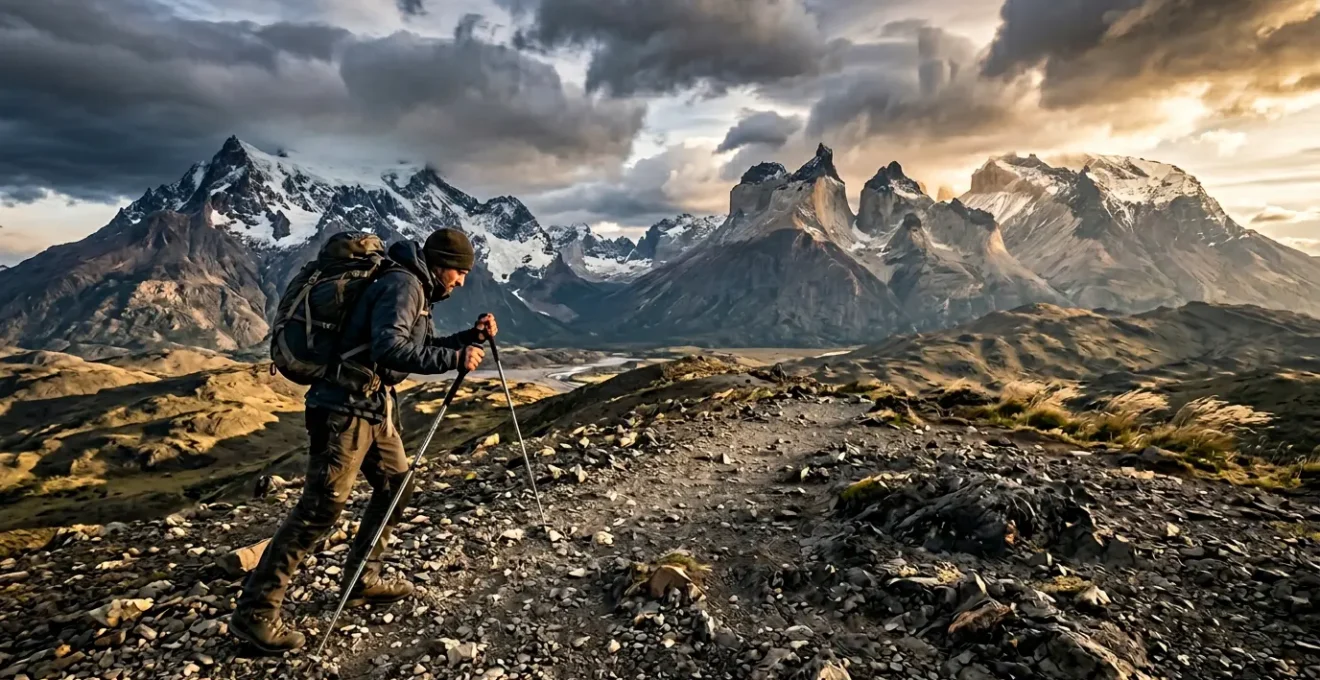
Your hard-won UK mountain experience is a liability in Patagonia, not an advantage.
- Standard expedition gear, particularly tents, is not rated for the unique physics of Patagonian wind and will fail catastrophically.
- Conventional layering techniques can lead directly to life-threatening hypothermia when sweat meets extreme wind chill on exposed ridges.
- The psychological challenge of enforced isolation due to weather requires a total mindset shift from “pushing on” to strategic patience.
Recommendation: Do not adapt your existing kit and skills; you must fundamentally reset them based on the principles of catastrophic failure, moisture management as life support, and total self-sufficiency.
You’ve battled the horizontal rain on Crib Goch and navigated the Cairngorms in a whiteout. You understand layering, you know your gear, and you respect the mountains. That’s good. That competence is the entry ticket. But it’s also your biggest vulnerability when you face Patagonia. Many experienced hikers arrive thinking it’s just a bigger version of Scotland or the Lakes. They are dangerously wrong.
The common advice to “pack layers” and “be ready for wind” is a criminal understatement. Patagonia doesn’t just have ‘weather’; it has a physically violent force that actively tries to dismantle you and your equipment. The very instincts that serve you well in the UK—judging a tent’s strength, managing your own body heat, pushing through a bad spell of weather—can lead to catastrophic failure here. This isn’t about adding another fleece to your pack. It’s about understanding that the fundamental rules have changed.
This guide isn’t a packing list. It’s a debrief from the front lines. We are going to dismantle your assumptions, piece by piece, and rebuild your approach from the ground up. We will look at why your gear fails, how your body becomes the enemy, and how to adopt the mindset required not just to survive, but to thrive in one of a handful of places on Earth where nature is still unequivocally in charge. We will cover equipment tolerances, a strategic approach to route planning, and the critical skills needed when you are days from any assistance.
This article provides a no-nonsense breakdown of the essential strategic shifts you must make. Below is a summary of the critical areas we will cover, from the physics of wind resistance to the psychology of extreme weather delays.
Summary: Hiking the Rugged Patagonian Andes: Surviving 100mph Winds and Freezing Nights
- Why Standard UK Camping Tents Collapse Under Patagonian Winds?
- How to Layer Merino Wool Clothing for Sub-Zero Mountain Mornings?
- The W Trek or the O Circuit: Which Fits a 10-Day Itinerary?
- The Water Filtration Mistake That Causes Severe Stomach Illness
- How to Dry Wet Hiking Boots Overnight Without a Heat Source?
- In What Order Should You Tackle High Ridges to Avoid Afternoon Storms?
- How to Overcome Extreme Weather Delays in Isolated Regions?
- Why Patagonian Glaciers Aren’t the Alps: A Lesson in Self-Sufficiency
Why Standard UK Camping Tents Collapse Under Patagonian Winds?
Let’s be blunt: that high-end, 4-season tent that saw you through a gale in the Peak District is a liability in Torres del Paine. The problem isn’t quality; it’s physics. Patagonian wind isn’t a steady force; it’s a violent, katabatic phenomenon with gusts that can exceed 100mph. Your UK-spec tent is likely designed to handle a consistent pressure, not the explosive, ground-level turbulence that defines this region. An analysis of standard recreational tents shows that most can only withstand winds of 25-30 mph before risking structural failure. In Patagonia, that’s considered a calm day.
The failure mode is predictable. First, the wind gets under the flysheet, creating aerodynamic lift. This puts immense, uneven pressure on the poles, which are not designed for that kind of flexion. They don’t just bend; they snap. Once the structure is compromised, the fabric, no matter how ripstop, will tear to shreds in minutes. You need a tent with a low-profile, aerodynamic design—typically a geodesic dome or tunnel tent—that presents the smallest possible surface area to the wind. Pole material is also critical; DAC Featherlite or similar aluminum alloys are non-negotiable.
Even with the right tent, your pitching technique must be flawless. Forget relying on standard pegs. You’ll need to employ advanced techniques to anchor your shelter to the planet itself. This includes:
- Creating ‘deadman’ anchors by burying stuff sacks filled with rocks or gravel.
- Orienting the tent’s narrowest profile to face the dominant wind.
- Using every single guyline and pre-tensioning them to distribute stress evenly across the entire structure.
- Adding internal guylines, if your tent allows, to create a rigid internal ‘shear wall’ that prevents the frame from deforming.
How to Layer Merino Wool Clothing for Sub-Zero Mountain Mornings?
You know how to layer. Base, mid, shell. It’s mountaineering 101. But in Patagonia, a simple mistake in this system is the primary cause of evacuations. The issue isn’t getting cold; it’s getting hot, sweating, and then having that moisture freeze to your body when you hit an exposed ridge. According to guides at EcoCamp Patagonia, improper layering is the number one reason for hypothermia incidents. Trekkers overheat on a steep ascent, their insulation layers get soaked with sweat, and then the ferocious wind chill at a pass cools them down at a catastrophic rate.
This is where the unique properties of merino wool become life-saving. Unlike cotton which holds moisture and synthetics which can feel clammy, merino wool actively manages moisture. Its fibres can absorb up to 30% of their own weight in water vapour before feeling wet, pulling moisture away from your skin to keep you dry from the inside. The natural crimp in the fibres also traps air, providing outstanding insulation even when damp.
Your Patagonian layering system must be fanatical about moisture management. It should consist of a lightweight merino or synthetic base layer (never cotton), one or two merino mid-layers of varying weights for adaptable insulation, and a fully waterproof and windproof hard shell. Softshells are for the pub; here, you need a fortress. During a strenuous climb, you must be disciplined enough to stop and remove layers *before* you start sweating heavily. It feels counter-intuitive to undress when the wind is howling, but it’s the only way to keep your insulation dry and effective for when you truly need it.
The W Trek or the O Circuit: Which Fits a 10-Day Itinerary?
With a tight 10-day window from the UK (including travel), choosing your route is a critical strategic decision. The famous W Trek and the full O Circuit are fundamentally different experiences, and trying to rush the latter is a recipe for exhaustion and failure. The W Trek is the greatest hits album: the Torres, French Valley, and Grey Glacier. It’s logistically simpler with more *refugios* (mountain huts), but it is intensely crowded, especially in peak season. The O Circuit includes the W but adds a remote, wild “backside” with the formidable John Gardner Pass. It offers solitude but demands full camping gear and greater self-sufficiency.
For a 10-day trip, cramming in the full O Circuit (7-9 days of trekking) is technically possible but leaves zero room for weather delays, fatigue, or acclimatisation. This is a rookie mistake. A much smarter approach is to plan for a well-paced W Trek (4-5 days), allowing you to add extra nights at key locations for side hikes or to simply wait out a storm. This gives you buffer days. Alternatively, a ’10-Day Hybrid’ option, often with a guided component, can allow you to experience parts of the backside without committing to the full loop.
The following table breaks down the core decision factors, but remember the most important one: time. Don’t let your ambition write cheques your itinerary can’t cash.
| Factor | W Trek (4-5 days) | O Circuit (7-9 days) | 10-Day Hybrid Option |
|---|---|---|---|
| Solitude Score | Low (very crowded) | High (remote backside) | Medium (mix of both) |
| Logistical Complexity | Easy (multiple refugios) | Complex (camping required) | Moderate (guided extras) |
| Physicality Score | Moderate | Challenging (John Gardner Pass) | Moderate with rest days |
| Crowd Factor | December-February: queues at viewpoints | Backside nearly empty | Strategic timing possible |
A final, non-negotiable point: you cannot just show up. The park’s popularity and conservation rules mean that campsites and refugios must be booked at least 6 months in advance for the peak season (December to February). Spontaneity is not an option here; meticulous planning is mandatory.
The Water Filtration Mistake That Causes Severe Stomach Illness
The streams in Patagonia run crystal clear, tumbling down from pristine glaciers. It looks like the purest water on Earth, and it’s tempting to drink it straight. Do not. While the water is largely free of industrial pollutants, it can be contaminated with animal faeces, leading to debilitating gastrointestinal illnesses like Giardia. A stomach bug in a remote valley isn’t just unpleasant; it’s a serious medical emergency that can lead to severe dehydration and evacuation. Every experienced trekker knows to filter their water, but the critical mistake made here is not filtration, but cross-contamination during the filtration process.
Your hands, the ‘dirty’ water bottle, and the outside of your filter are all contaminated. If any of them touch the ‘clean’ nozzle of your filter or the threads of your clean water bottle, you have rendered the entire process useless. You must adopt a sterile, almost surgical, procedure for water treatment every single time. It’s not about being paranoid; it’s about being professional. The consequences of a single lapse in concentration are too high. Hikers should also be aware of their increased hydration needs in the dry, windy climate; on the W Trek, you should plan to drink at least 2 gallons per day to stay properly hydrated.
Your sterile procedure should look like this:
- Sanitise your hands with alcohol gel before touching any of your filtration equipment.
- Fill your ‘dirty’ container (a bladder or bottle) without letting its rim dip into the stream.
- Attach your filter (e.g., a Sawyer Squeeze or Katadyn BeFree) without touching the clean-side nozzle.
- Filter the water into your ‘clean’ bottle, ensuring the dirty container never makes contact with the clean bottle’s threads.
- Cap the clean bottle immediately, and do not touch the inside of the cap.
- After use, store your filter in a sealed plastic bag to prevent it from freezing overnight, which can damage the filter membrane and render it useless.
How to Dry Wet Hiking Boots Overnight Without a Heat Source?
Wet boots are more than just uncomfortable; they are a direct route to trench foot, debilitating blisters, and the end of your trek. In a damp UK climate, you might get away with a night of wet feet. In the harsh Patagonian environment, it’s a critical failure. The common mistake is to place boots near a camp stove or fire. This is incredibly dangerous. The intense, direct heat can melt the synthetic materials, unglue the rand, and cause the sole to delaminate, permanently destroying your most crucial piece of gear. Never apply direct heat to your boots.
The key to drying boots in the field without a heat source is a two-pronged attack: absorption and airflow. As Patagonian guides will tell you, the most effective method is to use absorbent materials. Forget newspaper; it’s too slow. You need to actively draw the moisture out.
First, remove the insoles and open the boots up as wide as possible to promote airflow. Then, stuff them tightly with dry, absorbent materials—spare socks, a camp towel, or even tampons, which are exceptionally absorbent. The crucial step is to change this material every 2-3 hours. As the material becomes saturated, it stops working. You need to replace it with fresh, dry material to continue wicking moisture away. For an extra boost, you can use the ‘hot water bottle’ technique: fill a Nalgene bottle with hot (not boiling) water, wrap it in a sock to diffuse the heat, and place it inside the boot. This gentle, radiant heat will significantly speed up the drying process without damaging the boot. As a last resort for a critical morning start, stuffing the boots with fresh socks and putting them in the bottom of your sleeping bag uses your own body heat to dry them—uncomfortable, but effective.
In What Order Should You Tackle High Ridges to Avoid Afternoon Storms?
In the UK, an “alpine start” is often a good idea. In Patagonia, it is a non-negotiable law of survival. The weather pattern in the Andes is brutally predictable: mornings are often calm and clear, but as the sun heats the mountains, strong thermal and katabatic winds build, culminating in violent afternoon storms on high passes and ridges. Your entire day must be structured around one goal: being up and over any exposed high point and descending to safety before this afternoon onslaught begins. Rangers at remote camps like Los Perros will enforce a cut-off time, often as early as 6:30 or 7:00 AM, for starting the climb to a pass.
You must shift your mindset from “how far can I go today?” to “what is the safe weather window for this segment?”. This requires active and intelligent planning. Do not rely on a general park forecast. You need to use specific forecasting tools like Windguru or Windy, looking at the detailed predictions for the exact pass you intend to cross. Pay close attention to wind speed and direction. As a rule of thumb, wind speeds above 35 mph (56 km/h) on an exposed ridge are considered unsafe for travel, as a single gust can easily throw you off balance.
Learn to read the sky. The appearance of lenticular clouds—smooth, lens-shaped clouds that form over peaks—is a classic and reliable indicator of very high winds at altitude. They are your advance warning system, often appearing hours before the wind hits the valleys.
Your Action Plan: Weather Window Strategy
- Check Windguru forecasts for specific pass locations, not general park weather.
- Start hiking by 6:30-7:00 AM as enforced by rangers at key camps like Los Perros.
- Monitor lenticular clouds over peaks as a primary indicator of high winds arriving within hours.
- Plan your ascents on the windward side of mountains for the morning, when thermal activity is at its minimum.
- Pre-identify lower-elevation bail-out routes on your map for each high-consequence segment of the trek.
How to Overcome Extreme Weather Delays in Isolated Regions?
You’re tent-bound. A storm has been raging for 24 hours, the wind is a constant roar, and you can’t see more than ten feet. Your UK hill-walking instinct, forged on one-day excursions, might be screaming with frustration. You have a schedule, a plan. This delay is a problem. This mindset is what you must overcome. In Patagonia, weather delays are not an inconvenience; they are an integral, expected part of the trek. Fighting them is futile. The key is to reframe them as strategic recovery opportunities.
As one trekker noted after being caught in an unexpected snowstorm at John Gardner Pass, the successful groups used the forced tent time productively. They didn’t just sit and fret. They performed crucial gear maintenance, mended clothing, and meticulously cared for their feet. They used the time for journaling to mentally process the intensity of the experience, preventing burnout. They focused on hydration and calorie loading, effectively refuelling for the next weather window. This is the professional mindset. A delay is a pit stop, not a roadblock.
This is where modern technology like a satellite messenger (Garmin inReach, Zoleo) becomes invaluable. It’s not just an SOS button; it’s your logistical lifeline. During a delay, you can communicate with the outside world to rebook your next *refugio* or arrange for a later pickup, relieving the psychological pressure of a missed connection. As photographer Martin Heck remarked after a sudden storm:
Weather completely flipped from warm and calm into a snow-storm within minutes. But that’s what we expect and makes Patagonia such a special and wild place.
– Martin Heck, Photographer’s experience in Torres del Paine
Embracing this philosophy is essential. You are a guest in a wild environment, operating on its schedule, not yours. Cultivating this strategic patience is as important as any piece of gear you carry.
Key Takeaways
- Your gear’s stated limits are irrelevant; only its performance under the unique physics of Patagonian wind matters.
- Moisture management is not about comfort, it is a life-support system. Sweat is your primary enemy.
- The correct mindset is not to conquer the mountain, but to strategically navigate its weather windows and respect its power.
Why Patagonian Glaciers Aren’t the Alps: A Lesson in Self-Sufficiency
For an experienced UK walker with Alpine experience, the sight of a glacier may seem familiar. You know about crevasses, you understand the need for ropes and ice axes. This is another dangerous assumption. The scale, remoteness, and nature of Patagonian ice fields, such as the vast Southern Patagonian Ice Field accessed via passes like John Gardner, demand a level of self-sufficiency that is completely alien to the European Alpine environment. In the Alps, you are rarely more than a few hours from a hut or a helicopter rescue. Here, you are utterly on your own.
The John Gardner Pass itself is a formidable challenge, reaching an elevation of around 1,250 meters with a gruelling 750m ascent, often in deep snow. But it is the nature of the ice beyond that changes the game. Unlike in the Alps, the crevasses can be significantly wider, requiring longer 60-70m ropes. Wind scouring creates vast, unpredictable snow bridges whose stability cannot be assessed with traditional techniques. Navigation is complicated by the sheer scale and lack of features. Small teams must be entirely self-sufficient in crevasse rescue, with pre-rigged Z-drag pulley systems ready for immediate deployment, because assistance could be days away, if it can reach you at all.
This is not a place to “learn on the job.” The technical skills for glacial travel and crevasse rescue must be second nature *before* you arrive. You are not just a hiker; you are your own rescue team. This environment brutally exposes any weakness in your technical systems, your fitness, and your nerve. It is the ultimate test of mountain craft, where the consequences of a mistake are absolute. The confidence gained in the Alps can breed a fatal complacency on Patagonian ice.
The mountain demands respect, and that respect is paid through meticulous, uncompromising preparation. Your journey doesn’t start at the trailhead; it starts now, by dismantling your assumptions and rebuilding your approach. Begin your preparations today.