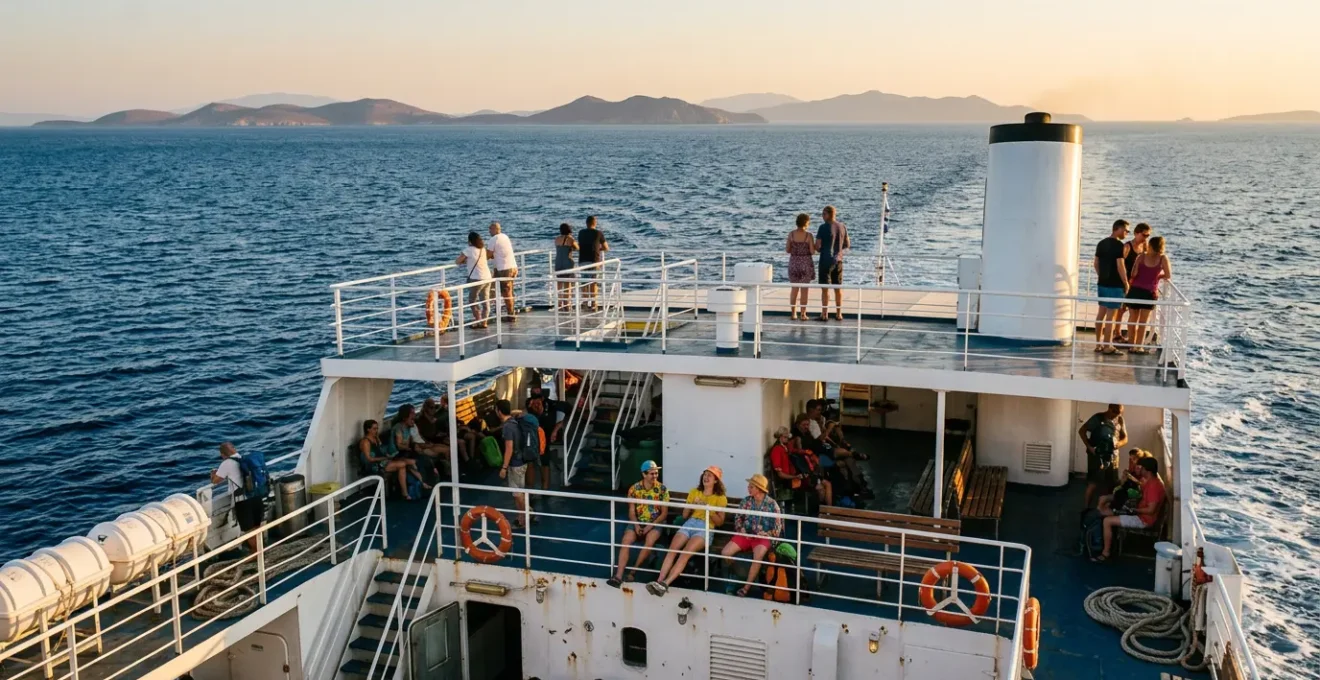
The key to a romantic Greek island-hopping trip isn’t luck; it’s understanding the logistics that govern the summer chaos.
- Weather dictates everything: the infamous Meltemi wind makes fast catamarans notoriously unstable, while larger, slower ferries remain reliable.
- Your booking order is a strategic decision. Using a “hub” island like Paros provides a crucial buffer against unpredictable delays and strikes.
Recommendation: Prioritise stability over speed by choosing conventional ferries during peak Meltemi season (July-August), and structure your itinerary around a central island hub to maintain flexibility.
The vision is always so clear: a romantic, sun-drenched escape through the Greek Cyclades, hopping from one idyllic island to the next with effortless grace. You and your partner, watching a whitewashed village shrink into the Aegean blue from the deck of a ferry. But the reality of a peak-season trip can quickly shatter that dream. The logistical gauntlet of chaotic ports, confusing tickets, unpredictable delays, and the churning stomach that comes with a rough crossing can turn a romantic getaway into a stressful ordeal.
Standard advice often feels inadequate. You’ll be told to “book tickets in advance” and “pack seasickness pills,” but this barely scratches the surface. This advice treats the symptoms, not the cause. It fails to explain the fundamental forces at play—the physics of different vessels, the strategic logic of port operations, and the predictable patterns of summer weather that a seasoned traveller can use to their advantage.
But what if the key was not just to endure the system, but to master it? This guide moves beyond the platitudes. As a maritime logistics expert, I’ll show you the ‘why’ behind the chaos. We will not just give you a checklist; we will provide you with the operational knowledge to make informed decisions. By understanding the vessel dynamics, port intelligence, and strategic sequencing, you can transform potential holiday disasters into predictable, stress-free crossings, reclaiming the romance of your Greek island adventure.
This article will provide you with the essential logistical framework to navigate the Cyclades ferry system with confidence. We’ll explore the critical factors that determine a smooth journey, from choosing the right vessel to planning for inevitable disruptions.
Summary: Greek Island Hopping by Ferry: An Expert’s Guide to Avoiding Chaos and Delays in the Cyclades
- Why High-Speed Catamarans Cause Severe Sea Sickness in Summer Winds?
- How to Secure Shaded Deck Seating on a Crowded August Crossing?
- Slow Ferries vs Fast Jets: Which Guarantees a Calmer Stomach?
- The Port Arrival Mistake That Causes Backpackers to Miss Their Boat
- In What Order Should You Book Multi-Island Tickets to Allow for Strike Delays?
- How to Use the Marine Traffic App to Predict Empty Streets?
- How to Use the Public Bus System (KTEL) to Navigate the Cliffs Safely?
- Exploring Coastal Port Cities: How to Evade the 10,000-Person Cruise Ship Crowds?
Why High-Speed Catamarans Cause Severe Sea Sickness in Summer Winds?
The allure of a high-speed catamaran, often called a “fast jet,” is obvious: it promises to slash travel time between islands, seemingly offering more time for exploration. However, this speed comes at a significant cost to comfort, especially during the peak summer months of July and August. The culprit is the Meltemi, a strong, dry northern wind that dominates the Aegean Sea. These are not gentle breezes; during a strong Meltemi event, winds in the Cyclades can occasionally exceed speeds of 100 km/hour (62 miles).
The core of the problem lies in “vessel dynamics.” A catamaran’s design, with its two parallel hulls, provides excellent stability in calm waters. But in the choppy, high-frequency waves generated by the Meltemi, this design becomes a liability. The wide base and lack of a deep, single keel mean the vessel doesn’t cut through waves but instead rides over them, resulting in a jarring, unpredictable motion that is a perfect recipe for severe motion sickness. It’s a sharp, side-to-side and up-and-down movement, far more unsettling than the gentle roll of a larger ship.
Furthermore, these high-speed vessels are often completely enclosed with limited or no access to an outside deck. The combination of recycled air, no view of the horizon, and the constant, erratic motion creates a disorienting environment. For a couple hoping for a romantic crossing, being trapped inside a vibrating cabin with dozens of fellow green-faced passengers is the antithesis of the dream. Understanding this fundamental mismatch between the vessel’s design and the sea conditions is the first step to avoiding a miserable journey.
How to Secure Shaded Deck Seating on a Crowded August Crossing?
On a conventional ferry in the heart of a Greek summer, the most valuable real estate isn’t a numbered seat in an air-conditioned lounge; it’s a slice of shade on the open deck. Securing one of these coveted spots is a strategic operation that begins the moment you step on board. In the August heat, the sun is relentless, and being able to enjoy the sea breeze without being directly exposed is the difference between a pleasant journey and a draining ordeal.
The key is to board with a clear objective. Most passengers will be preoccupied with stowing large luggage in the vehicle bay or finding their assigned indoor seats. This is your window of opportunity. As a pair, you have an advantage: one person can manage the main bags while the other heads directly to the upper decks with a smaller daypack containing essentials like water, snacks, and towels. Ignore the indoor lounges and make a beeline for the stern (rear) of the ferry, as these areas often have the largest covered overhangs.
Once you’ve identified a promising spot, claim it decisively. Use your daypack and a towel or sarong to mark your territory. Don’t be shy; this is standard practice. The goal is to create a small personal zone. Even if plastic chairs are scarce, sitting on a towel on the deck is infinitely preferable to being stuck indoors or baking in the sun. A case study in passenger boarding strategy highlights a related point: on smaller islands, ferries can board and depart in mere minutes. The advice to “be there half an hour ahead” is critical, not just to make the ferry, but to be among the first to board and execute your shade-securing mission.
Slow Ferries vs Fast Jets: Which Guarantees a Calmer Stomach?
When choosing your vessel, the decision between a slow, conventional ferry and a high-speed catamaran (“fast jet”) is the single most important factor for passenger comfort. From a logistics expert’s perspective, the choice is clear, especially in summer: the slow ferry is overwhelmingly superior for guaranteeing a calm stomach and a reliable journey. The difference lies in their fundamental design and their resilience to the Meltemi winds.
High-speed ferries are more susceptible to cancellations. As the following table shows, they have a much lower tolerance for wind and wave conditions. A wind force of 7 on the Beaufort scale, common during summer, is often enough to cancel a catamaran’s sailing, throwing your entire itinerary into chaos. Conventional ferries, being larger monohull vessels, can often operate in conditions up to a force 8 or even 9.
This data on cancellation thresholds, based on publicly available maritime advisories, reveals a clear pattern as shown in this comparative analysis of weather resilience.
| Ferry Type | Cancellation Wind Threshold | Wave Height Sensitivity |
|---|---|---|
| High-speed ferries/Catamarans | 7 Beaufort scale | Affected from 2-3 meters |
| Conventional ferries | 8+ Beaufort scale | Can sail up to 4-5 meters |
| Large vessels | 9+ Beaufort scale | Can handle rougher seas |
Beyond reliability, the physical experience is profoundly different. The slow, heavy monohull of a conventional ferry acts like a plough, cutting through the waves with a deep keel that provides stability. This results in a gentle, predictable rolling motion. As the team at Travel Buddies Lifestyle notes in their report on the Greek ferry experience:
Big, slower ferries look like cruise liners, ensuring you hardly feel the movement of the waves.
– Travel Buddies Lifestyle, Greek Ferry Experience Report
For a romantic trip where the journey is part of the experience, the choice is self-evident. Trading an extra hour or two of travel time for a stable, comfortable, and reliable crossing on an open deck is a trade that ensures your holiday remains a pleasure, not a test of endurance.
The Port Arrival Mistake That Causes Backpackers to Miss Their Boat
Arriving at the port early is standard travel advice, but in Greece, it’s dangerously incomplete. The single most common and stressful mistake travellers make is not one of timing, but of geography: assuming all ferries depart from the same port, or even the same gate within a single, massive port. This is a critical piece of “port intelligence” that can make or break your island connection.
The port of Athens is a perfect case study. It is served by two main ferry ports, Piraeus and Rafina, located on opposite sides of the Attica peninsula. As a crucial navigation insight points out, they serve different strategic purposes. Piraeus is the primary, sprawling hub for most Cyclades routes, including the popular lines to Santorini, Naxos, and Paros. Its sheer size is overwhelming, with different gates for different island groups that can be a 15-20 minute walk apart. Your ticket will specify a gate number (e.g., E7), and finding it amidst the chaos is a challenge in itself.
In contrast, Rafina is a smaller, less chaotic port that is significantly closer to Athens International Airport. If you are flying in and immediately heading to islands like Mykonos, Andros, or Tinos, choosing a ferry from Rafina can save you an hour of transit time and considerable stress. Always double-check your ticket for the port of departure. A taxi to the wrong port is an expensive and time-consuming error that often results in a missed boat. This isn’t just about being on time; it’s about being in the right place, with a clear understanding of the port’s layout before you even arrive.
In What Order Should You Book Multi-Island Tickets to Allow for Strike Delays?
For a multi-island itinerary, the order in which you book your tickets is a strategic decision that builds resilience into your plans. The common impulse is to book everything in a linear sequence: Island A to B, then B to C. A logistics expert, however, thinks in terms of hubs, spokes, and buffers. The primary risks you are mitigating are not just weather delays, but also the possibility of ferry strikes, which can halt all traffic for 24-48 hours with little warning.
The solution is “strategic sequencing” using a hub-and-spoke model. Instead of a linear trip, identify a central island with excellent connections to act as your base. Paros is the logistical heart of the Cyclades, acting as a natural hub. From here, you can take day trips or shorter two-day trips to surrounding islands like Antiparos, Naxos, or even Mykonos, always returning to your base on Paros. This approach has two major advantages. Firstly, if a strike is announced, you are not stranded on a remote island with limited options; you are on a major hub with more accommodation and alternative transport possibilities once services resume. Secondly, you only need to book the outbound and return spoke journeys, giving you more flexibility than a complex chain of one-way tickets.
Weather-related cancellations, while disruptive, are typically short-lived. Even with the powerful Meltemi, it’s useful to know that over the summer period, ferry cancellations due to the strongest Meltemi winds occur for no more than 2-3 days at a maximum. A hub-and-spoke model provides the perfect “logistical buffer” to wait out such a delay without your entire holiday unravelling. You can explore your hub island further instead of worrying about your next connection.
How to Use the Marine Traffic App to Predict Empty Streets?
In the picturesque, narrow alleys of a Greek port town, the difference between a charming stroll and a frustrating human traffic jam is often timed to the minute. The key to “crowd evasion” is knowing when a massive cruise ship or ferry is about to disgorge thousands of people into the streets. This is where modern technology provides an invaluable logistical edge. You can move beyond guessing and use real-time data to your advantage.
Your primary tool for this is a vessel-tracking application. While there are several options, Marine Traffic is the industry standard, offering a live map of nearly every commercial vessel in the world. By monitoring this app, you can see exactly which cruise ships and large ferries are scheduled to arrive and, more importantly, depart. This allows you to plan your day with surgical precision. See a 5,000-passenger cruise ship docked? That’s your cue to explore a more remote beach or have a leisurely lunch far from the main port.
The most magical time in any port town is the “golden hour” just after a large cruise ship has departed. The streets suddenly empty, the light softens, and you have the town almost to yourselves. By setting alerts for a specific ship’s departure time, you can time your return to the port to coincide with this peaceful window. This is the essence of smart travel: using information to create a better experience. Your phone becomes a tool not for distraction, but for strategic planning.
Your Action Plan: Real-Time Crowd Prediction
- Download Core Apps: Install both the Marine Traffic app for live vessel tracking and the Ferryhopper app for real-time schedule updates and delay notifications.
- Identify the Giants: Before you arrive, look up the major cruise lines that frequent your destination port. Note the names of their largest vessels (those with 3,000+ passenger capacity).
- Set Departure Alerts: In the Marine Traffic app, find the target cruise ships and set a notification for their scheduled departure time. Plan your main town exploration for the 90-minute window that follows.
- Cross-Reference Ferry Arrivals: Check the Ferryhopper app for the arrival times of large conventional ferries (1,500+ passengers). Avoid the port area for the 60 minutes after these arrivals to dodge the disembarkation rush.
- Plan with an Alternative: Use Vesselfinder as a backup tracking platform. If one app is slow to update, having a second source ensures your information is always current.
How to Use the Public Bus System (KTEL) to Navigate the Cliffs Safely?
While ferries get you between islands, navigating the islands themselves presents its own logistical challenge, especially those known for their dramatic cliffs and winding roads, like Santorini or Amorgos. Renting a car or ATV can be stressful and expensive, while taxis are often scarce. The unsung hero of on-island transport is the public bus system, known as the KTEL. It’s an efficient, safe, and remarkably affordable way to get around.
Each major island operates its own KTEL network, with the main bus station typically located in the port town or the main village (Chora). From here, routes radiate out to the most popular beaches, villages, and archaeological sites. The schedules are posted at the main station and are surprisingly reliable, designed to align with the rhythms of local life and tourism. For a couple, it removes the stress of navigating unfamiliar, narrow roads and the hassle of finding parking, which can be nearly impossible in popular spots during high season.
Using the KTEL system is also a smart move for managing your energy. The Greek summer heat is intense, and sightseeing during the midday peak can be exhausting. As the Cyclades Travel Guide wisely advises, the ideal conditions for exploring are in the cooler parts of the day.
Temperatures between 15°C and 25°C are ideal for walking and sightseeing
– Cyclades Travel Guide, Island Transportation Advisory
A savvy logistical approach is to use the air-conditioned KTEL bus to travel between locations during the hottest part of the day (1 pm to 4 pm), saving your energy for exploring on foot during the more pleasant morning and late afternoon hours. It’s a simple strategy that maximizes both your comfort and your sightseeing time, allowing you to enjoy the stunning cliff-top views without the associated risks of driving.
Key Takeaways
- Prioritise stability over speed: In the windy months of July and August, always choose larger, slower conventional ferries over high-speed catamarans to avoid seasickness and cancellations.
- Embrace the hub-and-spoke model: Use a central, well-connected island like Paros as your base to build a “logistical buffer” against unpredictable strikes and delays.
- Use technology for crowd evasion: Leverage vessel tracking apps like Marine Traffic not just for ferry schedules, but to predict when massive cruise ships will depart, leaving you with blissfully empty port towns.
Exploring Coastal Port Cities: How to Evade the 10,000-Person Cruise Ship Crowds?
You’ve successfully navigated the Aegean Sea and arrived at a stunning port city. The final logistical challenge is not on the water, but on land: how to enjoy the charm of these historic towns when you’re sharing them with thousands of other people who have just disembarked from a floating city? The key is to think in reverse. Instead of following the crowd, you must actively move against its predictable tide.
The moment a cruise ship docks, a wave of 3,000 to 5,000 people (or more, if multiple ships are in port) floods the most obvious attractions: the main shopping street, the most famous viewpoint, and the waterfront tavernas. Your strategy is simple: go where they are not. This means having a pre-planned “Plan B” itinerary for ship days. This could involve immediately taking a KTEL bus to a remote beach, exploring a lesser-known inland village, or visiting an archaeological site that is further afield. You enjoy the island’s quieter side while the crowds concentrate in the port.
Then, as discussed, you use your vessel tracking app to pinpoint the cruise ship’s departure. This is your signal to move back towards the port. As the thousands of passengers are recalled to their ship, the town undergoes a dramatic transformation. The crowded alleys empty out, the noise subsides, and the authentic atmosphere returns. This is your time to enjoy the port city as it was meant to be seen. You can secure a prime table at a waterfront restaurant for sunset, wander the streets without jostling for space, and experience a sense of peace that was unimaginable just a few hours earlier. This counter-cyclical approach turns the greatest challenge of popular ports into your greatest advantage.
With this logistical knowledge, you are now equipped to plan your Cyclades adventure with the confidence of a seasoned traveller. The next step is to start mapping your route and booking your core transport with these strategies in mind, ensuring your romantic getaway is defined by serene moments, not stressful queues.