Visiting the Great Barrier Reef responsibly is not about a simple checklist; it’s about understanding the fragile systems you are entering to become an active guardian, not just a tourist.
- Your choice of sunscreen, tour operator, and even your swimming technique has a direct and measurable impact on coral health.
- True eco-tourism goes far beyond reusing towels, involving verifiable certifications and tangible contributions to conservation.
Recommendation: Shift your mindset from passively “seeing” the reef to actively understanding and protecting it with every decision you make before and during your trip.
The Great Barrier Reef is more than a destination; it is one of the planet’s most complex and fragile living structures. For many, like you, seeing its vibrant colours and majestic creatures is the fulfilment of a lifelong dream. Yet, there is an understandable anxiety that comes with this pilgrimage: how can one witness this wonder without contributing to its decline? The common advice—don’t touch the coral, wear a hat—is a starting point, but it barely scratches the surface of what it means to be a truly responsible visitor.
Most guides focus on what not to do. This one is different. As a conservationist working on this very ecosystem, my purpose is to equip you with a deeper understanding. The key to protecting the reef is not a list of prohibitions but a genuine comprehension of its interconnected systems. It’s about learning the science behind why a specific sunscreen ingredient is devastating, what an “Advanced Ecotourism” certification truly signifies, and how mastering your own buoyancy transforms you from a potential threat into a graceful observer.
This guide will move beyond the platitudes. We will explore the chemical impact of pollutants, the criteria for selecting genuinely sustainable operators, the specific marine science that dictates where and when to find the best visibility, and the practical skills you can learn to minimise your physical footprint. By understanding the ‘why’ behind each choice, you become more than a tourist; you become a temporary custodian of this irreplaceable world heritage site, ensuring your visit is one of reverence and regeneration, not regret.
To help you navigate these crucial decisions, this article breaks down the essential knowledge for a truly conscious journey. The following sections provide a clear roadmap, from pre-trip planning to in-water conduct, empowering you to make choices that genuinely support the reef’s future.
Summary: A Conscious Explorer’s Handbook for the Great Barrier Reef
- Why Standard Suncreams Bleach and Destroy Millennia-Old Coral Reefs?
- How to Book an Eco-Certified Catamaran From Cairns or Port Douglas?
- Outer Reef vs Inner Reef: Where Are the Best Visibility Levels?
- The Buoyancy Control Error That Snaps Fragile Coral Branches
- What Time of Year Guarantees the Calmest Waters for Snorkelling?
- Coral Bleaching vs Natural Erosion: What Are You Really Seeing?
- Why “Towel Reuse” Signs Do Not Make a Hotel Truly Eco-Friendly?
- Protecting Fragile Marine Ecosystems: The Truth Behind Swimming With Dolphins
Why Standard Suncreams Bleach and Destroy Millennia-Old Coral Reefs?
The first act of reef protection begins in your suitcase. While protecting your skin is vital under the Queensland sun, conventional sunscreens are a chemical scourge on coral ecosystems. The issue lies with specific UV-filtering chemicals, most notably oxybenzone and octinoxate. When these wash off your skin into the water—and they do, in vast quantities—they trigger a catastrophic reaction in coral polyps. These chemicals disrupt coral reproduction, damage their DNA, and, most critically, induce bleaching even at low temperatures.
Coral’s vibrant colour comes from microscopic algae called zooxanthellae living within its tissue in a symbiotic relationship. These chemicals are toxic to the algae, causing the coral to expel them. Without their colourful partners, the coral tissue becomes transparent, revealing the white skeleton beneath—a phenomenon known as bleaching. A bleached coral is not dead, but it is starving and under extreme stress, making it vulnerable to disease and mortality. With studies estimating that 8,000–16,000 tons of sunscreen enter coral reef areas globally each year, your personal choice has a collective, significant impact.
The good news is that protecting both your skin and the reef is entirely possible. The solution is to use mineral-based sunscreens. Look for products where the only active ingredients are ‘non-nano’ zinc oxide or titanium dioxide. These ingredients form a physical barrier on your skin rather than a chemical one and are not harmful to marine life. The term “reef-friendly” is unregulated, so you must always check the active ingredients list yourself. This simple switch is one of the most powerful and direct contributions a visitor can make to the reef’s health.
How to Book an Eco-Certified Catamaran From Cairns or Port Douglas?
Choosing your tour operator is arguably the most significant decision you’ll make for your reef trip. The vessel that takes you out is not just transport; it’s a mobile classroom and a potential conservation partner. In Queensland, the term “eco-certified” is more than a marketing buzzword; it refers to a rigorous, independently assessed framework managed by organisations like Ecotourism Australia. Understanding this system is key to separating genuine stewards from businesses engaging in greenwashing.
Not all certifications are equal. The system is tiered, reflecting a progressively deeper commitment to sustainability and conservation. A basic ‘Nature Tourism’ certification ensures an operator is compliant with regulations, but the ‘Ecotourism’ and ‘Advanced Ecotourism’ levels signify a much higher standard. These operators are committed to minimal impact, provide high-quality interpretive tours that educate guests about the reef, and actively contribute to conservation. The Great Barrier Reef Marine Park Authority (GBRMPA) recognizes these high-standard operators, and those with Advanced Ecotourism status can even be granted 20-year permits, rewarding their long-term commitment.
When booking from hubs like Cairns or Port Douglas, look for the official Ecotourism Australia logo and inquire about the specific certification level. An operator proud of their ‘Advanced’ status will advertise it prominently. These businesses invest in quieter, more efficient engines, advanced waste treatment systems, and often participate in GBRMPA’s ‘Eye on the Reef’ monitoring program, using their daily trips to collect valuable data on reef health. Choosing them ensures a portion of your tourist dollars directly supports the ecosystem you’ve come to admire.
This table breaks down the Ecotourism Australia certification tiers, helping you to identify a truly committed operator.
| Certification Level | Requirements | Benefits |
|---|---|---|
| Nature Tourism | Basic environmental practices, valid permits | Green Travel Guide listing |
| Ecotourism | Minimal impact operations, education focus | GBRMPA High Standard recognition |
| Advanced Ecotourism | Best practice standards, conservation contributions | 20-year permit eligibility, Hall of Fame consideration |
Outer Reef vs Inner Reef: Where Are the Best Visibility Levels?
The Great Barrier Reef is not a single entity but a vast system of nearly 3,000 individual reefs. A common question is whether to visit the ‘Inner Reef’ or ‘Outer Reef’. From a conservation and experience perspective, the answer is almost always the Outer Reef. These reefs are located further from the mainland, far from the coastal runoff that carries sediments and pollutants, which significantly reduce water clarity. This distance results in the crystal-clear, 20- to 40-metre visibility that the reef is famous for.
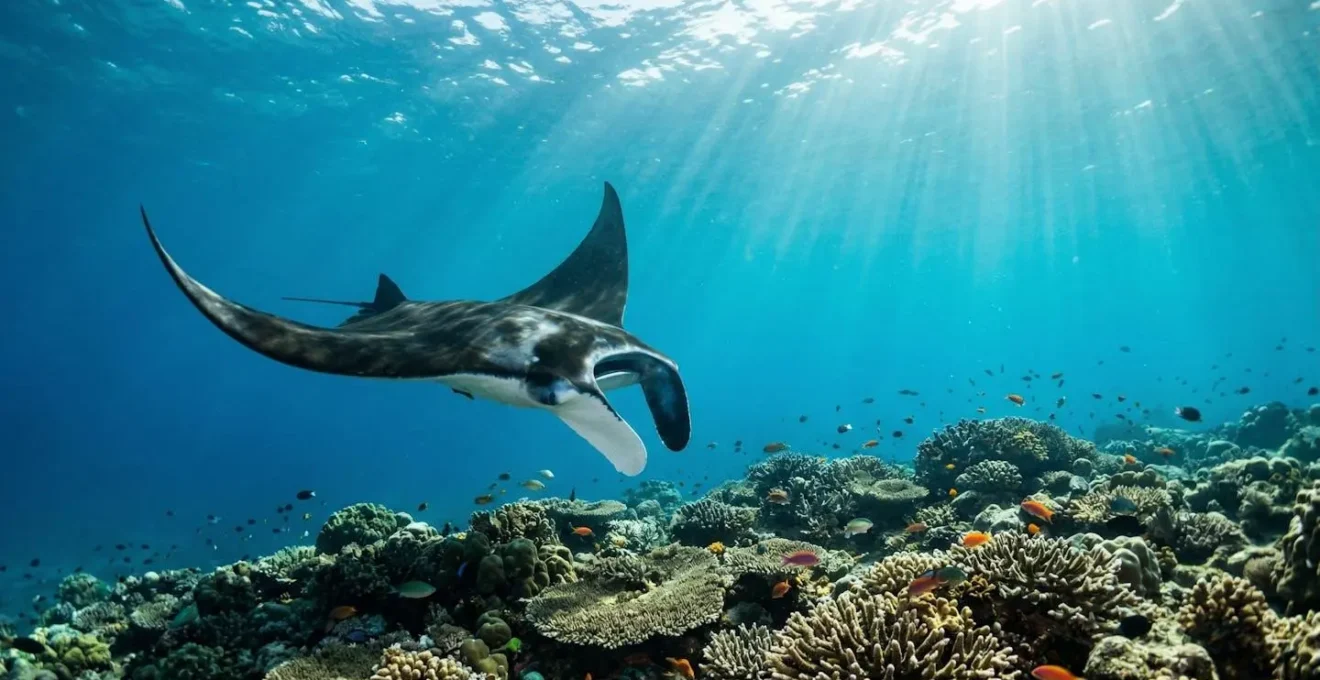
But superior visibility is only part of the story. The Outer Reef’s location on the edge of the continental shelf makes it a hub of marine biodiversity. Here, deep oceanic currents cause an upwelling of nutrient-rich water, creating a vibrant food web that attracts a higher density and diversity of life. This is precisely why these areas are known as ‘manta magnets’. Locations like Lady Elliot Island, a coral cay in the southern Outer Reef, are world-renowned aggregation sites. The island’s geography and proximity to plankton-rich currents create a perfect habitat, and as a result, research from the Lady Elliot Island Eco Resort shows it accounts for roughly 70% of all manta ray sightings on Australia’s east coast.
These Outer Reef sites are not just better for sightings; they are often healthier. Being further from land-based stressors, they have shown greater resilience to bleaching events and other pressures. A trip to the Outer Reef is a longer boat ride, but it rewards you with healthier coral, breathtaking visibility, and a much higher probability of encountering large marine megafauna like manta rays, sharks, and turtles in their natural, thriving habitat.
The Buoyancy Control Error That Snaps Fragile Coral Branches
The most common cause of direct, tourist-inflicted damage to the reef isn’t malicious; it’s accidental. A misplaced fin kick or a sudden need to stand up can destroy decades of fragile coral growth in a single second. Corals, especially branching species like staghorn and table corals, are incredibly brittle. The number one skill to prevent this damage is mastering neutral buoyancy—the ability to float effortlessly in the water without sinking or rising.
Many novice snorkelers make two critical errors. First, they adopt a vertical, ‘sea horse’ position in the water, which causes their fins to kick downwards directly onto the coral below. The correct position is horizontal, with your body parallel to the surface. Second, they use an inefficient ‘bicycle kick’. The proper, most controlled technique is the ‘frog kick’: knees bent, you move your fins outwards and then snap them together. This propels you forward without any downward thrust, keeping the delicate ecosystem below you safe. Your hands should never be used for swimming; keep them crossed over your chest or behind your back to avoid any temptation to touch or steady yourself.
As you can see, maintaining a safe distance is easy with the correct horizontal posture. This skill isn’t just for scuba divers; it is essential for any responsible snorkeler. Before your trip, you can practice in a local swimming pool. Getting comfortable with your gear and your body’s position in the water will make your reef experience more relaxed, graceful, and, most importantly, harmless. It transforms you from a clumsy visitor into a weightless observer, gliding over the coral gardens without leaving a trace.
Action Plan: Pre-Trip Buoyancy Drills
- Float horizontally in a pool, maintaining your position without touching the bottom or sides for at least two minutes to build core stability.
- Master the frog kick technique: Practice keeping your knees bent and moving your fins outwards before snapping them together for propulsion.
- Practice hovering at different depths using only your breath control, without using your hands for stabilization.
- If possible, set up weighted hoops in a pool and practice swimming through them without making contact to simulate navigating around coral bommies.
- Focus on slow, controlled breathing. Inhaling will cause you to rise slightly, and exhaling will cause you to sink, allowing for fine-tuned depth adjustments.
What Time of Year Guarantees the Calmest Waters for Snorkelling?
Timing your visit to the Great Barrier Reef is about balancing weather, crowds, and wildlife cycles. While the reef is a year-round destination, the dry season, which runs from May to October, is widely considered the best time for a visit. During these months, the weather is typically sunny and stable, with lower humidity and minimal rainfall. This translates to calmer sea conditions and consistently excellent water visibility, which is paramount for snorkelling and diving.
This period also aligns perfectly with the peak season for spotting some of the reef’s most iconic residents. For instance, manta rays are most frequently sighted from May to October, when cooler water temperatures lead to an increase in the plankton they feed on. Similarly, this is the prime time for whale watching, as humpback whales migrate from Antarctica to the reef’s sheltered waters to breed and give birth.
For the eco-conscious traveller looking to balance ideal conditions with fewer people, the ‘shoulder’ months of May, September, and October are perfect. As one local guide notes, visiting just before or after the peak winter crowds of June through August often provides the best of all worlds. You can enjoy the calm waters and high chances of manta ray sightings without the congestion of the main school holiday periods. Conversely, the wet season (November to April) brings hotter, more humid weather, a higher chance of cyclones, and the presence of marine stingers (jellyfish), which require the use of a full-body protective suit when swimming.
Coral Bleaching vs Natural Erosion: What Are You Really Seeing?
When you look down upon a coral reef, you are reading a story of its health. Not all white coral is a sign of a climate catastrophe. It’s crucial for a conscious visitor to learn to differentiate between active, severe coral bleaching, natural processes, and signs of recovery. Coral bleaching, caused by heat stress, results in a stark, uniform white appearance across large patches of a reef as the coral expels its symbiotic algae. It is a sign of an ecosystem in crisis.
However, you may also see isolated white tips on branching corals, which can be a sign of rapid growth. You might also see patches of coral rubble, which could be the result of a recent storm or natural erosion. Furthermore, you might see coral that is pale or even brightly fluorescent—this is a stress response that often precedes or follows a bleaching event. Understanding these nuances helps you to interpret the health of the reef more accurately. You might also spot the Crown-of-Thorns Starfish, a native predator that can cause immense damage when its population explodes. Seeing one or two is normal; seeing dozens is a sign of a serious outbreak.
As a visitor, you can transform your observations into valuable data. The Great Barrier Reef Marine Park Authority runs a ‘citizen science’ program called Eye on the Reef. Using a simple smartphone app, you can record your sightings of coral health, specific marine life, or threats like the Crown-of-Thorns Starfish. This information is fed directly to reef managers and scientists, providing a vast network of eyes on the water that helps them monitor the reef’s health in near real-time.
To participate, you can follow these simple steps:
- Download the free ‘Eye on the Reef’ app to your phone before your trip.
- Take clear photos of coral, noting the GPS location (most phones do this automatically).
- Use the app’s visual guides to help you assess and report what you are seeing (e.g., healthy coral, bleached coral, disease).
- Submit your sightings with details like date, time, and approximate depth.
Why “Towel Reuse” Signs Do Not Make a Hotel Truly Eco-Friendly?
In the world of tourism, the term “eco-friendly” is often used so loosely that it becomes meaningless. Many accommodations engage in ‘greenwashing’—promoting minor, cost-saving measures as significant environmental actions. The classic example is the sign asking you to reuse your towels. While water conservation is positive, this action alone does not make a hotel a true partner in sustainability. It is a superficial gesture that often masks a business-as-usual approach in all other areas.
Genuine eco-lodges and sustainable hotels go much deeper. Their commitment is woven into the very fabric of their operations and infrastructure. Instead of just saving on laundry, they invest in comprehensive systems like advanced wastewater treatment to prevent polluted runoff, large-scale solar panel arrays to generate their own clean energy, and total elimination of single-use plastics rather than just a token reduction. The Great Ocean Ecolodge, for example, operates entirely on solar power and relies on collected rainwater as its main water source, demonstrating a holistic approach.
The most reliable way to identify these genuinely committed businesses is to look for reputable, third-party certifications like Ecotourism Australia or EarthCheck. These certifications are not given out for simple towel-reuse programs. They require a rigorous audit of a property’s energy and water consumption, waste management, community engagement, and contributions to local conservation. A truly sustainable hotel doesn’t just ask you to help them save water; they invest their own capital to build a fundamentally lower-impact operation.
This table highlights the key differences between superficial greenwashing and the practices of a genuinely sustainable tourism operator.
| Greenwashing Signs | Genuine Eco-Practices |
|---|---|
| Towel reuse programs only | Comprehensive water treatment systems |
| Generic ‘eco-friendly’ claims | Third-party certification (Ecotourism Australia, EarthCheck) |
| Single-use plastic reduction | Complete elimination with alternatives |
| Energy-saving bulbs | Solar power and renewable energy systems |
Key takeaways
- Your individual choices, from sunscreen to tour operator, have a direct and cumulative effect on the Great Barrier Reef’s health.
- Understanding the ‘why’ behind responsible travel guidelines—the science of coral, the tiers of eco-certification, the skill of buoyancy—is more powerful than following a simple checklist.
- True conservation involves shifting from being a passive tourist to an active, informed steward who can identify threats, recognise genuine eco-practices, and even contribute to citizen science.
Protecting Fragile Marine Ecosystems: The Truth Behind Swimming With Dolphins
The desire to interact with intelligent marine life, whether it’s dolphins or the majestic manta rays of the Great Barrier Reef, is a powerful motivator for many visitors. However, these encounters must be managed on the animal’s terms, not ours. Manta rays, for example, are highly intelligent creatures; research confirms that manta rays have the highest brain-to-body mass ratio of all fish, an indicator of significant cognitive ability. This intelligence means they are also sensitive to stress from improper human interaction.
The principle of a responsible encounter is to be a passive observer. The goal is never to chase, touch, or block the path of a marine animal. The most rewarding interactions happen when an animal, feeling safe, chooses to approach you out of curiosity. To facilitate this, operators in key manta ray aggregation sites have developed a strict code of conduct designed to protect both the animals and the visitor experience. These rules are not arbitrary; they are based on scientific understanding of the animals’ behaviour.
Key rules include always maintaining a minimum distance (typically 3-4 metres), approaching from the side rather than from above or behind, and never pursuing an animal if it swims away. If you are at a ‘cleaning station’—a coral bommie where large animals gather to have smaller fish clean them—you should remain low, still, and several metres away on the sand, allowing the natural behaviour to unfold without interruption. Following these guidelines doesn’t diminish the experience; it enhances it, creating the potential for a truly authentic and magical encounter based on mutual respect.
We intend to carry out similar work in 2026, where we’re hoping we will be able to see some pregnancies!
– Dr. Asia Haines, University of Sunshine Coast Project Manta research
By embracing this deeper level of understanding and responsibility, your journey to the Great Barrier Reef becomes a positive force. You are not just a spectator but a guardian, and your informed choices are a direct investment in the future of this global treasure. The next logical step is to start planning your trip using these principles as your guide.