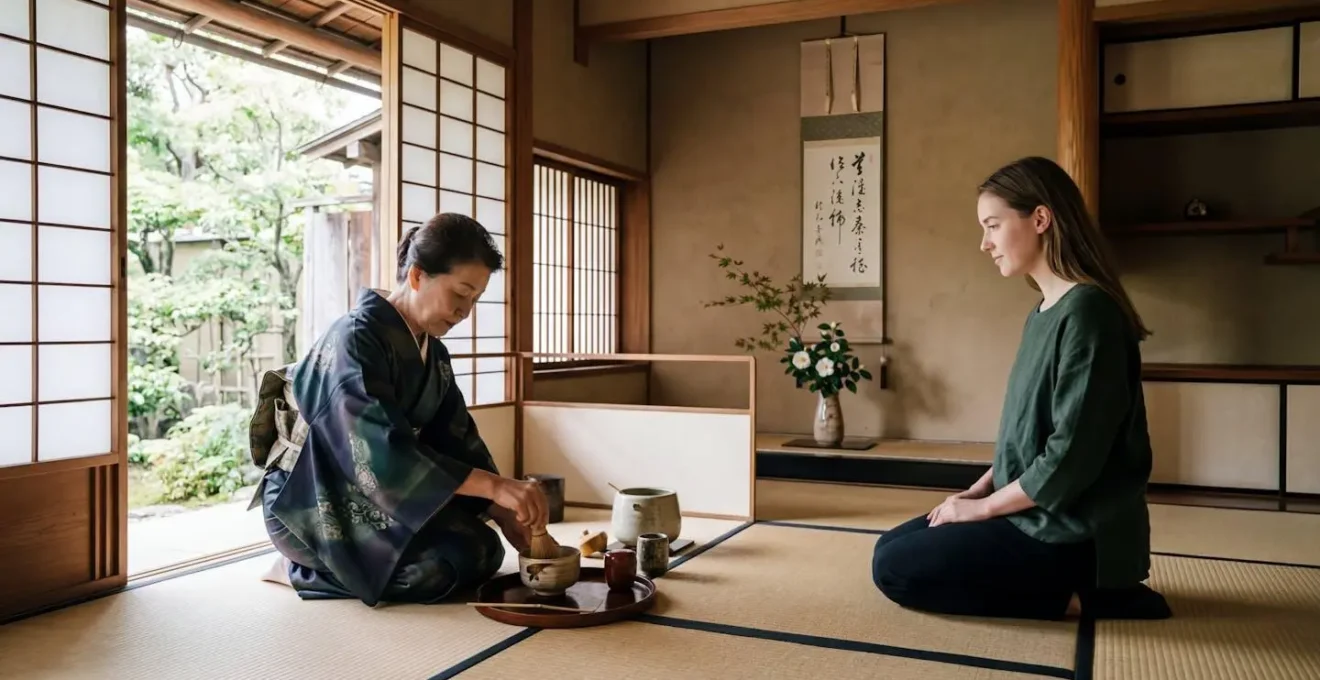
Fearing a cultural misstep at a Japanese tea ceremony is common, but memorising endless rules isn’t the solution.
- True respect comes from understanding the core principle of harmony (Wa), not just mimicking actions.
- Every rule, from foot placement to the way you drink, is designed to create a shared, peaceful experience.
Recommendation: Shift your focus from “What should I do?” to “Why is it done this way?” to transform anxiety into genuine appreciation.
The thought of attending a traditional Japanese tea ceremony in Kyoto fills many British travellers with a mix of excitement and deep-seated anxiety. You’ve booked the trip, you’re fascinated by the culture, but the fear of committing a grave, unspoken faux pas is palpable. We’ve all heard the horror stories: a misplaced foot, a loud comment, or an incorrect gesture that shatters the serene atmosphere. The typical advice is a daunting list of dos and don’ts, often leaving you more confused than confident. You’re told to sit a certain way, drink a specific way, and stay quiet, but rarely are you told why.
This guide takes a different approach. As an expat who has spent years studying these traditions, I can tell you the secret isn’t about perfectly memorising dozens of complex rules. It’s about understanding the single, unifying philosophy behind them all: Wa (和), or harmony. Every gesture, every silence, every object is part of a shared, intentional effort to create a moment of peace and mutual respect between the host and guests. Instead of viewing etiquette as a rigid test you might fail, see it as a set of tools to help you participate in creating that harmony. This shift in mindset is the key to moving from a state of fear to one of respectful participation.
Throughout this article, we won’t just list the rules. We’ll decode the logic behind them, exploring the intentionality of each movement and the concept of “sensory respect”. We will cover everything from the physical challenge of sitting correctly to the subtle art of silent communication, so you can enter the teahouse with the quiet confidence of an informed guest, ready to fully embrace one of Japan’s most beautiful cultural treasures.
To help you navigate this intricate world, this article is structured to answer the most pressing questions a British visitor might have. The following summary outlines the key areas we will explore to build your confidence step by step.
Summary: Your Path to Mastering Tea Ceremony Etiquette
- Why Pointing Your Feet at the Host Causes Deep Cultural Offence?
- How to Correctly Drink Matcha Without Spilling on Tatami Mats?
- Authentic Geisha Houses vs Tourist Teahouses: How Do They Differ?
- The Casual Dress Code Mistake That Gets You Turned Away
- How Long Should You Sit Silently Before Asking Your Host Questions?
- Why Wearing Yoga Pants in Traditional Markets Attracts Aggressive Harassment?
- How to Adjust Your Body Language to Show Instant Respect?
- Beyond the Teahouse: Applying These Lessons Across Japan
Why Pointing Your Feet at the Host Causes Deep Cultural Offence?
In Western culture, how we position our feet is often a matter of simple comfort. In a Japanese tea room, it’s a profound statement of respect. The core reason pointing your feet at anyone—especially your host—is offensive is because feet are considered unclean. They touch the ground, the lowest point. The tatami mat floor is a purified space, and the host’s area, where the tea is prepared, is the most sacred part of that space. Directing the soles of your feet towards the host is akin to pointing something dirty at their heart, a deep sign of disrespect that disrupts the ceremony’s harmony.
This isn’t about being deliberately rude; it’s a cultural blind spot for most visitors. The primary seating position, seiza (正座), where you kneel with your feet tucked neatly underneath you, naturally solves this problem. However, holding this position for more than ten minutes can be excruciating for those not accustomed to it. This is where understanding alternatives becomes crucial. The goal isn’t to endure pain but to maintain respect while managing comfort. You are not expected to be perfect, but you are expected to be mindful.
To help with this, many teahouses catering to tourists offer small, low-backed floor chairs (zaisu). Don’t be afraid to ask for one. It shows you are aware of the etiquette and are trying to respect it within your physical limits. The key is the intentionality of your movement; even when shifting position to relieve numbness, a slight bow and a quiet, discreet adjustment show you are still engaged and respectful of the space.
As the image demonstrates, even in alternative postures like the side-sitting yoko-zuwari (for women) or cross-legged agura (for men), the feet are always tucked away, pointing back or to the side, never towards another person. Mastering this simple principle of body awareness is your first major step towards participating with grace.
How to Correctly Drink Matcha Without Spilling on Tatami Mats?
Once you’ve received the tea bowl (chawan), the next moment of anxiety often revolves around drinking the matcha. The process seems laden with rules, but again, each step has a clear purpose rooted in appreciation and cleanliness. The fear of spilling vibrant green tea on a pristine, cream-coloured tatami mat is real, but the ritual itself is designed to prevent that very mishap.
The most important sequence involves rotating the bowl. The host will always present the bowl to you with its most decorative side, or ‘front’, facing you. To drink from this side would be akin to putting your lips on the most beautiful part of a work of art. Therefore, you must rotate the bowl clockwise twice (about 180 degrees) in the palm of your hand. This is a gesture of humility, signalling that you are not “worthy” of drinking from its most esteemed face. It also ensures you drink from a plain, undesecorated part of the rim.
Case Study: Camellia Tea Ceremony House’s Success with British Tourists
Venues like Camellia Tea Ceremony, founded by Director Atsuko Mori, have thrived by demystifying these rituals for Western guests. Established in 2014, their locations near Ryoan-ji and Ninenzaka specifically cater to tourists by providing detailed English explanations for each movement, including the bowl rotation. They successfully teach the philosophy of ‘Wa Kei Sei Jaku’ (Harmony, Respect, Purity, and Tranquility) while making the experience accessible, proving that with the right guidance, tourists can comfortably and respectfully participate.
The drinking itself is done in approximately three sips. This isn’t a strict count, but rather a guide to drink deliberately, not rush. The final sip is accompanied by a distinct, audible slurp. Far from being rude, this slurp is a crucial signal to the host. It says, “I have finished, and it was delicious.” This sound is an integral part of the communication, letting the host know they can proceed. After drinking, you wipe the rim where your lips touched with your thumb and forefinger, and then rotate the bowl back to its original position before setting it down. This small act of cleaning ensures the next person (or the host) receives a clean bowl.
Authentic Geisha Houses vs Tourist Teahouses: How Do They Differ?
Many British tourists arrive in Kyoto with a romantic image of sharing tea with a geisha (more accurately, a geiko in Kyoto dialect) in a traditional wooden teahouse. However, a critical distinction exists between an authentic ochaya (geisha house) and a tourist-friendly chashitsu (tea room), and understanding this difference is key to managing both expectations and budget.
An authentic ochaya is an exclusive, introduction-only establishment. You cannot simply book online or walk in. Access is typically granted through a long-standing, trusted Japanese client who acts as your guarantor. These are venues for high-level entertainment and business, with an evening costing anywhere from £500 to over £2,000. The experience is entirely in Japanese and lasts for several hours. In contrast, a tourist-friendly chashitsu is an educational venue designed to introduce foreigners to the art of the tea ceremony. They are accessible via online booking, provide English explanations, and offer a focused 45-90 minute experience for a fraction of the cost.
This distinction is not about one being “better” than the other; they serve entirely different purposes. For a first-time visitor, the tourist-friendly option is almost always the right choice. It provides the cultural insight you’re seeking in a format that’s accessible and pressure-free. The growing demand for such experiences is clear, as recent data shows that international visitors are willing to pay premium prices for authentic cultural experiences. In 2024, the average spend per tourist visit reached ¥190,000 (£1,200), with a notable increase in spending on personalised activities like private tea ceremonies.
This table from a Lonely Planet guide breaks down the key differences, helping you choose the right experience for your trip.
| Aspect | Authentic Ochaya (Geisha House) | Tourist-Friendly Chashitsu |
|---|---|---|
| Access | Introduction-only, requires Japanese contact | Open booking, online reservations accepted |
| Cost | £500-2000+ per evening | £30-100 per session |
| Duration | 3-4 hours full evening entertainment | 45-90 minutes focused experience |
| Language | Japanese only, no translations | English explanations provided |
| Group Size | Private parties 2-6 guests | Mixed groups up to 15 people |
The Casual Dress Code Mistake That Gets You Turned Away
Your choice of attire for a tea ceremony is another form of non-verbal communication. It’s not about fashion; it’s about “sensory respect.” The tea room is a carefully curated environment for all five senses, and your clothing should not disrupt it. The most common mistake tourists make is dressing for a day of sightseeing, not for a semi-formal cultural ritual. Bright colours, large logos, and casual wear like shorts or revealing tops are distracting and show a lack of awareness.
The biggest no-go, however, is related to two things that can cause physical damage or sensory interference: jewellery and fragrances. Rings, watches, and bracelets can easily scratch the delicate, often antique and priceless tea bowls. You will always be asked to remove them. Similarly, strong perfumes or aftershaves are strictly forbidden. The ceremony includes the subtle aroma of incense and the earthy scent of matcha. A foreign fragrance completely overpowers these delicate notes, ruining a key part of the experience for everyone present.
Finally, never enter a tea room with bare feet or the socks you’ve been wearing all day. The tatami is a clean, respected surface. You should always bring a pair of fresh, clean, plain white socks to change into just before entering. White is chosen for its association with purity. This simple act demonstrates a deep understanding of the distinction between the outside world and the purified space of the teahouse.
Your Pre-Ceremony Dress Code Checklist
- Footwear Protocol: Pack a pair of fresh, plain white socks. Change into them right before entering the tea room and never walk on tatami with bare feet.
- Clothing Choice: Opt for loose-fitting trousers or a midi-length skirt in dark, modest colours (navy, grey, black). Avoid tight jeans, bright patterns, or logos.
- Jewellery Removal: Take off all rings, watches, and bracelets before the ceremony begins to prevent scratching the antique tea bowls.
- Fragrance Ban: Do not wear any perfume, aftershave, or strongly scented lotions. The ceremony’s own subtle aromas are part of the experience.
- Comfort for Seating: Ensure your chosen clothing is flexible and allows you to sit comfortably on the floor for an extended period.
How Long Should You Sit Silently Before Asking Your Host Questions?
The silence in a tea ceremony can be the most intimidating element for a Brit. We’re culturally conditioned to fill empty auditory space with small talk. In the tea room, however, silence is not an absence of communication; it is a form of it. It’s a shared space for observation and appreciation. But when is it acceptable to speak? The key is to understand that the event unfolds in distinct phases.
The Urasenke school, Japan’s largest tea ceremony institution, provides a helpful framework that many tourist experiences emulate. Think of it in three phases. Phase 1 is Appreciation (5-10 minutes): Upon entering, you should silently appreciate the room’s setup—the scroll on the wall, the flower arrangement. This is a time for quiet contemplation. Phase 2 is Observation (20-30 minutes): This is the heart of the ceremony, where the host prepares the tea. This period should be completely silent. Your focus should be entirely on the host’s graceful, efficient, and intentional movements. Speaking during this time is the equivalent of talking during a musician’s solo.
Phase 3 is Conversation: This is the time for questions and discussion. It begins only *after* the host has served the tea, finished cleaning the utensils, and given a final bow. This bow is your cue. It signals that the formal ritual is complete and a more relaxed atmosphere can commence. Asking questions at this stage about the tools, the tea, or the host’s training is welcomed and shows you were paying attention. The structure is designed to reduce anxiety by providing clear, unspoken cues for when to shift from silent observer to engaged participant.
The Urasenke School’s Three-Phase Communication Protocol
The Urasenke school’s method has been successfully taught to thousands of international guests. Instructors note that once visitors understand this three-phase structure—Appreciation, Observation, and Conversation—their anxiety visibly decreases. They stop worrying about *when* to speak and start using the silent phases for their intended purpose: to heighten the meditative quality of the experience and focus on the host’s artistry.
The host makes a bowl of tea, and the guest drinks the tea. Everything else is detail.
– Michael Sōzui, Urasenke Tea Master, Lonely Planet’s Guide to Japanese Tea Ceremony in Kyoto
Why Wearing Yoga Pants in Traditional Markets Attracts Aggressive Harassment?
It may seem like a huge leap from the serene tea room to a bustling market, but the underlying cultural logic is identical. The aggressive glares or even verbal chastisement a tourist in yoga pants might receive at Nishiki Market stems from the same principle of respect that governs the tea ceremony: TPO (Time, Place, Occasion). This deeply ingrained Japanese concept dictates that attire should be appropriate for the specific context. Wearing athletic wear in a traditional market is seen as profoundly disrespectful, as if you’re treating a centuries-old place of business and culture like your personal gym.
Chris Rowthorn, a long-time Kyoto resident and author, explains that for the vendors who have run these stalls for generations, their workplace is not a casual backdrop for a tourist’s holiday. It’s a respected environment with its own codes. Just as you wouldn’t wear a swimsuit to a formal dinner in London, you don’t wear gym clothes to a traditional Japanese market. This isn’t about being prudish; it’s about acknowledging the purpose and history of the space you are in. The “harassment” is often a frustrated, last-ditch attempt to communicate this sense of violated propriety.
For a British tourist, the easy solution is to apply the same mindset you’d use for the tea ceremony. Opt for “smart casual” attire when exploring traditional areas. This doesn’t mean you need to be uncomfortable. Japan’s own clothing brands, like Uniqlo, excel at creating stylish, comfortable travel wear that perfectly aligns with TPO principles. A simple switch from yoga pants to a pair of wide-leg linen trousers or a midi-skirt signals that you see the market not just as a place to shop, but as a cultural space to be respected.
- Wide-leg linen trousers: Breathable and polished, perfect for walking in traditional settings.
- Uniqlo travel pants: Comfortable, formal enough, and widely available in Japan for around £20-£30.
- Midi-length skirts or dresses: Ensure easy movement while respecting conservative norms.
- Smart-casual shorts: For hot weather, tailored Bermuda shorts are acceptable; avoid athletic or beach styles.
How to Adjust Your Body Language to Show Instant Respect?
Beyond specific rules about feet and dress codes, your general body language communicates your level of respect more than anything else. You can instantly signal your awareness and good intentions by adjusting a few key behaviours. The demand for this knowledge is high; data from 2024 reveals that 86% of tourists requested cultural experiences like tea ceremonies in their tour packages, showing a massive desire to engage authentically.
The foundation of respectful body language in Japan is the bow. You don’t need to master its complex variations, but a simple, slight nod of the head and inclination of the shoulders when receiving the tea bowl, when the host bows to you, or when entering and leaving the room, is a universal sign of humility and gratitude. Another key adjustment is to handle objects with two hands. When you are given the tea bowl, receive it with your left hand cupping the bottom and your right hand supporting the side. This gesture shows that you recognize the object’s value and are giving it your full attention.
Finally, your posture speaks volumes. Sit up straight, whether in seiza or on a small chair. Slouching implies boredom or disinterest. Keep your hands resting in your lap when not in use. Avoid fidgeting or making large, sudden movements. These principles are all expressions of the four core tenets of the Way of Tea, first articulated by the master Sen no Rikyū:
- Wa (和 – Harmony): Your calm demeanour contributes to the room’s peaceful atmosphere.
- Kei (敬 – Respect): Your careful handling of objects and bowing shows respect for the host and tools.
- Sei (清 – Purity): Your clean socks and absence of fragrance respect the purified space.
- Jaku (寂 – Tranquility): Your quiet observation and minimal movement create a state of calm.
By consciously embodying these principles through your body language, you are no longer just following rules; you are actively participating in the spirit of the ceremony.
Key Takeaways
- The core of tea ceremony etiquette is not memorising rules, but understanding the principle of Harmony (Wa).
- Respect is shown through specific actions: correct seating, rotating the tea bowl, and a conscious dress code (no jewellery or perfume).
- Silence is a form of communication; learn the three phases (Appreciation, Observation, Conversation) to know when to speak.
Beyond the Teahouse: Applying These Lessons Across Japan
The most valuable lesson from a Kyoto tea ceremony isn’t how to hold a bowl, but how to hold yourself. The principles of Harmony (Wa), Respect (Kei), and mindfulness of Time, Place, and Occasion (TPO) are not confined to the tatami mat. They are the invisible operating system of Japanese society, and understanding them will transform your entire trip, from the temples of Kyoto to the neon-lit crossings of Tokyo.
When you visit a shrine, the quiet reverence you learned in the teahouse will guide you. When you eat at a tiny ramen shop, the focused appreciation for the chef’s craft will feel familiar. The intentionality of movement—placing your shoes neatly at a home’s entrance, accepting a business card with two hands, or waiting for the “walk” signal without a single person jaywalking—all stem from the same cultural source. You have already practiced the fundamentals.
By participating in a tea ceremony, you are not just ticking off a tourist activity; you are receiving a cultural masterclass. You learn to observe before acting, to find meaning in small gestures, and to see your role as a participant in a shared social harmony, not just an individual consumer of experiences. This mindset is the ultimate souvenir. It allows you to navigate the complexities of Japan not with a checklist of rules, but with an intuitive understanding that makes every interaction more meaningful and respectful.
Embrace your journey in Japan not as a test of your ability to follow rules, but as an opportunity to practice this deeper awareness. It will change your trip from a simple holiday into a profound cultural exchange.