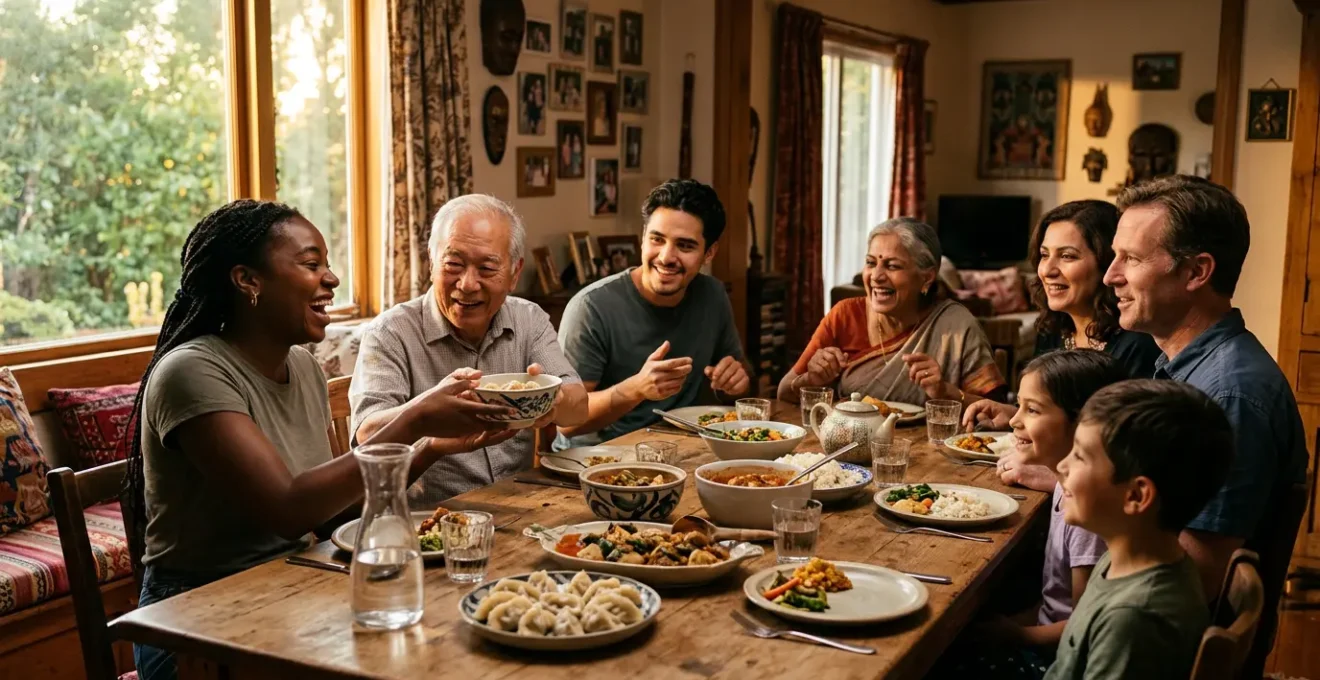
True cultural immersion isn’t found, it’s built. The key is consciously shifting from a transactional guest mindset to one of relational connection.
- Vet potential hosts for relational cues in their profiles, not just for the quality of their amenities.
- Choose a private room for language intensity but be prepared to manage the risk of “immersion burnout.”
- Prioritise gifts of culture and service—like sharing a recipe or a game—over expensive, impersonal items.
Recommendation: Actively participate in the family’s daily life, even in moments of comfortable silence. Your goal should be to become part of the family, not just a guest in their home.
There’s a familiar hollowness that can creep into modern travel. It’s the feeling of standing in a beautifully designed, yet utterly soulless, hotel lobby, realising you could be in London, Tokyo, or Dubai without noticing the difference. You followed the advice: you booked a trip to an “authentic” destination. You planned to eat where the locals eat. Yet, you find yourself isolated by the very infrastructure designed for your comfort, shielded from the beautiful, messy, and genuine chaos of daily life. The tourist bubble, with its air-conditioned coaches and English-language menus, is a comfortable prison.
The common antidote prescribed is to “go local,” and for many, that translates to booking a homestay. It’s a step in the right direction, but simply sleeping in a local’s spare room doesn’t automatically unlock a deep cultural connection. You can still be a tourist, just one with a smaller bathroom. But what if the true secret wasn’t just about changing your location, but about changing your entire mindset? What if the key to breaking the bubble wasn’t the homestay itself, but how you approached it—transforming a simple lodging transaction into a meaningful relational bond?
This guide is built on that principle. It’s for the traveller who wants more than a bed; it’s for the person who wants to build a temporary home. We won’t just tell you to read reviews. Instead, we’ll explore the subtle art of vetting a host for their spirit of hospitality, the nuances of choosing a room for language learning, the unspoken rules of gift-giving, and how to turn potential awkwardness into a bridge for connection. We’ll show you how to be more than a guest, and in doing so, how to find the authentic experience you’ve been searching for.
This article provides a complete roadmap for transforming your travels. We’ll cover everything from the initial vetting of your host family to the delicate art of maintaining the friendships you forge long after you’ve departed.
Summary: A Guide to Relational Travel Through Homestays
- Why Large Hotel Chains Isolate You From Authentic Local Life?
- How to Vet a Foreign Host Family Through Online Booking Platforms?
- Private Rooms vs Entire Homes: Which Accelerates Language Learning?
- The Gift-Giving Faux Pas That Offends Traditional Hosts
- When Should You Discuss Dietary Requirements With Your Host Family?
- Off-Grid Glamping vs Green Hotels: Which Has the Lowest Footprint?
- How to Maintain Long-Distance Friendships While Constantly Moving?
- Spotting Genuine Sustainable Nature Lodges: How to Avoid Holiday Greenwashing?
Why Large Hotel Chains Isolate You From Authentic Local Life?
The fundamental difference between a hotel and a true homestay isn’t the thread count of the sheets; it’s the nature of the space. Large hotels are masterpieces of transactional design. Every element, from the frictionless check-in kiosk to the uniform decor, is engineered to provide a predictable, standardized, and anonymous service. You are a customer purchasing a product: a safe, clean room for the night. This system is efficient, but it’s also inherently isolating. It creates a sterile barrier between you and the vibrant, unpredictable rhythm of the place you came to visit.
As the image above illustrates, these spaces are built on a philosophy of managed separation. The architecture itself—vast, minimalist, and impersonal—discourages spontaneous interaction. You are meant to feel serviced, not connected. In contrast, the ethos of a homestay is, at its best, relational. It is a space where memorable interactions and personalised experiences are the core value. The goal is not to process a customer, but to welcome a person. This shift from a transactional to a relational environment is the first and most crucial step in breaking out of the tourist bubble and experiencing a culture from the inside out.
How to Vet a Foreign Host Family Through Online Booking Platforms?
Finding a truly relational homestay starts long before you pack your bags. It begins with the careful art of vetting potential hosts on booking platforms. The key is to look beyond the star ratings and photos of the room, and instead, hunt for clues about the host’s mindset and intentions. Are they running a mini-hotel, or are they genuinely interested in cultural exchange? As travel writer Bea Adventurous notes, the language a host uses is a major tell.
Phrases like ‘we love to welcome travellers and treat them like family’ or ‘happy to hang out or give local tips’ are green flags for an immersive homestay. If the listing just talks about amenities and is very businesslike, it might be more of a side hustle rental and less of a cultural exchange.
– BEA ADVENTUROUS, Skip the International Hotel and Stay in a Homestay
This means you need to become a detective. Read the host’s profile in detail. What do they say about their family, their interests, their reasons for hosting? A host who is excited to share their culture will often reveal it in their description. Beyond the host’s own words, scrutinise the platform’s vetting process itself. Reputable organisations often have robust procedures in place that signal a commitment to quality placements over quantity.
Your Vetting Checklist for Finding a Relational Host
- Review the platform’s process: Look for evidence of an extensive recruitment and vetting process, which should ideally include home visits and background checks for hosts.
- Check for a matching philosophy: Does the platform state that it considers both the guest’s and the host family’s interests when making a placement? This signals a focus on compatibility.
- Verify host preparation: Ensure the platform requires host families to attend some form of orientation or pre-arrival training sessions, which prepares them for cultural exchange.
- Analyse guest reviews for relational cues: Go beyond “the room was clean.” Look for comments about shared meals, helpful conversations, or feeling “like part of the family.”
- Initiate pre-booking communication: Don’t be afraid to send a message with specific questions. A host eager for connection will respond warmly and thoroughly; a purely transactional host may be brief.
Private Rooms vs Entire Homes: Which Accelerates Language Learning?
For the traveller aiming to improve their language skills, the choice between renting a private room in a shared home versus an entire apartment seems obvious. A private room forces interaction and provides a constant stream of high-intensity conversational practice. However, the decision is more nuanced. While a private room offers unparalleled active immersion, it also carries the significant risk of ‘immersion burnout’—the mental and emotional fatigue that comes from constantly operating in a foreign language. For a successful learning experience, a balance between active practice and quiet processing is essential.
This is where an entire home can surprisingly offer its own language-learning advantages. It provides crucial decompression time, allowing you to study, review vocabulary, and mentally prepare for the next day’s interactions. Furthermore, it pushes you to develop a different kind of fluency: ‘life admin’ fluency. You are forced to navigate grocery stores, ask for directions, and handle daily tasks independently, building practical skills that classroom learning often misses. For deep conversational practice, however, a shared space is superior, though it helps to have a foundation. In fact, some experts suggest that a proficiency equivalent to at least three years of dedicated language study is recommended for the most effective communication in an immersive homestay.
Ultimately, the best choice depends on your personality, current language level, and the length of your stay. A shorter trip might benefit from the intensity of a private room, while a longer stay might necessitate the balance offered by a private home. The following table breaks down the key differences:
| Aspect | Private Room | Entire Home |
|---|---|---|
| Language Intensity | High-intensity conversational practice with host family | Lower intensity but includes passive learning opportunities |
| Immersion Type | Active learning through direct conversation | Passive learning through neighborhood interactions |
| Mental Fatigue Risk | Higher risk of ‘immersion burnout’ | Crucial decompression time for study and processing |
| Practical Skills | Conversational fluency focus | ‘Life admin’ fluency – shopping, directions, daily tasks |
| Host Interaction | Constant interaction with family members | Independent exploration with occasional local encounters |
The Gift-Giving Faux Pas That Offends Traditional Hosts
The gesture of bringing a gift for your host family is a wonderful way to show appreciation, but it’s a moment fraught with cultural nuance. The most common mistake travellers make is treating it like a formal transaction, often choosing a gift that is too expensive. This can inadvertently create awkwardness, highlight economic disparities, and put pressure on the host to reciprocate in a way that makes them uncomfortable. The goal is not to “pay” for their hospitality with an object, but to open a door for connection. A successful gift is a bridge, not a price tag.
The best gifts are those that offer cultural reciprocity—they should tell a story about you and your home. Consider items that are lightweight, meaningful, and serve as conversation starters. A beautifully designed photo book of your hometown, a popular board game from your country, or a small artisanal product unique to your region are excellent choices. Even better are ‘gifts of service’. Offering to cook a traditional meal from your country one evening does more to build a bond than any store-bought item ever could. It’s an act of sharing and participation that shifts the dynamic from guest/host to one of shared family life.
I began to go on morning walks with my homestay mother early in the morning. Even though at times we would just walk in silence, I learned to become comfortable with it and that sometimes just being intentional with being present speaks louder than words. I also started to insert myself into the kitchen. I was told that if you don’t physically ask to get put to work, they will just treat you as a guest. I came in with the motive to be more than ‘just a guest’.
– Homestay Participant, Fund for Education Abroad
This testimony captures the essence of relational travel. The true gift is your intentional presence and willingness to participate. Ask to help with groceries, offer to teach the children a simple game, or simply be present during family activities. Present your physical gift casually, not as a formal presentation upon arrival, but during a quiet, shared moment. It’s this motive to be more than “just a guest” that truly shows your gratitude.
When Should You Discuss Dietary Requirements With Your Host Family?
Discussing dietary requirements can feel awkward, especially when you are a guest in someone’s home. The fear of appearing demanding or ungrateful is real. However, clear and early communication is an act of respect for both you and your host. Leaving this conversation until you’re sitting at the dinner table puts your host in an incredibly difficult position and can create unnecessary stress. The key is a two-step communication protocol that is polite, clear, and frames the requirement as your responsibility, not their burden.
First, address the topic before you book. When you inquire about the stay, politely and clearly state your needs (e.g., “I have a serious peanut allergy,” or “I am a vegetarian”). This gives the host an honest opportunity to decide if they can comfortably accommodate you. Second, send a friendly reminder a few days before you arrive. This ensures your needs are fresh in their mind as they plan for your stay. When you communicate, phrases like, “I’m happy to buy and prepare some of my own food to make it easier for you,” can transform the dynamic. It shows you are a considerate and proactive guest.
Better still, use your dietary needs as a bridge for connection. Offering to go grocery shopping with your host or cook a meal together can turn a potential limitation into a fantastic bonding opportunity. It invites you into the kitchen—the heart of the home—and creates a natural setting for conversation and cultural exchange. This approach reinforces the idea that you want to be a participant in the household, not just a passive guest to be served.
Off-Grid Glamping vs Green Hotels: Which Has the Lowest Footprint?
The desire to travel more consciously often leads us away from mainstream hotels and towards alternatives that promise a lighter touch on the planet. This impulse is part of the same spirit that draws us to homestays: a search for authenticity and a rejection of mass-market, high-impact tourism. This is especially relevant as a response to the problem of over-tourism, a reality for destinations where tourism inflows exceed local carrying capacity, such as Venice and Barcelona. In this context, two popular “green” options emerge: off-grid glamping and certified green hotels. But which truly has the lowest environmental footprint?
A green hotel often focuses on operational efficiency. They invest in energy-saving lighting, water-saving fixtures, robust recycling programs, and sourcing food locally. These are significant and commendable efforts, but they are often retrofitted onto a large, permanent structure with a substantial initial carbon footprint from construction. Their impact reduction is primarily about being ‘less bad’ than a conventional hotel.
Off-grid glamping, on the other hand, operates on a different philosophy. It typically involves semi-permanent structures (like yurts, safari tents, or tiny cabins) designed for minimal site disturbance. Their strength lies in what they *don’t* have: no connection to municipal water or power grids. They rely on renewable energy like solar panels, use composting toilets to eliminate wastewater, and often harvest rainwater. While their day-to-day resource use can be incredibly low, their footprint depends heavily on the materials used, how waste is managed off-site, and whether they truly integrate with the local ecosystem or simply occupy it. The lowest footprint option is not a category, but a specific case: a small-scale, locally owned operation—whether a hotel or glamping site—that is transparent about its construction, energy, water, and waste processes.
How to Maintain Long-Distance Friendships While Constantly Moving?
The bittersweet reality of a powerful homestay experience is the departure. You’ve forged a genuine bond, shared meals and stories, and created a temporary family. The challenge is preventing that connection from fading into a pleasant memory. Maintaining these friendships across continents while you continue to travel requires the same intentionality that you used to build them in the first place. It’s about moving from shared space to shared memory.
The key is practicing ‘High-Context Check-ins.’ A generic “how are you?” is easily lost. Instead, send a message that references a shared experience: “I was just telling a friend about that hilarious card game you taught me,” or “I tried making that pasta dish you showed me—it wasn’t as good as yours!” This immediately reactivates the emotional connection and shows that their impact on you was specific and memorable. Another powerful strategy is digital reciprocity. If you know they are working on their English, send them an interesting article. If they shared their favourite music with you, send them a playlist of songs from your country. It’s a small way of continuing the cultural exchange.
Using forward-looking language both during and after your stay also strengthens the bond. Phrases like, “I can’t wait to host you if you ever visit my country,” plant a seed for future connection. It reframes the goodbye not as an end, but as a pause. It is this conscious effort that transforms a host family into something more, a sentiment perfectly captured by a former traveller:
At the beginning of my homestay, I referred to my host family as my ‘host family’ and my real family as my ‘real family.’ By the end of the trip, there was no ‘host,’ and there was no ‘real’. Family is family, familia es familia.
– Former Experimenter, The Experiment Homestay Program
Key Takeaways
- Shift your mindset from a transactional guest to a relational family member to unlock true immersion.
- Vet hosts based on their desire for cultural exchange, not just the quality of their amenities.
- The best gift is your active participation and intentional presence in the family’s daily life.
Spotting Genuine Sustainable Nature Lodges: How to Avoid Holiday Greenwashing?
In the world of travel, “sustainability” has become a powerful marketing buzzword. This is partly driven by demand, with research showing that 42% of Millennials prefer eco-friendly travel options and are willing to seek out sustainable accommodations. Unfortunately, this has led to a rise in “greenwashing,” where businesses make vague or misleading claims about their environmental practices to attract conscious travellers. Spotting a genuinely sustainable lodge—be it a homestay or a small hotel—requires you to look for proof, not promises.
First, look for ‘Process Proof’ over slick eco-badges. A genuinely sustainable lodge will be transparent and proud of its methods. Their website or literature should detail *how* they manage waste, *where* their water comes from, and *who* built the lodge using what materials. Vague claims like “we’re eco-friendly” are red flags. Next, apply the ‘Community Integration Test.’ Does the lodge employ local people in management positions, not just in low-wage service jobs? Do they source their food from neighbouring farms? Do they contribute to local community projects like schools or conservation efforts? True sustainability is as much about social and economic support for the local community as it is about environmental protection.
Finally, conduct the ‘Staff Litmus Test’ if you’re on-site. Talk to the guides, the cooks, the groundskeepers. Ask them about their work, the lodge’s connection to the community, and local environmental issues. Their answers—and their enthusiasm—will often reveal the true commitment of the leadership far more effectively than any marketing brochure. Also, be aware of ‘Green-Hushing.’ Ironically, many of the most genuinely sustainable, family-run homestays and lodges don’t have the marketing budget or expertise to advertise their eco-credentials. Their sustainability is simply a way of life. Spotting them often requires the same deep vetting and attention to detail as finding a great relational host.
By embracing this relational mindset—from vetting your host to giving gifts and communicating your needs—you fundamentally change your role from a passive consumer of a place to an active participant in its life. You trade sterile predictability for the beautiful, unpredictable, and ultimately more rewarding experience of human connection. This is the heart of slow, authentic travel. Start planning your next journey not just by asking “where will I stay?” but “who will I meet?”.