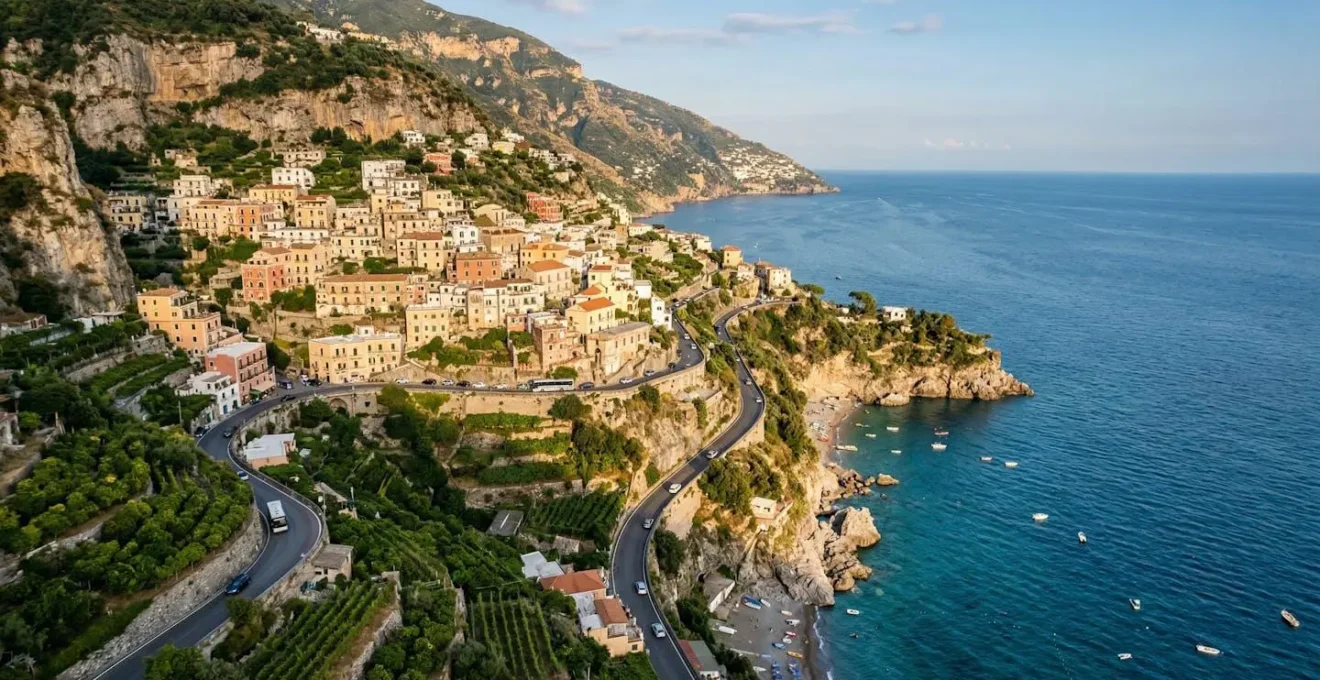
The romantic dream of driving the Amalfi Coast is a trap; the reality is a stressful, expensive nightmare that a car-free strategy beautifully solves.
- Renting a car introduces constant anxiety from navigating impossibly narrow roads, finding non-existent parking, and risking hefty traffic fines (ZTLs).
- A strategic combination of ferries (the “Blue Highway”), public buses (SITA), and pre-booked drivers offers more flexibility, stunning views, and far less stress.
Recommendation: Ditch the car rental reservation. Instead, choose a strategic base like Salerno or Sorrento and embrace the local transport network for a genuinely relaxing and more authentic coastal experience.
Every year, I see you. The hopeful British couple, fresh from watching a classic film, pulling up to the car hire desk in Naples. You’ve got the designer sunglasses, the new linen shirts, and a romantic vision of yourselves winding along a sun-drenched coastal road in a zippy Fiat 500, a beautiful headscarf fluttering in the breeze. You imagine pulling over for spontaneous espresso stops and discovering hidden coves, all with the freedom that only a car can provide. As a local, let me tell you with all the love in my heart: stop. That dream is a fantasy, and trying to live it will systematically dismantle your holiday, your budget, and quite possibly, your relationship.
The common advice to “book a small car” or “be a confident driver” is a dangerous platitude. It fails to grasp the fundamental truth of this place. The Amalfi Coast wasn’t designed for cars; it was carved by fishermen and farmers into vertical cliffs long before the automobile was invented. To drive here is not to experience freedom; it’s to enter a battle against geography, logistics, and a system that will penalise you at every turn. Forget freedom; the reality of a rental car is Parking Meter Panic, the dreaded Reverse of Shame on a cliff edge, and the constant, low-level anxiety that erodes the joy of being here.
But this is not a message of despair. It’s an intervention. There is a way to experience the profound, jaw-dropping beauty of this coastline, a way that is more relaxing, more scenic, and far more intelligent. It involves abandoning the flawed premise of the rental car and embracing the coast on its own terms. This guide is your roadmap to doing just that. We will dismantle the car rental myth piece by piece and show you how to navigate the cliffs, the towns, and the logistics like a seasoned traveller, not a stressed-out tourist.
This article will guide you through the critical mistakes tourists make and provide the insider strategies to avoid them. You’ll learn how to master the public transport system, choose the right base of operations, and pack smart for the coast’s unique “vertical reality”.
Summary: A Local’s Guide to Surviving the Amalfi Coast Without a Car
- Why ZTL Traffic Zones in Positano Guarantee an Unexpected €100 Fine?
- How to Use the SITA Public Bus System to Navigate the Cliffs Safely?
- Sorrento vs Salerno: Which Base Offers Better Access to the Coastline?
- The Luggage Mistake That Leaves You Dragging 20kg Up 300 Vertical Steps
- When Exactly Should You Hike the Path of the Gods to Avoid the Heat?
- Why the Hire Desk Always Claims Your UK Excess Policy Is Invalid?
- The Single-Track Road Mistake That Causes £1,000 of Rental Damage
- Navigating Rural Geography: Unlocking Europe’s Hidden Villages Safely
Why ZTL Traffic Zones in Positano Guarantee an Unexpected €100 Fine?
The “Zona Traffico Limitato” or ZTL is the first and most painful lesson for drivers on the Amalfi Coast. It’s not a suggestion; it’s an automated, camera-enforced system designed to keep non-resident traffic out of historic town centres. For you, it’s a financial trap waiting to be sprung. Driving past a ZTL sign, even for a few seconds to turn around, triggers a camera, and a fine will be sent to your rental company. They will then charge your credit card, often with an added administrative fee, months after you’ve returned home. It’s a guaranteed way to ruin the memory of your trip.
Many tourists think, “I’ll just be careful,” or “My GPS will know.” Your GPS does not know. It will happily route you directly through a ZTL. The signs are often in Italian and can be missed in the chaos of navigating a narrow street. In a town like Positano, the entire central area is effectively a ZTL. There is nowhere to go. Trying to “just drive through” is a guaranteed penalty, with fines that can be severe. Recent traveller reports show fines ranging from €80 to €300 per violation, and they can take up to a year to arrive in your letterbox, a long-forgotten sting from your Italian adventure.
The only way to win this game is not to play. The stress of constantly looking for signs, worrying if you’ve crossed an invisible line, and the inevitable fine is the epitome of “Parking Meter Panic”. It completely undermines the relaxed holiday you came here for. The solution is to park in designated lots far outside the centres and walk or use local transport, which begs the question: why have the car at all?
Your action plan: 5 Steps to Avoid ZTL Fines in Italian Coastal Towns
- Before entering any town center, look for white circular signs with red borders marked ‘ZTL’ or ‘Zona Traffico Limitato’.
- Download official ZTL maps from municipal websites before your trip, not relying solely on GPS navigation.
- If staying at a hotel within a ZTL zone, email your license plate number 48 hours before arrival for permit registration.
- Park in designated areas outside the ZTL and walk or use local transport to reach your destination.
- If you accidentally enter a ZTL, contact local police within 24 hours to potentially avoid or reduce the fine.
How to Use the SITA Public Bus System to Navigate the Cliffs Safely?
While you’re stuck in a rental car performing the “Reverse of Shame” against an oncoming coach, the people inside that coach are relaxed, taking photos, and being chauffeured by a driver who has navigated these cliffs thousands of times. That coach is the SITA bus, and it’s your best friend. These buses are the workhorses of the coast, forming a reliable network that connects all the major towns from Sorrento to Salerno, including Positano and Amalfi. They are cheap, efficient, and allow you to focus on the spectacular views instead of the sheer drop a few inches from your tyre.
In summer, departures can be as frequent as every 20-25 minutes. A single ride costs a few euros, but the real value is in the COSTIERASITA 24-hour pass. For around €10-€12, you get unlimited rides, allowing you to hop on and off between towns like Positano, Amalfi, and Ravello. The key is to buy your tickets *before* you board. You can find them at “tabaccherie” (tobacco shops), newspaper stands, or bars near the bus stops. Remember to validate your ticket in the machine as you get on; inspectors are common, and the fines for not validating are steep.
Yes, the buses can get crowded in July and August. You might have to stand. But this is a small price to pay for avoiding the nightmare of driving and parking. The experience is part of the local fabric. You’ll be travelling alongside residents, hearing Italian chatter, and seeing the coast from a higher vantage point. It’s an authentic experience, unlike the sterile, stressful bubble of a rental car.
To give a clear overview, this table compares the main transport options. Notice how the bus and ferry offer the best balance of cost and access, especially when compared to the enormous expense of a private driver or the limited availability of taxis.
| Transport Mode | Cost Range | Pros | Cons | Availability |
|---|---|---|---|---|
| SITA Bus | €1.50-€6.80 | Year-round, budget-friendly | Crowded in summer, delays | Daily 6am-10pm |
| Ferry | €9-€26 | Scenic, faster, avoids traffic | Weather dependent | April-October only |
| Private Driver | €150-€250 | Comfortable, flexible | Expensive | Must book ahead |
| Local Taxi | €40-€80 per trip | Direct, no waiting | Limited availability | Variable |
Sorrento vs Salerno: Which Base Offers Better Access to the Coastline?
Where you choose to sleep is the single most important strategic decision for a car-free Amalfi Coast holiday. Your base determines the ease of your day trips and the overall flow of your itinerary. The two main contenders are Sorrento to the west and Salerno to the east. The romanticised choice is often Sorrento, but for the savvy, car-free traveller, Salerno presents a compelling, and arguably superior, argument.
Sorrento is the classic gateway. It’s lively, packed with amenities, and offers direct, quick ferry access to the island of Capri. Its position makes it a natural starting point for the SITA bus journey eastward along the coast. However, it is also extremely crowded, more expensive, and its train connection to Naples is the slower, less comfortable Circumvesuviana line. For first-timers who prioritise easy access to Capri and Positano, it remains a strong choice.
Salerno, on the other hand, is a real, working Italian city, not just a tourist hub. This makes it more affordable for both accommodation and food. Crucially, it’s on Italy’s high-speed train line, meaning you can get from Rome or Naples to your hotel quickly and comfortably. It’s the starting point for both the ferry network and the SITA bus heading west, making it an excellent base for exploring the entire coast. As one experienced traveller on the Rick Steves forum noted, the value proposition is hard to ignore. A contributor wisely points out, as highlighted in a travel forum discussion:
Another good thing about Salerno is that it is much less expensive than Sorrento – for both food and lodging. By staying in Salerno, and Pompei, we were able to afford private guides, including a boat charter, and car services. Plus, Salerno is an easy train ride back to Rome.
– Rick Steves Forum Contributor, Rick Steves Travel Forum Discussion
This table breaks down the key differences to help you make an informed, strategic choice based on your priorities and budget, not just popular opinion.
| Criteria | Sorrento | Salerno |
|---|---|---|
| Access to Capri | Direct ferries, 20-45 min | No direct ferries |
| Access to Positano | SITA bus or ferry, gateway position | Ferry or bus, eastern approach |
| Train Connection | Circumvesuviana to Naples (slower) | High-speed to Rome/Naples |
| Accommodation Cost | Higher prices, tourist hub | More budget-friendly |
| Crowds | Very crowded in season | Less touristy |
| Best For | First-timers, Capri access | Budget travelers, train connections |
The Luggage Mistake That Leaves You Dragging 20kg Up 300 Vertical Steps
This is the moment the romantic fantasy of the Amalfi Coast collides with its “Vertical Reality”. You’ve managed to navigate to your hotel in Positano on the map, but the map doesn’t show the 300 steep, narrow, uneven stone steps between the road and your front door. Your rental car, which you’ve paid a fortune to park half a mile away, is now completely useless. And that large, stylish 20kg suitcase you packed is now your enemy. I have witnessed this scene a thousand times: red-faced, sweating tourists dragging heavy wheeled luggage up endless flights of stairs, the clatter of the wheels echoing their frustration. It is the opposite of a relaxing holiday.
This is a problem that a car cannot solve. In fact, it often makes it worse by creating a false sense of security that you can just “drive to the door”. The solution lies in a radical shift in thinking before you even leave home. First, pack light. A backpack or a small, carry-on-sized duffel bag is infinitely better than a large suitcase. You must be able to carry your luggage comfortably for at least 15 minutes, potentially up and down stairs.
Second, plan your logistics with this verticality in mind. When booking accommodation, choose a place near a ferry dock or a main SITA bus stop to minimise the walk. Use Google Street View to scout the actual path from the transport stop to your hotel; don’t trust the map’s straight line. For a truly stress-free arrival, many hotels can arrange a porter service (“servizio di facchinaggio”) to meet you and carry your bags for a fee. It is worth every single euro. Trying to save money by hauling your own oversized bags is a classic rookie mistake that starts your trip with exhaustion and arguments.
When Exactly Should You Hike the Path of the Gods to Avoid the Heat?
The “Sentiero degli Dei,” or Path of the Gods, is one of the most breathtaking hikes in the world. It offers divine views of the coastline from high up in the Lattari Mountains. It’s also become incredibly popular, and doing it wrong can turn a heavenly experience into a hellish one. The two biggest enemies on this trail are the crowds and the sun. A rental car is irrelevant here; your success depends entirely on timing and preparation.
The single most important piece of advice is to start early. Painfully early. The vast majority of tourists will start the hike from Bomerano between 9 AM and 11 AM. By that time, the trail is crowded, and the Mediterranean sun is starting to get fierce, with very little shade along the route. To truly experience the magic, you must be on the trail at sunrise. Local hiking guides suggest that a 7 AM start time reduces crowds by 80% and heat exposure by 60%. This transforms the hike from a conga line of tourists into a serene, almost spiritual experience, as you watch the sun illuminate the coast below.
Proper footwear is also non-negotiable. This is a mountain path, not a stroll in the park. As a 17-year resident of the coast stated in an interview, the beauty can be dangerously distracting:
The Path of the Gods, which is located above the towns of Praiano and Positano, has become extremely popular in recent years. However, injuries and even deaths happen every year along this popular hike. It’s important to always stay aware — even with the distractingly beautiful vistas — and to wear proper footwear… you do need comfortable and supportive shoes with good tread.
– 17-year Amalfi Coast resident, Business Insider Interview
Getting to the trailhead in Bomerano is easily done by bus or a pre-booked taxi from Amalfi. The hike ends in Nocelle, high above Positano, from where you can take a local bus or walk the 1,700 steps down into town. No part of this perfect day requires a rental car. It only requires an early alarm and a good pair of shoes.
Why the Hire Desk Always Claims Your UK Excess Policy Is Invalid?
Welcome to the “Insurance Theatre,” a well-rehearsed performance that plays out at car hire desks across Italy. You arrive, proud that you’ve smartly purchased a third-party car hire excess insurance policy from a UK provider for a fraction of the rental company’s price. You present your documents, and the agent shakes their head gravely. They deliver the lines with practiced sincerity: “Ah, I am sorry, sir, but we do not accept these policies,” or “This is not valid in Italy,” or “This does not provide the correct coverage.”
This is almost always untrue. The goal is simple: to create fear and doubt, pressuring you into buying their own expensive “Super Collision Damage Waiver” or “zero-excess” policy, on which they earn a hefty commission. They will explain that without their policy, they must block a huge amount on your credit card—often €2,000 or more—as a security deposit. They know many travellers don’t have that available credit or are simply too intimidated to argue. It’s a highly effective tactic.
The key to defending yourself is preparation and understanding their game. Some local agencies in the Campania region have clauses in the fine print stating they only cover 50% of costs, even with their ‘full’ insurance, making the whole situation a minefield. To fight back, you need to arrive with printed copies of your policy, a high-limit credit card ready for the deposit, and the confidence to stand your ground. You must then meticulously document every single pre-existing scratch on the vehicle and even video record the car’s condition before you drive away. This entire process is stressful, confrontational, and can take an hour of your precious holiday time. It is the absolute antithesis of a relaxing start to your trip.
The Single-Track Road Mistake That Causes £1,000 of Rental Damage
The main road along the coast, the SS163 “Amalfitana,” is famously narrow. But it’s often the smaller, single-track roads leading to a villa or a hidden restaurant that cause the real financial pain. You follow your GPS down a seemingly charming lane, only for it to narrow, the stone walls closing in on either side. Suddenly, another car appears, or you face a hairpin bend you simply cannot make. There is no room to turn. Your only option is the dreaded “Reverse of Shame.”
This isn’t just embarrassing; it’s expensive. Scraping a wing mirror or scratching the bodywork against a stone wall is incredibly easy. That tiny ‘scrape’ can quickly turn into a massive bill. Rental agencies have standardised, and often inflated, costs for repairs. According to reports from Italian rental agencies, the average cost for mirror damage is €500, and it’s the most common claim. A more significant series of scratches along the side of the car can easily exceed £1,000. Your holiday budget, and your security deposit, are gone.
Even on the main road, the danger is constant. As one travel blogger accurately describes the chaos:
This road offers you stunning views of the coastline! But it’s rather narrow, it has only one lane in each direction, and there is constant traffic on it. You will cross path with cars driving very fast, coaches, but also motorbikes, scooters and cyclists. Many of them are overtaking on blind bends which will increase the danger.
– Travel blogger with Amalfi driving experience, Limitless Secrets Travel Guide
You are not a local. You do not know which roads are safe and which are traps. The drivers of the SITA buses and the NCC (private drivers) do. They know every inch of these roads. By trying to “explore” in a rental car, you are not finding freedom; you are driving into a high-risk, high-cost environment where one small error of judgement has serious financial consequences.
Key takeaways
- Renting a car is a source of stress, not freedom, due to traffic, ZTL fines, and extreme parking challenges.
- The public transport system, particularly the SITA bus and the ferry network (the “Blue Highway”), is efficient, affordable, and scenic.
- Strategic planning is paramount: choose a well-connected base like Salerno, pack light for the vertical geography, and time activities like hiking to avoid crowds and heat.
Navigating Rural Geography: Unlocking Europe’s Hidden Villages Safely
The ultimate irony is that a rental car, the supposed key to discovery, actually limits your exploration of the Amalfi Coast. It tethers you to the few places with (extortionately priced) parking and keeps you stuck in traffic on the one main road. The real secret to unlocking the coast’s hidden gems lies in a multi-modal approach, using the landscape’s natural highways: the sea and the paths.
Think of the ferry network as the “Blue Highway”. From April to October, companies like TravelMar operate a frequent and reliable service connecting the main towns. This is not just transport; it’s a glorious sightseeing experience. Approaching Positano from the sea is a view that will be seared into your memory forever. The ferry is faster than the bus, completely avoids traffic, and allows easy access to smaller, charming villages like Cetara or Minori, which are often bypassed by car-bound tourists. It turns the journey between towns into a highlight of the day, not a stressful ordeal.
For destinations the ferry can’t reach, like the hilltop town of Ravello with its magnificent gardens, you can deploy a hybrid strategy. Take a ferry to Amalfi, then use the local bus or a pre-booked taxi for the short, steep journey up to Ravello. This targeted use of transport is far more efficient and enjoyable. A smart strategy involves using the Moovit app for real-time bus tracking and booking any necessary private transfers or restaurant shuttles well in advance. This is how you travel with intelligence and purpose, using the right tool for each specific job. This car-free approach doesn’t limit you; it liberates you from the constraints of the car, opening up the entire coast for authentic, stress-free discovery.
So, cancel that car rental. Re-allocate that budget towards a beautiful hotel in Salerno, a private boat trip for a day, or some unforgettable meals. You came here to relax, to soak in the beauty, and to fall in love with Italy. The greatest freedom you can give yourself is the freedom from the four-wheeled prison you thought you needed.