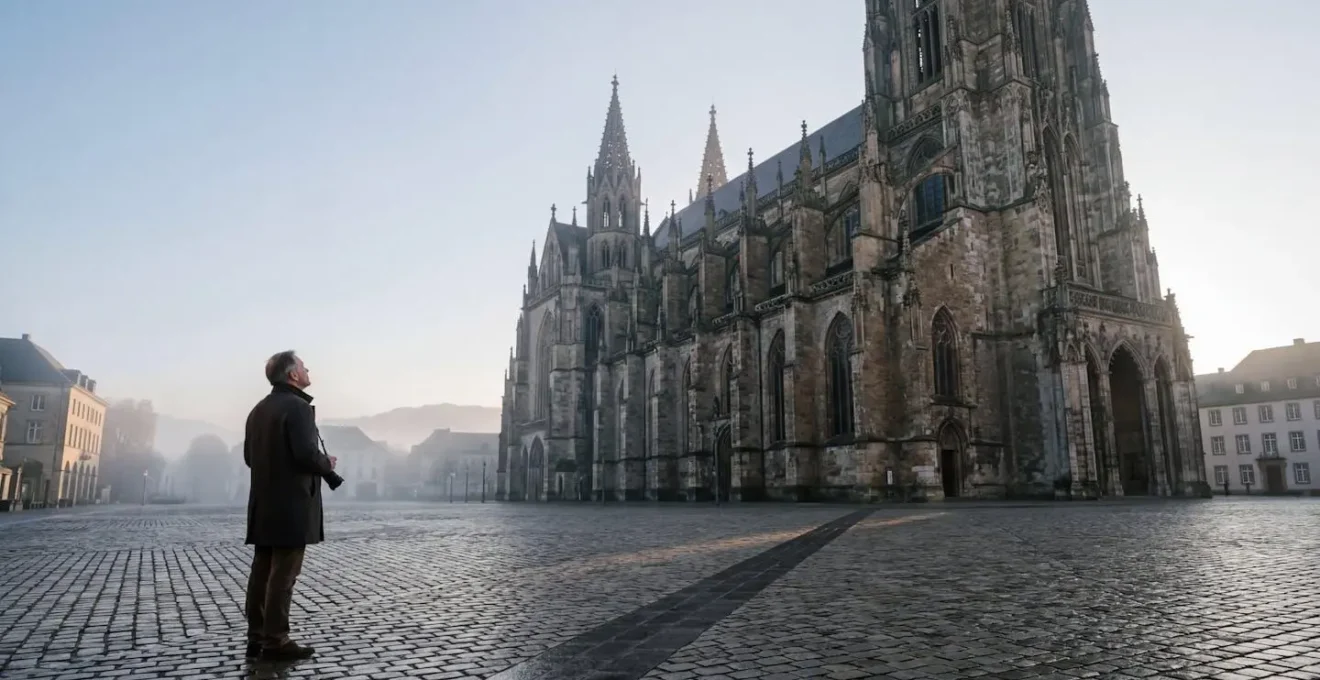
The secret to experiencing world heritage isn’t finding an empty monument; it’s learning to see it with a historian’s eyes, even when surrounded by others.
- True appreciation comes from deliberate observation and understanding a site’s hidden narrative, not just avoiding people.
- Engaging a local expert or using specific observation techniques can transform a crowded visit into a profound personal discovery.
Recommendation: Replace the goal of ‘avoiding crowds’ with the practice of ‘intellectual preparation’—plan not just when you’ll go, but how you’ll look.
For the discerning traveller, the very idea of visiting a world-renowned cathedral or an ancient temple can evoke a sense of dread. The vision is not one of quiet contemplation but of a jostling sea of smartphones, the air thick with chatter, the monument itself reduced to a mere backdrop for another fleeting selfie. The common advice—go in the off-season, arrive at dawn—scratches the surface but misses the fundamental point. These are logistical tricks, not a strategy for intellectual enrichment. They might offer a moment of relative quiet, but they do not guarantee a meaningful connection with the history embedded in the stone.
The frustration felt at these sites isn’t just about the crowds; it’s about a disconnect between our desire for a profound experience and the reality of mass tourism. We seek narrative resonance, a moment where the past feels tangible, but are instead met with a superficial spectacle. What if the solution wasn’t about finding an empty space, but about cultivating a different way of seeing? What if, by adopting the mindset of an architectural historian, you could unlock the hidden details and stories of a place, rendering the surrounding crowd irrelevant?
This guide is not about tourist hacks. It is an argument for a slower, more deliberate form of exploration. We will dismantle the common frustrations of visiting heritage sites and replace them with a framework for genuine engagement. This is about transforming your visit from a passive viewing into an active, intellectual dialogue with the past, giving you the tools to experience architectural marvels with the depth and intimacy they deserve.
This article provides a structured approach to transform your visits. The following sections break down the key strategies, from practical timing to the art of observation, allowing you to build your historian’s toolkit.
Summary: A Guide to Experiencing Architectural History
- Why Midday Visits to European Cathedrals Guarantee Peak Frustration?
- How to Hire an Expert Local Historian for Under £40?
- Guided Audio Tours vs Live Experts: Which Unlocks Hidden Details?
- The Flash Photography Error That Gets Tourists Banned
- When to Arrive at Heritage Sites for Optimal Morning Lighting?
- How to Use the Marine Traffic App to Predict Empty Streets?
- How Long Should You Sit Silently Before Asking Your Host Questions?
- How to Support Authentic Cultural Heritage Sites Without Funding Tourist Traps?
Why Midday Visits to European Cathedrals Guarantee Peak Frustration?
The midday bell of a European cathedral no longer calls monks to prayer; it signals the arrival of peak tourist density. Between 11 a.m. and 3 p.m., these sacred spaces often transform into crowded hubs, making any form of quiet contemplation impossible. The sheer volume of people not only creates physical discomfort but also a form of sensory overload that actively prevents deep engagement. While focused on Asia, research from Beijing architectural heritage tourism studies shows that high visitor density fundamentally alters the experience of a site, turning it from a place of discovery into a challenge of navigation. The constant movement, noise, and lack of personal space shatter any chance of achieving the narrative resonance we seek.
The frustration is rooted in a conflict of purpose. You arrive seeking a connection with centuries of faith and artistry, while many around you are on a rapid-fire tour, ticking a box on a list. This creates an atmosphere where deliberate observation is nearly impossible. Instead of tracing the curve of a Gothic arch or studying the faded colours of a fresco, your attention is constantly pulled away by the logistics of moving through a crowd.
To reclaim the experience, one must be strategic, not just to avoid people, but to find moments where the building’s intended atmosphere can re-emerge. This means targeting times when the tour-bus cycle is at its lowest ebb. Consider these timings not as crowd-avoidance tactics, but as windows of opportunity for authentic connection:
- Arrival at Opening: Be there when the doors open (typically 8-9 AM) to experience the space before the large tour groups arrive from major cities.
- The Lunch Hour Lull: Many organised tours break for lunch between 12 PM and 2 PM, creating a brief but noticeable drop in visitor numbers.
- Off-Season Serenity: Visiting between November and March drastically reduces crowds, though the trade-off may be shorter opening hours or colder weather.
- The Overnight Advantage: Staying in the town or city of the monument, rather than day-tripping, grants you access during the quietest early morning and late evening hours.
By choosing these moments, you are not just getting a better photo; you are giving yourself the gift of space and silence, the two essential ingredients for allowing a historic building to tell its story.
How to Hire an Expert Local Historian for Under £40?
The single greatest accelerant to understanding an architectural marvel is to see it through the eyes of an expert. A good local historian does more than recite dates; they unravel the narrative of the building, point out details invisible to the untrained eye, and connect the structure to the human stories that unfolded within it. While bespoke private tours can be prohibitively expensive, there are several highly effective strategies for finding world-class expertise on a budget, often for less than the cost of a mediocre group dinner.
The key is to bypass the mainstream tourist industry and connect directly with the sources of academic and local knowledge. You are seeking an individual driven by passion and scholarship, not just a guide repeating a script. These individuals often work outside of large tour companies and offer a far richer, more personal experience.
Case Study: The Local Historia Model
Organizations like Local Historia in the US demonstrate the power of this approach. They offer walking tours led by public historians, grounded in professional research and reliable sources. This model proves that a tour can be both academically rigorous and deeply engaging, moving far beyond the typical tourist-level information. This is the quality of experience you are looking for.
Finding such an expert requires a little “intellectual preparation” before your trip, but the payoff is immense. You move from being a passive spectator to an active participant in an expert dialogue.
Your Action Plan: Finding an Affordable Expert
- Contact University History Departments: Directly email the history or architecture department of a local university. Ask if any PhD students or post-graduates offer freelance guiding services. They are often incredibly knowledgeable and appreciate the small income.
- Seek ‘Friends of the Monument’ Societies: Many major sites have associated charitable or volunteer societies. These groups often run expert-led tours for members or for a small donation, which goes directly to preservation.
- Engage Local Historical Societies: Small, local historical societies are treasure troves of information. They may offer volunteer-led walks or be able to connect you with a retired professor or local expert for a private fee.
- Vet Online Platforms Carefully: On platforms like Withlocals, don’t just book a guide with good reviews. Message potential guides beforehand with a specific, insightful question.
- Ask the Litmus Test Question: A powerful question to ask a potential guide is: “What is a common misconception about this site that you love to debunk?” Their answer will instantly reveal their depth of knowledge and passion.
Guided Audio Tours vs Live Experts: Which Unlocks Hidden Details?
Upon entering a heritage site, you’re often faced with a choice: the ubiquitous audio guide handset or the promise of a live tour. For the traveller seeking genuine insight, the decision is crucial. While audio guides offer flexibility, they represent a one-way, passive reception of information. A live expert, however, opens the door to a dynamic expert dialogue, a two-way exchange that can be tailored precisely to your intellectual curiosity. This distinction is the difference between listening to a lecture and participating in a seminar.
An audio guide is a pre-recorded, finite resource. It cannot read your expression of interest in a particular stained-glass window, nor can it elaborate on a point that piques your curiosity. A live expert, particularly one found through the methods previously discussed, does exactly that. They adjust their focus based on your questions, turning the visit into a collaborative exploration. As The Cultural Experience Tours notes about their guides:
Each of our guides are experts in their respective fields. Authors, historians, lecturers and fellows… guide you throughout the day, and dine with you in the evening…
– The Cultural Experience Tours, Expert-Led Historical Tours
While you may not be dining with your guide, the principle holds: true expertise provides a level of interaction and customisation that a recording can never match. The ability to ask “Why that specific saint?” or “What was happening in the city when this was built?” is what unlocks the deepest layers of understanding. The following comparison, based on a comparative analysis of Rome tours, highlights the fundamental trade-offs:
| Feature | Audio Guide | Live Expert |
|---|---|---|
| Cost | $10-20 | $30-50 |
| Flexibility | Self-paced, pause anytime | Fixed duration |
| Customization | Pre-recorded content | Tailored to interests |
| Questions | No interaction | Real-time Q&A |
| Best Time | Early morning/late afternoon | Any time with booking |
The table makes it clear: the slightly higher cost and reduced flexibility of a live expert are small prices to pay for a vastly superior intellectual return. The audio guide is a tool for basic orientation; the expert is a key to unlocking the soul of the building.
The Flash Photography Error That Gets Tourists Banned
Nothing shatters the contemplative atmosphere of a historic space more than the sudden, sharp burst of a camera flash. It is not only a jarring intrusion for fellow visitors but also a practice rooted in a fundamental misunderstanding of both photography and preservation. From a historian’s perspective, the use of flash in a museum or ancient building is a cardinal sin, an act that prioritizes a poorly lit snapshot over the long-term integrity of the artefact itself. Many institutions now enforce strict no-flash rules, and repeated violations can lead to being asked to leave, a deeply embarrassing end to a cultural visit.
The damage is not theoretical. It is a slow, cumulative process of destruction. As museum conservation guidelines state, flash photography can inflict lasting harm on historical canvases and delicate textiles. The intense, repeated bursts of UV and visible light cause pigments to fade and fabrics to weaken. Each flash is a tiny act of vandalism, accelerating the decay of the very thing the photographer professes to admire. This is why a preservation-first mindset is a core tenet of mindful tourism.
Ironically, flash photography often produces inferior results in large, cavernous spaces like cathedrals. The light fails to reach distant ceilings, creating a brightly lit foreground with a dark, murky background—a photo that captures neither the detail nor the atmosphere of the space. A far better approach is to work with the building’s existing light, a practice which forces a more deliberate and rewarding photographic process.
- Embrace High ISO: Modern cameras perform exceptionally well at high ISO settings (1600-6400). This allows you to capture the ambient light without introducing flash.
- Use a Wide Aperture: A lens with a “fast” or wide aperture (e.g., f/1.8 to f/2.8) lets in more natural light, enabling sharper shots in dim conditions.
- Find Natural Stability: Instead of a tripod (often banned), gently brace your camera or body against a pillar, wall, or pew to reduce shake and achieve a sharp image.
- Shoot First, Then Immerse: Dedicate the first ten minutes of your visit to photography. Once you have your shots, put the camera away and engage with the space directly.
By adopting these techniques, you not only protect the heritage site but also create more evocative, atmospheric photographs that truly reflect your experience.
When to Arrive at Heritage Sites for Optimal Morning Lighting?
The standard advice to “arrive early” is well-meaning but lacks precision. For the architectural historian or the discerning photographer, the question is not just about being there before the crowds, but about arriving at the precise moment when the light best reveals the building’s form and texture. The soft, angular light of the “golden hour”—the period shortly after sunrise—is transformative. It casts long, elegant shadows, picks out intricate carvings in sharp relief, and bathes stone in a warm, ethereal glow that is lost in the harsh, flat light of midday.
This is not a matter of luck; it is a question of intellectual preparation. Planning your arrival for optimal lighting elevates the visit from a simple tour to a carefully orchestrated aesthetic experience. You begin to see the building not as a static object, but as a dynamic entity that interacts with the sun, changing its character throughout the day. This is when the cold stone seems to come alive, and you can appreciate the architect’s consideration of light as a building material in itself.
Fortunately, modern technology has made this level of planning accessible to everyone, allowing you to predict the sun’s behaviour with incredible accuracy.
Case Study: Using Photography Apps for Architectural Planning
Professional landscape and architectural photographers no longer guess about lighting. They use powerful mobile applications like PhotoPills or The Photographer’s Ephemeris (TPE). These tools function as sophisticated planning aids. As one review of the technology explains, these apps tell you the exact time and precise direction of sunrise and sunset for any location on earth, on any day of the year. For a cathedral with a famous west-facing facade, you can plan to be there not just “in the evening,” but at the exact moment the setting sun will illuminate its rose window.
By using these tools, you can arrive at a site knowing exactly where the light will be and what features it will accentuate. You can position yourself to capture the perfect photograph or simply to sit and watch as a sunbeam slowly moves across a nave, a private, fleeting performance arranged centuries ago by a master builder.
How to Use the Marine Traffic App to Predict Empty Streets?
The most advanced form of crowd avoidance involves thinking laterally and using unconventional data sources to predict population flows. While the title of this section points to a highly specific and brilliant tactic—using an app like Marine Traffic to see when a 5,000-passenger cruise ship is docking in a small port city like Venice or Dubrovnik and thus predict a surge of tourists—the underlying principle is far broader. The goal is to find data that signals crowd movement before the crowd itself materializes. It’s about moving your planning from reactive to predictive.
In the digital age, much of this data is hidden in plain sight. For most destinations, you don’t need to be a data scientist to get a significant edge. Your smartphone already holds powerful predictive tools, if you know how to look. For instance, the “Popular Times” feature in Google Maps is no longer just a historical average; apps like Google Maps often provide real-time trends for popular destinations, showing current visitor levels compared to the forecast. A quick check of this feature before leaving your hotel can help you make an executive decision to switch your morning and afternoon plans to avoid an unexpected peak.
The historian’s mindset here is to think about the “why” behind the crowds. Are they tied to a specific event, like a local market day? Are they linked to transport schedules, like the arrival of inter-city trains? For port cities, the Marine Traffic app is an inspired solution. For a city like Rome, it might be checking the Vatican’s official schedule for large papal audiences that will flood the surrounding area. It’s about identifying the local rhythm and its key drivers. By understanding what causes the influx, you can position yourself to be elsewhere, enjoying a quieter, more authentic part of the city while the masses are concentrated in one spot.
This predictive approach allows for a more fluid and intelligent travel style. It frees you from a rigid itinerary and empowers you to adapt based on real-world conditions, ensuring you spend more time in quiet contemplation and less time in a queue.
How Long Should You Sit Silently Before Asking Your Host Questions?
When engaging with an expert, a B&B host, or anyone with local knowledge, the quality of your questions is paramount. It signals your level of engagement and determines the quality of the answers you receive. A common mistake is to fill the silence with premature, generic questions. The truly insightful traveller knows that a period of quiet, deliberate observation is the necessary precursor to a meaningful question. But how long should you wait? The answer is not a measure of time, but of attention.
A heritage tourism expert suggests a powerful alternative to a time-based rule. The goal is to move from passive waiting to active looking, ensuring your questions are born from genuine curiosity, not a desire to simply make conversation.
Replace the time-based rule with the ‘Three Observations’ principle: Suggest waiting until you can formulate a question based on at least three specific, personal observations.
– Heritage Tourism Expert, Behavioral Techniques in Heritage Tourism
This principle is transformative. It forces you to engage your senses and notice details you would otherwise miss. Before asking a question, you must first build a small foundation of knowledge through your own perception. This practice of “sensory scaffolding”—using sounds, smells, and feelings to build a mental picture—makes your interaction far richer. Your host or guide will immediately recognise that you are not a typical tourist, and will respond with a greater level of detail and enthusiasm.
To put this into practice, focus on these active listening techniques:
- Engage All Senses: How does sound travel in this space? What is the smell of the old stone or wood? How does the air feel on your skin?
- Make Three Observations: Before asking your first question, force yourself to notice three specific things (e.g., “The wear on these steps is much deeper on the right side,” “That statue has a small, almost hidden symbol on its base,” “The light from that window only hits this spot for a few minutes”).
- Frame Questions Around Your Observations: Instead of “What’s that statue?”, ask “I noticed the statue’s base has a small symbol that looks like a shell; does that have a specific meaning for this site?”
This approach demonstrates respect for the place and the person you are speaking with. It elevates the exchange from a simple Q&A to a genuine dialogue, unlocking stories and insights that are never shared in response to a generic query.
Key takeaways
- Shift your goal from avoiding crowds to deepening your personal engagement with a site.
- Employ intellectual preparation: research timing, light, and expert guides before you arrive.
- Practice deliberate observation, using all your senses to ask better questions and build a richer understanding.
How to Support Authentic Cultural Heritage Sites Without Funding Tourist Traps?
The final, crucial piece of the historian’s mindset is understanding your role within the fragile ecosystem of cultural heritage. Tourism is a double-edged sword. While the economic impact of heritage tourism is profound, with millions of visitors to sites in France and Spain contributing to preservation, it’s vital to ensure your money supports the right things. Every pound you spend is a vote, either for the preservation of authentic culture or for the proliferation of the low-quality “tourist traps” you seek to avoid.
Supporting authentic heritage means looking for the channels that feed directly back into the site’s research, restoration, and preservation. It requires a conscious effort to bypass the commercial operations that simply skim profit from a site’s popularity without contributing to its long-term health. A discerning traveller learns to spot the difference between a business that serves the site and one that merely exploits it. A shop selling mass-produced souvenirs imported from another country is an exploiter; a small store selling crafts made by local artisans, with a portion of proceeds going to the “Friends of the Cathedral” society, is a supporter.
Your goal is to direct your financial support as close to the stone, parchment, or pigment as possible. Instead of a generic bus tour, you hire the PhD student who uses the fee to fund their research. Instead of a chain coffee shop, you buy a coffee from the small café run by the church’s preservation trust. These small, deliberate choices, when made consistently, have a significant impact. They help sustain the very authenticity you travelled so far to find, ensuring it will still be there for the next generation of discerning travellers. Think of it as your duty as a temporary custodian of the past: to experience it deeply, and to leave it better funded and more secure than you found it.
This is the ultimate expression of mindful travel: aligning your actions with your values and ensuring your visit is a net positive for the heritage you hold dear. It is the final step in moving beyond the selfie and becoming a true partner in preservation.
Now that you have the framework, the next step is to apply it. Begin planning your next cultural trip not by asking where you can go to avoid people, but by researching how you can engage more deeply with the history of the place you choose.