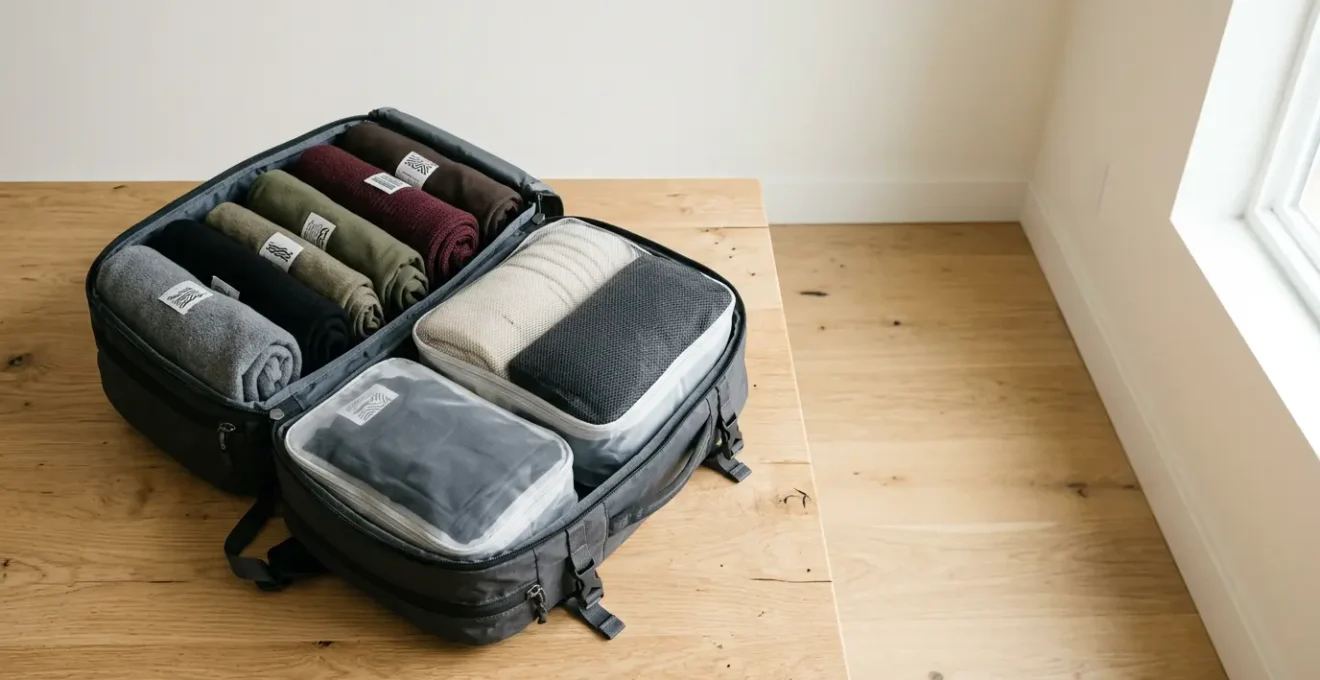
In summary:
- Ditch hard-shell cases for lighter, more flexible soft bags to reclaim up to 2kg of packing weight.
- Master compression techniques like Ranger Rolling and vacuum bags to reduce bulky winter clothes by over 30%.
- Adopt a hybrid system of packing cubes for organisation and compression sacks for maximum space-saving.
- Eliminate the majority of your liquids by switching to solid toiletries, making security a breeze.
- Your clothing is a system, not just outfits. Think in layers: base, mid, and a protective outer shell.
That dreaded email from EasyJet arrives two days before your trip. The subject line: “Manage Your Booking.” You know what it means. It’s the final shakedown, the last chance to pay the £48 tribute for a checked bag before the price skyrockets at the airport. For the chronic over-packer, this moment is pure anxiety. You’ve tried the usual advice: wearing your bulkiest coat, stuffing things into pockets, sitting on your suitcase to zip it. But for a two-week winter trip, it feels impossible. How can you possibly fit bulky sweaters, proper shoes, and toiletries into a tiny 10kg cabin bag?
The common wisdom on minimalist packing often misses the point. It focuses on sacrifice, on leaving things behind. But what if the real secret wasn’t about packing less, but about packing smarter? What if the true goal wasn’t just to avoid a fee, but to eliminate the stress, the heavy lifting, and the waiting at the baggage carousel? The problem isn’t your stuff; it’s your system. The anxiety you feel isn’t about the 10kg limit; it’s the “Anxiety Tax” you pay for inefficiency.
This guide isn’t another list of things you can’t bring. It’s a fundamental shift in thinking. We will deconstruct the common packing mistakes, from the suitcase you choose to the way you fold your clothes. We’ll explore the strategic systems used by decade-long carry-on-only travellers to build a packing method that prioritises freedom, efficiency, and comfort over everything else. Prepare to learn not just how to fit more into less space, but how to make travel feel liberating again.
This article will guide you through the essential systems and gear choices to master carry-on-only winter travel. Below is a summary of the key strategies we’ll cover, from optimising your luggage choice to rethinking your entire travel philosophy.
Summary: A Strategic Approach to 10kg Winter Packing
- Why Hard-Shell Suitcases Waste 20% of Your Usable Cabin Allowance?
- How to Roll and Compress Bulky Sweaters Using Vacuum Travel Bags?
- Packing Cubes vs Compression Sacks: Which Organises Backpacks Better?
- The Liquid Restriction Error That Slows Down Heathrow Security
- How to Select 3 Pairs of Shoes for 5 Different Formal Occasions?
- Why Standard UK Camping Tents Collapse Under Patagonian Winds?
- Why Airport Security Wait Times Make Short-Haul Flights Slower Than Trains?
- Mastering European Express Trains: Swapping EasyJet for High-Speed Rail Comfort
Why Hard-Shell Suitcases Waste 20% of Your Usable Cabin Allowance?
The first mistake most over-packers make happens before a single item is packed: they choose a hard-shell suitcase. Marketed as durable and sleek, these bags are the silent killers of your baggage allowance. The rigid polycarbonate shell comes with a significant, hidden “weight penalty.” According to industry comparisons, the average hard shell carry-on weighs 7-9 lbs (3.2-4kg) when empty. With a 10kg limit, you’ve sacrificed up to 40% of your allowance to the bag itself, leaving you with a mere 6kg for everything else. In contrast, a quality soft-shell bag weighs closer to 5-7 lbs, instantly giving you back 1-2kg of precious capacity.
Beyond weight, hard shells present a major logistical problem in a typical hotel room: the clamshell design. They require double the floor space to open fully, forcing a constant, frustrating shuffle. Soft-sided luggage, with its single, lid-style opening and external pockets, allows you to grab a passport or a jacket without exposing your entire wardrobe. Furthermore, the supposed “protection” of a hard shell is often a myth. A quality soft bag has a natural “squish factor,” allowing it to compress into tight overhead bins, whereas a rigid case might be rejected. For protecting electronics, padded compartments in a well-designed soft bag often provide better shock absorption than a hollow plastic box. The choice is clear: to maximise your allowance, you must first minimise your bag’s own footprint.
How to Roll and Compress Bulky Sweaters Using Vacuum Travel Bags?
Winter packing’s greatest challenge is bulk. A single wool sweater can occupy the space of five t-shirts. The solution isn’t to leave the sweater behind, but to conquer its volume. While vacuum bags offer maximum compression, a more versatile and equipment-free technique is the foundation of efficient packing: the Ranger Roll. This method, perfected by the U.S. Army, creates incredibly tight, uniform “burritos” of clothing. A case study on packing techniques found that the Ranger Roll method can reduce the volume of clothing by up to 30% compared to simple folding, while also minimising wrinkles. It works exceptionally well for t-shirts, trousers, and base layers.
For your bulkiest items like fleece or wool sweaters, you can combine rolling with vacuum travel bags for maximum effect. These are not the type that require a vacuum cleaner, but simple, heavy-duty plastic bags with a one-way valve. You place the rolled item inside, seal the bag, and then roll the bag itself tightly to force all the air out through the valve. The result is a rock-solid, compressed brick of fabric that takes up a fraction of its original space. This system—Ranger Rolling for everyday items and vacuum bags for the absolute bulkiest—is the key to fitting two weeks’ worth of winter clothing into a carry-on.
As the image demonstrates, the technique involves precise folds to create a pocket, which is then used to lock the roll in place, preventing it from unravelling inside your bag. Mastering this will fundamentally change how you view the capacity of your luggage. You are no longer just filling a bag; you are engineering space.
Packing Cubes vs Compression Sacks: Which Organises Backpacks Better?
Once you’ve compressed your clothes, the next challenge is organisation. Simply stuffing compressed rolls into a bag creates chaos. This is where two key tools come into play: packing cubes and compression sacks. They may seem similar, but they serve two very different functions, and the expert traveller knows how to leverage both. Packing cubes are about organisation and accessibility. They are rectangular, zippered pouches that act like drawers within your luggage, allowing you to categorise items (e.g., tops, bottoms, underwear) and access them without disturbing everything else.
Compression sacks, on the other hand, are purely about maximum space-saving. They are typically lightweight, nylon stuff sacks (often used for sleeping bags) that can reduce the volume of soft items by 30-50%. However, this comes at a cost: they create dense, irregular “blobs” that are hard to stack and require full unpacking to access anything inside. They are also only suitable for synthetic items or down, as they can damage the structure of natural fibres like wool over time.
The following table breaks down the core differences:
| Feature | Packing Cubes | Compression Sacks |
|---|---|---|
| Best For | Organization & quick access | Maximum space saving |
| Volume Reduction | 10-15% | 30-50% |
| Material Suitability | All fabrics | Synthetic only (damages down) |
| Access Speed | Instant via zipper | Requires full unpacking |
| Weight | 50-100g per cube | 30-70g per sack |
| Structure | Maintains shape | Becomes formless blob |
So, which is better? The guru-level answer is to stop seeing it as a competition. As noted by travel gear experts, a hybrid system is the most effective approach. Use one or two structured packing cubes for your primary, wrinkle-prone clothes that you need to access easily. Then, use soft compression sacks for bulky items like a down jacket, socks, and underwear, stuffing them into the irregular gaps left around the cubes. This combination gives you the best of both worlds: the structure and organisation of cubes, and the raw space-saving power of sacks.
The Liquid Restriction Error That Slows Down Heathrow Security
The single biggest friction point in modern air travel is the security checkpoint, and the 100ml liquid rule is its primary cause of delay. Many travellers assume the rules will be relaxed soon with new technology. However, recent security technology surveys show that only 15% of European airports have new CT scanners that allow larger liquids as of 2024. For the foreseeable future, the little transparent bag remains a reality. The common mistake is trying to play by the rules by decanting products into tiny, messy travel bottles. The minimalist guru’s goal is different: to eliminate the liquid bag entirely.
This is achieved by a systematic replacement of every liquid product with a solid alternative. This isn’t about sacrifice; it’s about discovering a new class of high-performance, travel-friendly products that are lighter, less messy, and bypass restrictions completely. By making a few simple swaps, you can almost completely “zero out” your liquids bag, allowing you to walk through security without ever having to unpack it. This not only saves you time and stress but also frees up your precious 100ml allowance for any truly irreplaceable liquid items.
Your Action Plan: Solid Swaps to Bypass Liquid Restrictions
- Replace shampoo/conditioner with solid bars (saves 200ml of liquid allowance).
- Switch to toothpaste tablets or powder instead of tubes (eliminates 75ml).
- Use a solid perfume stick or wax-based fragrance (saves 50-100ml).
- Pack a powder deodorant or a crystal stone (removes up to 150ml from your liquids bag).
- Choose a classic bar soap over body wash for an easy 100ml saving.
- Carry a solid moisturiser bar or stick for face and body (eliminates another 100-200ml).
Adopting even half of these changes can make the security process dramatically smoother, transforming a point of high anxiety into a seamless part of your journey.
How to Select 3 Pairs of Shoes for 5 Different Formal Occasions?
Shoes are the bane of the one-bag traveller. They are bulky, heavy, and awkward to pack. A typical traveller might pack walking shoes, dress shoes, and maybe a pair of boots, instantly consuming half their bag. The minimalist solution is not to go barefoot to dinner, but to apply a ruthless, function-first selection process. The goal is maximum versatility from minimum-weight items. A successful travel blogger proved this with the “One Boot Strategy” on a two-week winter trip to Norway. She travelled with just one pair of high-quality, waterproof leather boots and a pair of packable indoor slippers weighing only 100g. The boots were stylish enough for city restaurants, yet rugged enough for light hiking, while the slippers covered all indoor needs. This simple, strategic choice saved an estimated 2-3kg of luggage weight.
For a two-week trip with varied occasions, the “one boot” rule can be expanded to a three-item system:
- The Workhorse: A stylish, waterproof leather or high-quality synthetic boot (e.g., a Chelsea boot or sleek lace-up). This is worn on the plane. It handles walking, rain, and can be dressed up for most smart-casual dinners or events.
- The Lightweight Runner/Walker: A modern, minimalist trainer with a dark or neutral-coloured sole. This serves for exercise, long sightseeing days, and more casual settings. They are lightweight and can be compressed in your bag.
- The “Just in Case” Formal: For men, this could be a pair of ultra-lightweight, packable leather dress shoes or loafers. For women, a pair of elegant flats. These are for the truly formal occasions where the boots won’t cut it.
To pack the extra two pairs, you must use their internal space. The boots or shoes in your bag should never be empty.
As shown, the cavity of each shoe is prime real estate. Stuff them with socks, chargers, a small toiletry pouch, or any other small items. This not only saves space but also helps the shoes maintain their shape, turning dead volume into an integral part of your packing system.
Why Standard UK Camping Tents Collapse Under Patagonian Winds?
The title of this section may seem out of place, but it holds the most important metaphor for winter travel clothing. A tent’s job is to protect you from the elements. Your clothing system must do the same. As one outdoor gear expert eloquently puts it, you must think of your layers as a “tent for your body.” In this system, each layer has a specific job, just like the parts of a high-performance tent.
- The Base Layer is the inner tent. Its primary job is not warmth, but moisture management. It must be made of a material like merino wool or a technical synthetic that wicks sweat away from your skin to keep you dry. A wet base layer in winter is a recipe for getting cold, fast.
- The Mid-Layer is your sleeping bag. This is your insulation. It should be something light and warm that traps air, like a fleece jacket, a down vest, or a wool sweater. This is the layer you add or remove to regulate your temperature.
- The Outer Shell is the rainfly. This layer’s only job is to protect you from wind and rain. It should be lightweight, waterproof, and windproof. It doesn’t need to be insulated itself; that’s the job of the mid-layer.
Thinking this way stops you from packing bulky, single-purpose items. Instead of a massive, heavy winter parka, you pack three lighter, more versatile layers that can be combined in multiple ways to handle anything from a cool evening to a freezing blizzard. This system is not only warmer and more adaptable, but it’s also far easier to pack. Your bulky insulated “shell” is worn on the plane, and the other layers are easily rolled and compressed.
Key takeaways
- Your luggage is part of your allowance: Choose a lightweight soft-shell bag to save up to 2kg over a hard-shell case.
- Volume is your enemy: Use Ranger Rolling and compression bags to drastically reduce the size of bulky winter clothing.
- Embrace the solid swap: Replace liquid toiletries with solid alternatives to fly through security and free up packing space.
Why Airport Security Wait Times Make Short-Haul Flights Slower Than Trains?
The trend towards carry-on-only travel is growing, with recent travel surveys indicating that nearly 3 in 10 travelers now aim to avoid checked bags. This shift isn’t just about saving money; it’s about reclaiming time. The biggest time-sink in modern air travel is not the flight itself, but the “friction” on either side—especially security. A perfectly packed carry-on is rendered useless if you have to tear it apart at the scanner. This is where the next-level packing system comes into play: the “Two-Bag Security Strategy.”
This strategy acknowledges that you have two pieces of allowance: a main carry-on bag and a smaller “personal item” like a backpack or tote. A frequent traveler perfected a system to leverage this: the main 10kg carry-on contains *only* clothing and non-essential items. It is perfectly packed using cubes and compression sacks and is never, ever opened at the airport. The personal item becomes a dedicated “security shuttle.” It holds all the items that need to be removed for scanning: the laptop goes in a lie-flat pocket, the (now tiny) liquids pouch in an external pocket for instant access, and documents in a front compartment. A case study of this method found it reduces the user’s time in the security line from an average of 12 minutes down to under 3 minutes. You place your personal item and your coat in a bin, slide your unopened main bag onto the belt, and walk through.
This is the essence of system-thinking. It identifies the single biggest point of friction in the journey and designs a solution specifically to eliminate it. Your packing is no longer just about fitting things in a bag; it’s about engineering a smooth, stress-free passage through the airport environment.
Mastering European Express Trains: Swapping EasyJet for High-Speed Rail Comfort
You’ve done it. You’ve mastered the minimalist system. Your 10kg bag is a marvel of efficiency. You can now breeze through airports, avoiding fees and baggage carousels. But this new skill unlocks a higher level of travel enlightenment: realising that for many short-haul European trips, the plane is now the inferior option. The anxiety of budget airlines—the restrictions, the penalties, the cattle-herding process—is in stark contrast to the freedom of high-speed rail.
With a 10kg bag, you are perfectly equipped to thrive in the world of train travel. There are no liquid restrictions, no weigh-ins, and no need to arrive two hours early. You can simply walk on, place your perfectly compact bag above your seat, and enjoy the journey from city centre to city centre. This is the ultimate reward of minimalist packing. As one expert puts it:
Budget airlines are about restriction, anxiety, and penalties. High-speed rail is about efficiency, freedom, and comfort. The goal of minimalist packing isn’t to feel restricted, but to achieve a system so streamlined that it feels liberating.
– Minimalist Travel Expert, Carryology Packing Guide
This philosophy extends to your behaviour at the destination. A minimalist traveller knows it’s sometimes smarter to buy than to pack. Don’t waste 200g of weight and awkward space on a cheap umbrella; buy one for €5 if it rains. Use the hotel’s laundry service for a mid-trip refresh instead of packing 14 pairs of socks. The goal is not just to travel with a lighter bag, but with a lighter mindset, free from the “just in case” mentality that weighs us all down.
Your journey to becoming a minimalist traveller begins not when you arrive at the airport, but right now, with the decision to build a better system. Start by auditing your gear, practising these techniques, and prepare to discover a form of travel that is lighter, cheaper, and infinitely less stressful.