In summary:
- Ditch taxis and master the Suica card to avoid transport costs spiralling out of control.
- Choose your accommodation in Shinjuku for better last-train options, saving on late-night travel.
- Eat your main meal at lunchtime with ‘teishoku’ sets to cut your daily food bill by more than half.
- Prepare before you fly by installing an eSIM to ensure you have data and maps the moment you land.
- Use convenience stores as strategic ‘safe zones’ to navigate without looking like a vulnerable tourist.
The thought of Tokyo ignites the imagination: a dazzling metropolis of neon-drenched skyscrapers, ancient temples, and unparalleled culture. For a British first-timer, planning a two-week trip is thrilling, but it often comes with a significant fear—the sheer cost. With a budget of £1,500, the challenge seems immense. How do you experience the best of this hyper-modern city without your funds vanishing into the complex web of transport, dining, and daily expenses?
Most advice centres on generic tips like “eat at convenience stores” or “buy a JR Pass.” Whilst well-intentioned, this advice often misses the mark. A Japan Rail Pass, for example, is a costly mistake if you’re staying within Tokyo. The real threat to your budget isn’t the one-off big purchases, but the small, daily ‘budget leaks’ that accumulate unnoticed. A single wrong turn at night, a tourist-trap meal, or choosing the wrong neighbourhood to stay in can collectively drain hundreds of pounds from your travel fund.
This guide takes a different approach. We won’t just tell you what to do; we’ll show you how to build a ‘financial firewall’ against these common spending traps. It’s not about being cheap or skipping the highlights. It’s about being strategic. By understanding the small decisions that have the biggest financial impact—from mastering the public transport system to knowing the cultural nuances of dining out—you can navigate Tokyo with confidence, ensuring your £1,500 budget not only lasts but allows you to savour every moment.
This article will provide a clear, practical roadmap to mastering your Tokyo budget. We will break down the crucial areas of spending, offering actionable strategies to give you complete control over your expenses from the moment you land to your final day of exploration.
Summary: A Strategic Guide to Tokyo on a £1,500 Budget
- Why Relying on Tokyo Taxis Will Ruin Your £1,500 Travel Budget?
- How to Use the Suica Card for Seamless Travel Across 15 Tokyo Wards?
- Shinjuku or Shibuya: Where Should First-Time UK Travellers Stay?
- The Dining Mistake That Costs British Tourists £50 per Meal
- When to Visit the Shibuya Crossing to Avoid the 6 PM Rush Hour?
- The Street Navigation Error That Flags You as a Vulnerable Tourist
- How to Install an eSIM Before Landing to Guarantee Instant Uber Access?
- Thriving in Foreign Environments: How to Beat Culture Shock in 48 Hours?
Why Relying on Tokyo Taxis Will Ruin Your £1,500 Travel Budget?
For a first-time visitor, the labyrinthine Tokyo Metro can feel intimidating, making the convenience of a taxi seem like a tempting alternative. However, hailing a cab is the single fastest way to derail your £1,500 budget. The base fare is high, but the real damage comes from hidden costs and surcharges. For instance, a crucial detail for night owls is that taxi fares in Tokyo increase by 20% between 10 PM and 6 AM, turning a late-night journey back to your hotel into a significant expense.
The cost difference when compared to Tokyo’s world-class public transport is staggering. A short trip that might cost a few pounds on the metro can easily cost ten times more in a taxi. This isn’t a minor difference; it’s a fundamental budget leak that can cripple your daily spending allowance.
To put this into perspective, a recent analysis highlights the stark contrast in costs. A simple journey from one popular district to another demonstrates just how quickly taxi fares add up, transforming what should be a minor travel expense into a major outlay.
| Journey Type | Taxi Cost | Metro Cost | Savings |
|---|---|---|---|
| Shibuya to Shinjuku (3km) | ¥1,500 | ¥170 | ¥1,330 (£8.50) |
| Asakusa to Tokyo Station (5km) | ¥2,620 | ¥200 | ¥2,420 (£15.50) |
| Airport to City (Narita Express) | ¥23,000 | ¥3,070 | ¥19,930 (£127) |
Case Study: The Only Time a Taxi Makes Sense
While daily use is unaffordable, a taxi can be strategic upon arrival. Tokyo’s airports offer fixed-rate services to central zones (¥5,000-¥8,000). A group of three travellers arriving late at Narita with heavy luggage would face a difficult journey on the last train. Instead of each paying ¥3,070 for the Narita Express and struggling with bags, splitting an ¥8,000 fixed-rate taxi becomes a cost-effective and stress-free alternative, demonstrating a smart use of an otherwise expensive option.
This illustrates a core principle of budget travel in Tokyo: taxis are a tool for specific situations, like a group arrival with luggage, not a default mode of transport. Relying on them for daily travel is a guaranteed way to exhaust your funds prematurely.
How to Use the Suica Card for Seamless Travel Across 15 Tokyo Wards?
If taxis are the budget leak, the Suica card (or its counterpart, the Pasmo) is the financial firewall. This rechargeable smart card is your single key to unlocking almost all of Tokyo’s public transport, from JR lines and subways to buses. You simply tap it on the card reader at the ticket gate when you enter and tap again when you exit; the exact fare is automatically deducted. This eliminates the need to decipher complex fare maps and queue for single tickets, saving you time and preventing costly mistakes.
For a traveller staying exclusively within Tokyo, the Suica is far superior to the often-recommended Japan Rail (JR) Pass. The JR Pass is designed for long-distance travel on the Shinkansen (bullet train) and is an expensive and unnecessary purchase if your itinerary is focused on the capital. A Suica operates on a pay-as-you-go basis, ensuring you only pay for what you use.
While there are tourist-oriented travel passes available, they require careful calculation to be worthwhile. For example, analysis shows that Tokyo Subway Tickets offer unlimited travel for ¥800-1,500 for 24-72 hour periods. This can be economical if you plan a day packed with long-distance subway journeys, but for most days involving walking and exploring a single neighbourhood, the Suica’s pay-as-you-go model is often cheaper and offers more flexibility, as it also works on JR lines and buses which the subway ticket does not.
The best strategy is to get a Suica card immediately upon arrival at the airport. You can load it with an initial ¥5,000 to cover your first few days of travel and airport transfer. The card can also be used at most convenience stores, vending machines, and even some restaurants, making it a virtual wallet and further streamlining your daily transactions.
Shinjuku or Shibuya: Where Should First-Time UK Travellers Stay?
Your choice of neighbourhood is more than a matter of taste; it’s a critical budget decision that can save you significant money and stress. For first-time British travellers, the debate often boils down to two iconic districts: Shinjuku and Shibuya. Both offer a vibrant taste of Tokyo, but for the budget-conscious visitor, Shinjuku is the smarter choice. The primary reason is transport logistics. Shinjuku Station is the world’s busiest transport hub, meaning you have more train lines and, crucially, more late-night options to get back to your accommodation after a long day of exploring.
Missing the last train in Tokyo (typically around midnight) forces you into an expensive taxi ride, a classic budget leak. Staying in Shinjuku provides a wider safety net. As travel expert Helena Bradbury notes, this logistical advantage makes it a more forgiving base for newcomers.
Shinjuku offers more late-night train options, making it a slightly ‘safer’ bet for first-timers prone to losing track of time.
– Helena Bradbury, The best 3 day Tokyo itinerary (budget friendly)
While Shibuya pulsates with youth culture and trends, its accommodation tends to be slightly pricier, and its transport links, while excellent, are less comprehensive than Shinjuku’s for late-night travel. Shinjuku also offers a better balance of atmosphere, with bustling entertainment areas like Kabukicho on one side and the tranquil Shinjuku Gyoen National Garden and quieter business districts on the other, providing a respite from the sensory overload.
A direct comparison reveals how these factors impact a first-time visitor’s experience and budget, as detailed in an analysis from a Japan travel cost guide.
| Factor | Shinjuku | Shibuya |
|---|---|---|
| Vibe | Business district with quiet zones | Non-stop youth energy |
| Budget Hotels | ¥6,000-12,000/night | ¥8,000-15,000/night |
| Last Train Options | Multiple lines until 00:30 | Fewer late options |
| Morning Atmosphere | Quiet business cafes | Already buzzing by 8am |
| Best For | Introverts, first-timers | Extroverts, party seekers |
For a British traveller aiming to control costs and minimise logistical stress, Shinjuku offers a superior strategic base. The lower average cost of budget hotels combined with the robust transport network provides a solid foundation for your £1,500 budget.
The Dining Mistake That Costs British Tourists £50 per Meal
Dining in Tokyo can range from incredibly affordable to eye-wateringly expensive. The most common and costly mistake tourists make is treating lunch and dinner as interchangeable. In Japan, many restaurants offer heavily discounted set menus at lunchtime called ‘teishoku’. An evening meal that could cost ¥2,500 or more can often be found as a lunch set for around ¥1,000, including a main dish, rice, miso soup, and pickles.
Failing to adopt the ‘teishoku strategy’—making lunch your main meal of the day—is a massive budget leak. A couple dining out could save over £20-£30 per day simply by shifting their main sit-down meal to midday. As official travel guides confirm, Japanese restaurants typically charge significantly less for lunch sets than for equivalent evening meals. This isn’t just a small discount; it’s a fundamental part of Japanese dining culture that savvy travellers can leverage.
For dinner, embrace the culture of high-quality, affordable food from convenience stores (‘konbini’), department store basements (‘depachika’), or budget-friendly chain restaurants. This allows you to have a delicious and filling evening meal for under £10, preserving your budget for other experiences.
Case Study: Mastering Budget Chain Restaurants
Tokyo is filled with exceptional chain restaurants that deliver quality meals at low prices. For example, ‘family restaurants’ like Saizeriya offer surprisingly good Italian-inspired dishes from just ¥300-600. For a more traditional Japanese meal, chains like Yoshinoya and Matsuya serve hearty rice bowls (donburi) for between ¥400-800. For a group, an ‘izakaya’ (Japanese pub) like Torikizoku is a fantastic option, where every single food and drink item on the menu is a flat ¥360, allowing a group to eat and drink well for around ¥1,500 per person.
Other hidden costs to watch for include ‘otooshi,’ a small, compulsory appetiser served at many izakayas that functions as a table charge (typically ¥300-¥1,000 per person), and cover charges at small bars in areas like Golden Gai. Always be aware of these potential additions to your bill.
When to Visit the Shibuya Crossing to Avoid the 6 PM Rush Hour?
The Shibuya Crossing is the pulsating heart of modern Tokyo, an unmissable spectacle of organised chaos. At peak times, the world’s busiest pedestrian crossing handles up to 3,000 people in a single light change. Experiencing this is a must, but visiting during the 6 PM weekday rush hour can be an overwhelming and stressful ordeal for a first-timer. The sheer density of commuters makes it difficult to savour the moment or take photos. To get the best experience without the intense crush, timing is everything.
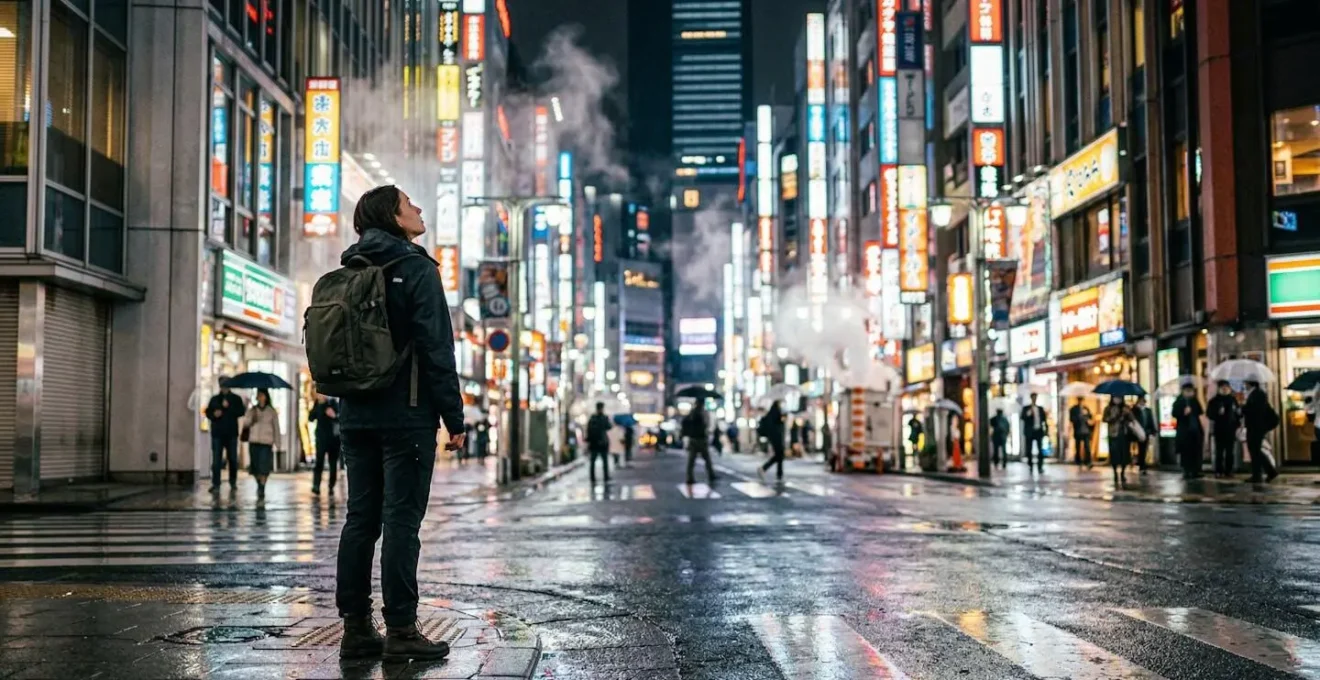
For that iconic, high-energy feeling with slightly more manageable crowds, a Sunday morning between 10 AM and 11 AM is ideal. You’ll still see a massive number of people, but the atmosphere is more relaxed, with shoppers and tourists rather than hurried commuters. Alternatively, for a completely different and more cinematic vibe, visit on a rainy evening. The reflection of neon lights on the wet pavement, combined with a sea of colourful umbrellas, creates a breathtaking, ‘Blade Runner’-esque scene that is often more memorable than the standard daylight view.
Finding the right vantage point is also crucial. Instead of just being in the scrum, you can get a fantastic free view from above. The walkway connecting the JR Station to the Shibuya Mark City building offers a perfect elevated perspective. For those willing to spend a little, the Shibuya Sky observation deck provides an unparalleled aerial view, but it’s best visited early in the morning to avoid long queues.
Here are some of the best strategies for experiencing the crossing:
- Visit on a Sunday morning (10-11 AM) for an iconic but less frantic version of the scramble.
- Use the free, elevated walkway between the JR station and the Mark City building for great photos.
- Go on a rainy evening to capture cinematic umbrella patterns and neon reflections.
- For minimal crowds and a quiet atmosphere, arrive on a weekday morning before 8 AM.
- For the ultimate aerial shot, book the Shibuya Sky observation deck for an early morning slot.
The Street Navigation Error That Flags You as a Vulnerable Tourist
Getting lost in Tokyo’s sprawling, unnamed streets is a rite of passage. However, *how* you handle being lost can make the difference between a minor inconvenience and flagging yourself as a vulnerable tourist. The common mistake is to stop dead in the middle of a busy pavement, pulling out your phone and looking confused. This immediately marks you as a disoriented visitor and can make you a target for touts or scams, especially in entertainment districts.
The key is to navigate with purpose, even when you’re unsure of your direction. Instead of freezing on the spot, adopt the local behaviour: step to the side, close to a building wall or shop front, before consulting your map. This simple act makes you less of an obstruction and helps you blend in. Inside sprawling train stations, ignore your phone’s GPS (which won’t work well) and learn to trust the excellent colour-coded signs and exit numbers.
Case Study: Using Konbini as Navigation Safe Zones
Tokyo’s 24-hour convenience stores (7-Eleven, FamilyMart, Lawson), located every few hundred metres, are the ultimate ‘navigation safe zones.’ If you’re lost, don’t stand on a street corner. Instead, step inside a konbini. You can buy a cheap ¥150 drink, use their often-free WiFi to check your maps, and even ask the staff for directions using a translation app. You appear as a regular customer, giving you a safe, well-lit space to recalibrate without looking lost and vulnerable on the street.
This proactive approach to navigation is a crucial part of staying safe and feeling confident. Creating a simple protocol for what to do when you feel disoriented can transform your experience of exploring the city.
Your 5-Step Street Smarts Protocol: Navigating Tokyo with Confidence
- Initial Action: When lost, immediately step to the side against a building or into a shop entrance before checking your phone.
- Station Strategy: Inside stations, ignore GPS and follow the official colour-coded line signs and numbered exit signs.
- Pre-emptive Planning: Before leaving your hotel, take a screenshot of your destination area on an offline map.
- Observation Tactic: During rush hour, observe and follow the general flow of locals; they instinctively know the most efficient routes.
- Seeking Help: For official and reliable directions, look for a ‘koban’ (police box), which are small local police stations found near most train stations.
How to Install an eSIM Before Landing to Guarantee Instant Uber Access?
One of the most stressful moments for a traveller is landing in a new country with no mobile data. You can’t check maps, contact your hotel, or access ride-sharing apps. Relying on spotty airport WiFi while surrounded by crowds is a recipe for anxiety. The solution is to set up an eSIM before you even leave the UK. An eSIM is a digital SIM card that you can install on your phone, giving you instant data access the moment you land.
This simple act of preparation is a cornerstone of a stress-free arrival. Having data means you can immediately look up your train route on Google Maps or, if necessary, use a taxi app. It’s a critical part of your financial and logistical firewall. The process is straightforward and should be done a day or two before your flight.
Here is a step-by-step guide to ensure you’re connected from the moment the plane doors open:
- Purchase an eSIM from a reputable provider like Airalo or Holafly at least 24 hours before your departure.
- Screenshot the QR code and any manual installation instructions they email you.
- Install the eSIM on your phone whilst you are still in the UK and connected to WiFi, but keep it deactivated in your settings.
- Download an offline Google Map of the greater Tokyo area to your phone as a backup.
- Install the Go and S.Ride apps, which are the dominant and often cheaper taxi-hailing apps in Tokyo.
- Immediately upon landing in Japan, before even leaving the plane’s WiFi, activate your newly installed eSIM in your phone’s settings.
It’s also important to note that while Uber exists in Tokyo, its presence is limited and it is often not the best or cheapest option, a fact many first-time visitors don’t realise.
Uber’s presence in Japan is limited and often more expensive than local alternatives. Apps like JapanTaxi, Go, and DiDi connect to local taxi fleets and offer similar services at competitive prices, especially during peak hours when Uber surge pricing kicks in.
– Japan Private Drivers
Having an eSIM ready empowers you to make the smartest choice on arrival, whether it’s navigating the train system or using a more cost-effective local taxi app.
Key Takeaways
- Master Public Transport: The Suica card is your key. Avoid taxis and understand that a JR Pass is not for Tokyo-only travel.
- Dine Strategically: Make lunch your main meal with ‘teishoku’ sets and embrace budget chains or konbini for dinner to slash food costs.
- Plan Proactively: Your trip’s success is determined before you leave. Choose your neighbourhood wisely (Shinjuku) and set up an eSIM for a stress-free arrival.
Thriving in Foreign Environments: How to Beat Culture Shock in 48 Hours?
Beyond the financial planning, thriving in Tokyo requires mental and emotional preparation. Culture shock is a real phenomenon, and the sensory overload of Japan’s capital can be intense. The language barrier, the different social etiquette, and the sheer scale of the city can feel overwhelming. However, you can proactively manage this by following a simple 48-hour acclimatisation protocol designed to build confidence through small, manageable wins.
The goal is not to see everything at once, but to gradually expand your comfort zone. The first day should be about conquering your immediate vicinity. A simple “konbini mission”—successfully entering a convenience store and purchasing a drink and an onigiri (rice ball)—is a huge confidence booster. It’s your first successful transaction and interaction in a completely foreign environment.
This structured approach replaces anxiety with a sense of accomplishment. By Day 2, you’ll be ready for a slightly bigger challenge, like a short metro journey. It’s about building a foundation of positive experiences that empowers you to tackle the rest of your trip.
- Day 1 Morning: Stay within a 500-metre radius of your hotel. Find a local coffee shop and just sit and observe.
- Day 1 Afternoon: Complete your first ‘konbini mission’ – go to a convenience store and buy an onigiri and a drink.
- Day 1 Evening: Take a one-hour walk through your neighbourhood with no destination in mind, just to absorb the atmosphere.
- Day 2 Morning: Take a single return journey on the metro to a nearby station to familiarise yourself with the process.
- Day 2 Afternoon: Visit one ‘easy win’ attraction, like the spacious and straightforward Senso-ji Temple in Asakusa.
- Day 2 Evening: Attempt your first restaurant meal, ideally one with a picture menu or plastic food displays.
It’s also vital to understand key cultural differences. For example, the perceived lack of small talk from service staff can be misread by Westerners.
The lack of small talk from service staff is not rudeness, but a cultural norm of efficiency and respect for privacy.
– Lonely Planet Tokyo Guide
Understanding this reframes the interaction from a negative experience to a cultural observation, which is the essence of beating culture shock. You move from feeling alienated to feeling like an informed observer.
With these strategies in hand, the daunting prospect of navigating Tokyo on a £1,500 budget transforms into an exciting and manageable challenge. You are now equipped not just with tips, but with a framework for making smart, confident decisions. The next logical step is to start building your own personalised itinerary based on these principles.