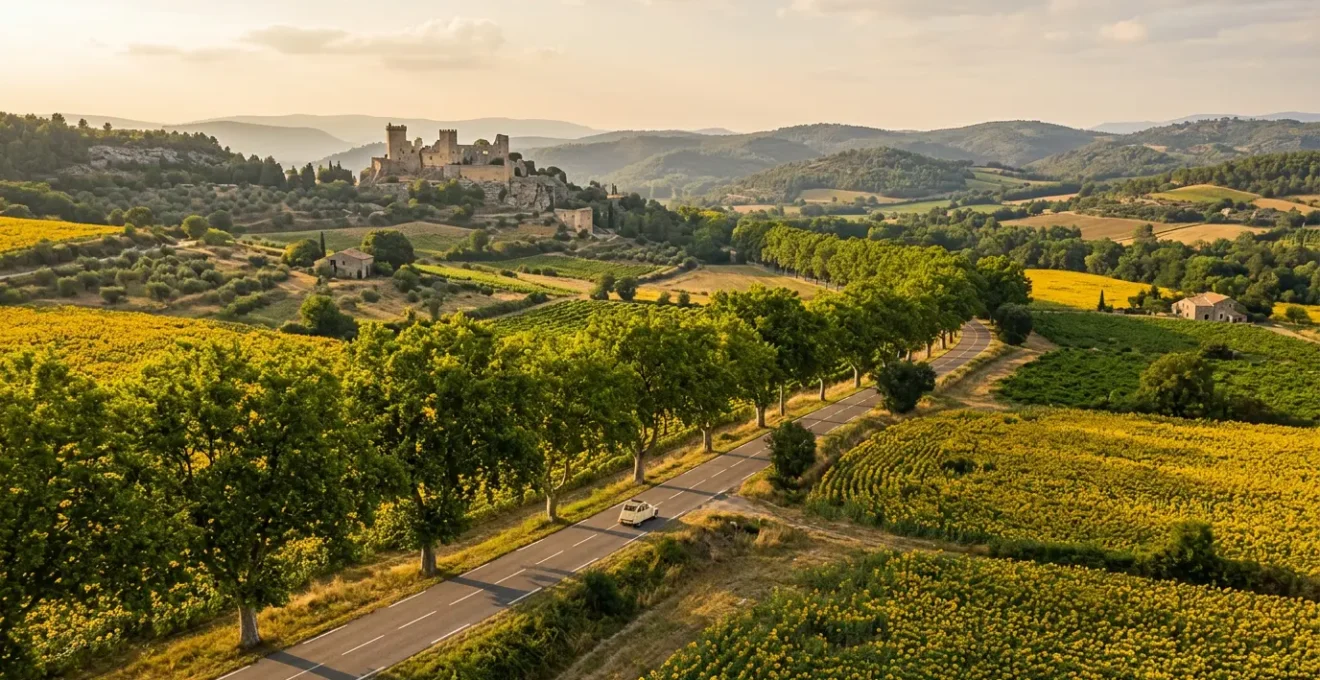
The best French road trip isn’t about avoiding tolls; it’s about intentionally seeking the discoveries the autoroute conceals.
- Authentic ‘Menu Ouvrier’ lunches often cost less than a motorway sandwich and offer a true taste of regional France.
- A few strategic waypoints on your Sat-Nav are more effective at creating a scenic journey than the default ‘avoid tolls’ button.
Recommendation: Plan your journey around the rhythm of rural France—timing your fuel stops and lunch breaks—for a truly immersive experience.
For many Francophile UK drivers, the ritual is the same. You roll off the ferry at Calais, the Sat-Nav barks its first instruction, and you’re funnelled onto the anodyne A16 or A26. For the next several hours, the romance of France is reduced to a grey ribbon of tarmac, punctuated only by overpriced service stations. The promise of discovering hidden châteaux and quaint village bistros seems to vanish in the rearview mirror. The common wisdom is to simply tick the “avoid tolls” box on your navigation app, but this often leads to a meandering, inefficient route through uninspiring suburbs.
The truth is, there’s an art to navigating France’s historic road network. It’s a conscious choice that goes beyond mere cost-saving. What if the goal wasn’t just to avoid a fee, but to trade sterile efficiency for genuine cultural and gastronomic discovery? The real value lies not in the cost-per-kilometre, but in the experiences-per-hour. This involves understanding the subtle hierarchy of French roads, from the grand Routes Nationales (N-roads) that connect major towns to the charming Routes Départementales (D-roads) that weave through the deep countryside.
This guide is your key to unlocking that authentic France. We’ll show you not just how to bypass the tolls, but how to master the ‘slow-road’ system. You will learn how to configure your navigation like an expert, how to spot the best value lunches that tourists never find, and how to sync your travel plans with the unique rhythm of rural French life. It’s time to reclaim the journey and turn your drive into the destination.
To help you master this art of slow travel, this article is structured to guide you through the essential strategies. The following summary outlines the key topics we will cover, from finding the best food to mastering your navigation and understanding the local customs that make all the difference.
Summary: A guide to mastering France’s scenic routes for an authentic journey
- Why the Iconic Route Nationale 7 Offers Better Food Than Any Service Station?
- How to Configure Your Sat-Nav to Strictly Follow the Routes Nationales?
- Autoroute vs Route Départementale: Which Suits a 14-Day Slow Travel Itinerary?
- The Sunday Driving Mistake That Leaves You Without Petrol in Rural France
- When Should You Pull Over for the “Menu Ouvrier” to Get the Best Value Lunch?
- Why Coastal Restaurants Near the Terminal Serve the Worst Overpriced Seafood?
- The Platform Validation Error That Incurs a €50 Fine in Italy
- Mastering European Express Trains: Swapping EasyJet for High-Speed Rail Comfort
Why the Iconic Route Nationale 7 Offers Better Food Than Any Service Station?
The soul of French road travel isn’t found at a chain-brand service station, but in the bustling, unpretentious world of the “routiers” and “restaurants ouvriers.” These establishments are the lifeblood of the country’s professional drivers and local workers, offering incredible value and an authentic taste of regional cooking. Forget the pre-packaged sandwich; here, you’ll find a complete, home-cooked three-course meal, often including wine and coffee, for a price that barely covers a coffee and croissant on the autoroute. It is a world away from the bland, overpriced fare designed for transient tourists.
The star of this culinary show is the “Menu Ouvrier” (worker’s menu). For a price that often hovers around €13 for a traditional workers’ lunch, you get an experience that is authentically French. These menus are not printed for tourists; they are chalked up on a blackboard daily, reflecting what’s fresh and in season. Finding them is part of the adventure, a treasure hunt for the discerning traveller. The key is to know the visual cues that separate a genuine local gem from a tourist trap.
To find these places, you must train your eye to look for the right signals. These are rarely advertised in English and rely on a reputation built over decades. Here are the key indicators you’re in the right place:
- Look for parking lots filled with white commercial vans and trucks between 12:00 and 14:00.
- Check for handwritten daily menus on chalkboards at the entrance, a sign of freshness.
- Spot the absence of multi-language tourist menus; the focus is on serving locals.
- Notice that local French license plates dominate the parking area.
- Find restaurants located on the main N or D roads, but typically just outside the picturesque town centres.
By seeking out these establishments, you’re not just having a meal; you’re participating in a cornerstone of French working life and enjoying regional cuisine at its most honest.
How to Configure Your Sat-Nav to Strictly Follow the Routes Nationales?
Simply ticking the “avoid tolls” box on your GPS is a novice mistake. This function’s logic is crude; it will often divert you onto slow, convoluted routes through industrial estates and residential areas, completely missing the scenic Routes Nationales you intended to drive. The secret to a perfect French road trip lies in “intentional navigation”—actively telling your device where you want to go, rather than passively accepting its laziest suggestion. This requires a slightly more hands-on approach but guarantees a journey that is both beautiful and efficient in its own right.
This hands-on approach transforms your Sat-Nav from a dictatorial commander into a helpful co-pilot. You remain in control of the journey’s character, ensuring you’re tracing the path of an old Roman road or following a river valley, not just dodging a toll booth. The key is to use waypoints not as obstacles, but as tools to sculpt your ideal route.
As you can see, taking a moment to plan your route allows you to be the master of your journey. Instead of being a passive recipient of the fastest algorithm, you become the curator of your own adventure. This multi-stop technique is the single most important skill for slow-travel driving in France.
Your Action Plan: The Multi-Stop Technique for Scenic Routes
- First, enter your final destination to see the default, high-speed autoroute. This is your baseline.
- Using the map, identify 3-4 charming villages or points of interest that lie along your desired N or D road.
- Add these locations as sequential “via points” or “waypoints” to your navigation. This forces the algorithm to thread the route through them.
- Ensure each waypoint is set as a “stop” or “via point” that you must drive through, not a “pass by” suggestion the GPS can ignore if it finds a shortcut.
- Once crafted, save this custom route for future use if your navigation device or app allows it, creating your own personal library of scenic drives.
With this method, you are no longer just avoiding tolls; you are actively choosing beauty, discovery, and a more engaged way of travelling.
Autoroute vs Route Départementale: Which Suits a 14-Day Slow Travel Itinerary?
For a longer, 14-day itinerary, the choice isn’t a simple binary between the fast autoroute and the scenic backroad. The expert slow-traveller knows that the best plan is often a hybrid approach, using each type of road for what it does best. Thinking of it as “Cost-per-Kilometre vs. Experience-per-Hour” helps to make strategic decisions. The autoroute is your tool for covering long, uninteresting distances quickly, while the N and D-roads are for the days dedicated to exploration and discovery.
A successful two-week trip might involve using the autoroute for the first and last days to efficiently get from the ferry terminal to your chosen region and back. This saves precious holiday time and reduces fatigue. Once you’re in the heart of the Dordogne or Provence, you then switch entirely to the N and D-roads for days of village-hopping and sightseeing. The following table breaks down the fundamental trade-offs you’ll be making.
This comparative data, derived from a recent analysis of French driving conditions, clearly illustrates the strategic choice at hand.
| Route Type | Speed Limit | Extra Time per 100km | Toll Cost (avg) | Best For |
|---|---|---|---|---|
| Autoroute (A roads) | 130 km/h | Baseline | €10 per 100km | Long distances, time-critical travel |
| Route Nationale (N roads) | 80-90 km/h | +25-40 minutes | Free | Scenic drives, town connections |
| Route Départementale (D roads) | 80 km/h | +45-60 minutes | Free | Deep countryside exploration |
Case Study: A Hybrid Itinerary for the Dordogne
The 105-mile (170 km) route following the Dordogne River is a prime example. As travel experts note, “It’s a place where medieval villages sit right on the water and castle towers rise out of limestone cliffs.” A balanced 14-day approach would use autoroutes for the initial arrival from Calais (saving 3-4 hours), then switch to D-roads for village-hopping between Sarlat and Beynac on days 2-6. N-roads would be used for medium transfers between regions on days 7-8, and the trip would conclude with a return via autoroute on the final day to ensure you comfortably make your ferry connection.
By using the right road for the right purpose, you get the best of both worlds: maximum time for enjoyment and minimal time spent on tedious transit.
The Sunday Driving Mistake That Leaves You Without Petrol in Rural France
One of the core tenets of embracing slow travel is syncing with the “rhythm of rural France.” This means understanding that life, especially outside the major cities, operates on a different schedule. The most common and frustrating mistake for visiting drivers is underestimating the Sunday shutdown. While the autoroutes, with a network where 76% of French motorways are toll roads and thus have 24/7 services, lull you into a false sense of security, the countryside is different. On a Sunday, many village petrol stations are simply closed.
Running out of fuel on a quiet Sunday afternoon in the middle of nowhere is the fastest way to ruin the romance of a road trip. The charmingly empty roads are only charming when you have a full tank of petrol. The solution is not to panic, but to plan ahead and adopt the strategy of local drivers. The key lies with the large supermarket chains like Auchan, Leclerc, and Carrefour, which are often located on the outskirts of towns. While the stores themselves may be closed on a Sunday, many of their fueling stations are not.
These supermarket stations feature 24/7 automated pumps that accept credit and debit cards. They are almost always significantly cheaper than both autoroute services and the few attended stations that might be open. Making a habit of topping up on a Saturday afternoon becomes a non-negotiable part of the weekend routine for any savvy driver in France. This proactive approach turns a potential crisis into a simple, cost-effective errand.
Here is a simple strategy to ensure you’re never left stranded:
- Before your trip, identify the major supermarket chains along your route: Auchan, Leclerc, Carrefour, Intermarché.
- Use their websites or Google Maps on Saturday evening to locate their 24/7 automated pumps (“station-service 24/24”).
- Make a habit of filling up your tank on Saturday afternoon as a standard precaution, even if you’re not empty.
- Keep a mental list of the nearest autoroute service stations as a last-resort, expensive backup option.
- Consider downloading a French fuel app like ‘Essence&CO’ which can provide real-time data on station availability and prices.
By thinking ahead, you ensure your Sunday is spent discovering hidden gems, not anxiously searching for an open petrol pump.
When Should You Pull Over for the “Menu Ouvrier” to Get the Best Value Lunch?
The golden window for securing a table and enjoying a “Menu Ouvrier” is surprisingly precise: you should be pulling over between 12:15 and 13:00. Arrive before noon and you might find the kitchen not yet ready; arrive after 13:30 and you risk finding the daily specials sold out or the service winding down. In France, lunchtime is a protected, almost sacred, ritual, and the entire local workforce seems to descend on these restaurants in a synchronized wave. Being part of this bustling, convivial atmosphere is a key part of the experience.
This timing is not arbitrary. It reflects the working day of the very people the menu is named after. Unlike a tourist-focused restaurant that serves continuously, a restaurant-ouvrier has one job: to serve a large number of people a good, hot, and quick meal during a specific one-hour window. The value proposition is astonishing when you consider that in more traditional establishments, traditional restaurants can charge between €16 and €28 for a ‘menu du jour’, while the ‘menu ouvrier’ often delivers a more rustic but equally satisfying meal for less.
The scene is a perfect snapshot of French culture: tables packed with workers in high-vis jackets and office shirts alike, lively conversation, and the clatter of cutlery. There’s a shared understanding that this hour is for nourishment and camaraderie. By pulling over at the right time, you are not an observer; you are a participant in this daily spectacle. It’s an immersive cultural experience that you will never find in a sterile autoroute cafeteria, and it’s one of the greatest rewards of choosing the slow road.
Therefore, plan your morning’s drive to arrive at a promising-looking town around 12:15, ready to join the locals for the best value lunch in France.
Why Coastal Restaurants Near the Terminal Serve the Worst Overpriced Seafood?
The paradox of the ferry port is a classic trap for the weary traveller. You’ve just arrived in France, you can smell the sea air, and your first instinct is to find a restaurant with a view of the water for some fresh seafood. Yet, these are often the most disappointing and overpriced meals of a trip. The reason lies in a simple economic principle: “captive audience economics.” These restaurants operate on a model similar to motorway service stations or airport terminals. Their business is based on a constant, high-volume churn of one-time visitors who are time-constrained and have few other obvious choices.
There is little incentive for these establishments to build a reputation for quality or value, as their customer base is perpetually renewed by the next ferry arrival. They don’t rely on repeat business from discerning locals, so the natural pressures that ensure quality and fair pricing are largely absent. The seafood may have been landed just a few hundred metres away, but it often ends up being frozen, poorly prepared, and marked up significantly.
Economic Model: Terminal vs. Fishing Port Restaurants
Ferry terminal restaurants operate on a ‘captive audience’ model. In contrast, restaurants located near the actual ‘port de pêche’ (the working fishing harbour), often just a five-minute drive away, operate on a completely different model. They rely on repeat local customers and a word-of-mouth reputation built on the freshness of their catch and the fairness of their prices. As experts on French dining note, “French restaurants generally offer excellent value. When eating out, most people opt for a ‘menu’, rather than choosing à la carte,” and this is especially true away from the immediate tourist zones.
Your first act upon arriving in France should therefore be to drive past the waterfront tourist traps and head towards the part of town where the actual fishing boats are. There, you’ll find the unpretentious bistros that the fishermen themselves frequent, and you’ll be rewarded with a meal that is both fresher and far better value.
Key takeaways
- The best French road trips are a hybrid, using autoroutes for long-haul and N/D roads for regional discovery.
- Mastering the “multi-stop” technique on your Sat-Nav is the key to crafting a truly scenic route.
- Embrace the rhythm of rural France: fill up with petrol on Saturdays and aim for a “Menu Ouvrier” lunch between 12:15 and 13:00.
The Platform Validation Error That Incurs a €50 Fine in Italy
While our focus is on the open road, the philosophy of slow travel often involves integrating other modes of transport. A common mistake for tourists across Europe, particularly in Italy and on French regional trains (TER), is the failure to validate a paper ticket before boarding. This small oversight can result in an on-the-spot fine of up to €50. The system, which relies on passengers stamping their own tickets in small machines (composteurs) located on the platform, can seem counter-intuitive to UK travellers accustomed to ticket barriers.
The logic behind this system is based on trust and efficiency, designed for a commuter population that knows the rules implicitly. The open platforms allow for quick access, but the responsibility for having a valid, time-stamped ticket rests entirely with the passenger. An un-validated ticket is considered the same as having no ticket at all by inspectors. For a tourist, what feels like an honest mistake is seen by the system as an attempt to reuse a ticket for multiple journeys.
The frustration of a fine can easily sour a travel experience. Understanding this simple but crucial step is part of becoming a savvy European traveller. Always look for the yellow or green validation machines on the platform or at the station entrance before heading to your train. This principle of understanding local systems, rather than assuming they work the same as at home, is a core tenet of smooth and respectful travel.
Increasingly, the solution lies in digital tickets purchased via official apps, which are often “pre-validated” or contain a QR code that serves the same purpose, eliminating this particular pitfall for the modern traveller.
Mastering European Express Trains: Swapping EasyJet for High-Speed Rail Comfort
The ultimate expression of slow travel can, paradoxically, be the high-speed train. While this guide champions the romance of the road, it’s essential for the modern traveller to recognise when driving is not the best option. For city-to-city journeys, such as Paris to Lyon or Brussels to Marseille, swapping the car—or a budget airline flight—for a high-speed train like the TGV can be a revelation in comfort, efficiency, and overall experience.
The common perception is that flying is always faster. However, when you factor in the “door-to-door” journey time, the train often comes out ahead. This includes travel to and from out-of-town airports, lengthy security queues, and baggage reclaim. The train, by contrast, delivers you directly from one city centre to another, with minimal fuss and a generous baggage allowance. You can work, read, or simply watch the French countryside blur past your window from a comfortable seat.
The table below breaks down a typical journey, showing how the perceived speed of a flight can be an illusion.
This comparison of total journey times highlights the often-underestimated efficiency of rail travel. The data makes a compelling case for choosing the train for inter-city travel within France.
| Journey Component | Flight (90 min) | Train (4 hours) |
|---|---|---|
| Travel to terminal | 45 min | 15 min |
| Check-in/Security buffer | 120 min | 5 min |
| Actual travel time | 90 min | 240 min |
| Baggage claim | 30 min | 0 min |
| Terminal to city center | 45 min | 0 min |
| Total time | 5.5 hours | 4.3 hours |
Choosing the train over a flight or a long, tedious drive between major cities is not a compromise; it’s an upgrade to your travel experience, perfectly aligned with the philosophy of valuing the journey itself.
Frequently asked questions about European Ticket Validation
Why do some European countries require ticket validation?
The self-validation system is based on trust and efficiency, designed for regular commuters who know the system. It allows open platform access without barriers, but places the responsibility on the passenger to time-stamp their ticket before travel.
What happens if you forget to validate in France?
Similar to Italy, French regional trains (TER) require the validation of paper tickets before boarding. Forgetting to do so is treated as travelling without a valid ticket, and fines can range from €35 to €50 even for what appears to be an honest mistake.
How can digital tickets help avoid validation issues?
Mobile tickets purchased through official railway apps typically include automatic validation through QR codes or are time-locked from the moment of purchase. This effectively eliminates the risk of forgetting to stamp a paper ticket at a platform machine.