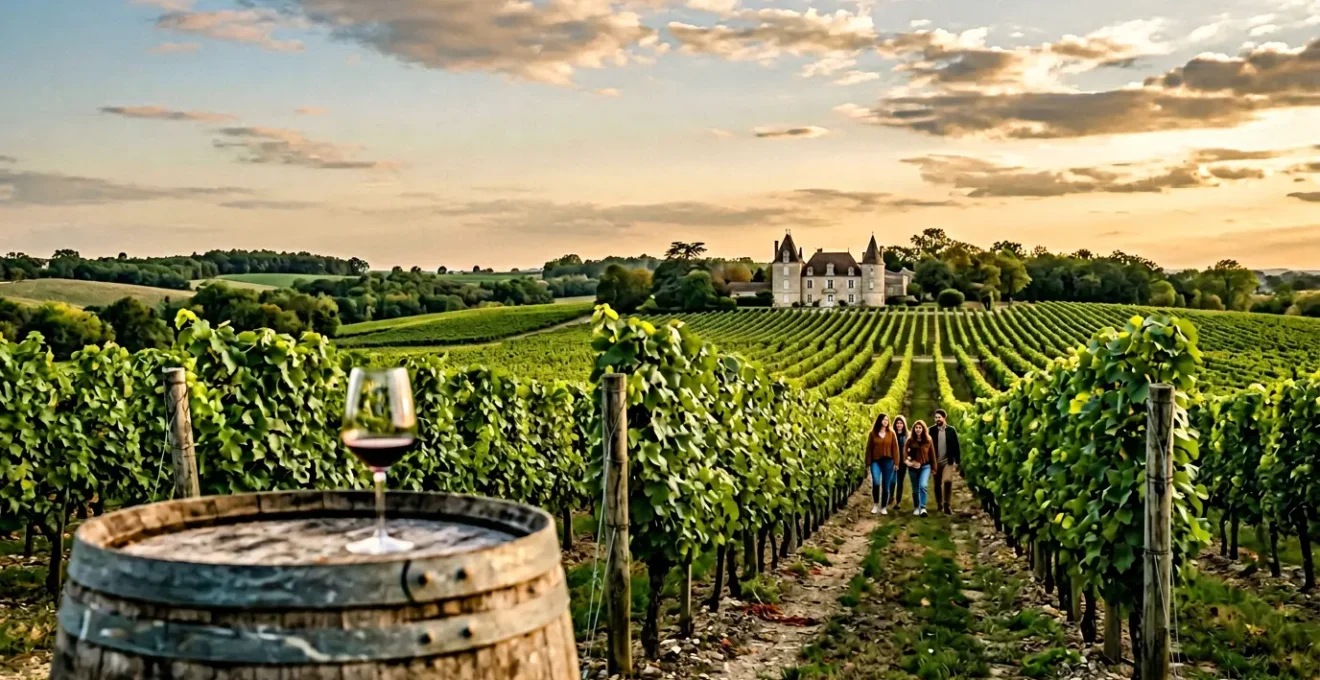
The “designated driver” argument is the single biggest point of friction for couples on a wine tour; the solution isn’t sacrifice, but superior logistical planning.
- Blend transport options using a “hub-and-spoke” model to eliminate drink-driving risks entirely.
- Structure your tasting day based on wine intensity and manage your palate’s endurance to maximize enjoyment.
Recommendation: Stop deciding who “misses out.” Instead, architect your tour around shared experiences by mastering transport, timing, and tasting technique.
The classic Bordeaux dream for a wine-loving couple: winding through sun-drenched vineyards, discovering historic châteaux, and sharing a moment over a world-class Grand Cru. But the dream often hits a logistical wall with a single, recurring question: “Who’s driving?” This isn’t just a practical issue; it creates an imbalance where one person becomes a chauffeur while the other enjoys the full experience. The default solutions—booking a crowded bus tour or simply abstaining—often feel like a compromise that dulls the magic of the trip.
Many guides will tell you to hire a private driver, and while that is a fantastic option, it’s often presented as the only solution without exploring the nuances of cost, pacing, and flexibility. The truth is, a truly seamless and equitable Bordeaux experience for two doesn’t come from a single choice, but from a strategic blend of logistics. It’s about understanding how to manage your ‘palate stamina’ as much as your travel time, and knowing the unwritten rules of château etiquette.
But what if the key wasn’t simply choosing a mode of transport, but designing a complete tasting architecture for your day? This guide moves beyond the obvious to give you the logistical framework of a professional tour organiser. We’ll deconstruct the day, from the science of preventing palate fatigue to the smartest way to get your precious bottles back to the UK. We’ll analyse the trade-offs between different transport styles and reveal the scheduling secrets that allow you to taste powerful reds without succumbing to afternoon fatigue. This is your blueprint for a perfect trip where the only thing you’ll be debating is the vintage, not the car keys.
To help you craft this perfect itinerary, this guide breaks down the essential strategies into a clear, actionable plan. The following sections provide a complete roadmap, covering everything from tasting technique to transport logistics.
Summary: A Sommelier’s Guide to Bordeaux for Couples
- Why Swallowing Every Sample Quickly Destroys Your Palate by Noon?
- How to Ship 12 Bottles Back to the UK Without Paying Absurd Customs Duty?
- E-Bike Tours vs Minibus Excursions: Which Offers a Better Tasting Pace?
- The Walk-In Mistake That Gets You Rejected From Grand Cru Estates
- When Should You Schedule the Heaviest Red Tastings to Avoid Afternoon Fatigue?
- Automatic vs Manual Rental Cars: Which Is Essential for Steep Rural Geography?
- How to Use Splitwise to Fairly Divide Costs When One Person Earns More?
- Navigating Rural Geography: Unlocking Europe’s Hidden Villages Safely
Why Swallowing Every Sample Quickly Destroys Your Palate by Noon?
The most common rookie mistake at a wine tasting isn’t misidentifying an aroma; it’s treating it like a bar. Swallowing every single sample, especially of young, tannic Bordeaux, is the fastest way to obliterate your palate. The culprit is palate fatigue, a state where your taste buds become overwhelmed and desensitised. The primary driver of this is the accumulation of tannins, the compounds in red wine that create a drying, astringent sensation. When tannins build up, they mask the subtler fruit, floral, and spice notes, making every subsequent wine taste harsh or muted.
This isn’t just a feeling; it’s a measurable phenomenon. Professional research shows that the sensation of astringency from tannins can linger for up to 6 minutes, creating a “carryover” effect that distorts the next wine you taste. If you’re visiting three châteaux before lunch and tasting three wines at each, swallowing every drop means your palate never gets a chance to reset. By the time you arrive at that prestigious Pauillac estate for your noon appointment, your ability to appreciate its complexity is severely compromised. Spitting isn’t rude; it’s a professional tool. It allows you to assess the wine’s structure, aroma, and finish without the cumulative alcoholic and tannic impact, preserving your most valuable tasting asset: your palate stamina.
To maintain this stamina, you need a deliberate reset strategy between tastings. It’s not just about waiting; it’s about actively cleansing your palate to prepare it for the next experience. The following checklist is what we use on professional tours to ensure our clients can appreciate the last wine of the day as much as the first.
Your Action Plan: The Strategic Palate Reset Sequence
- Take a sip of sparkling water between châteaux visits to lift tannin buildup.
- Eat a neutral cracker or piece of bread to physically ‘scrape’ the palate clean.
- Try a small cube of mild cheese; the fat content helps to break down and neutralise wine tannins.
- Consider a fresh apple slice for a juicy, acidic palate refresh, especially after heavy reds.
- Wait at least 20-40 seconds between tasting different wines to reduce sensory carry-over effects.
How to Ship 12 Bottles Back to the UK Without Paying Absurd Customs Duty?
You’ve found a spectacular case of Saint-Émilion Grand Cru, a wine you can’t get back home. The joy of discovery is quickly followed by the logistical headache: how do you get it back to the UK without facing a massive bill for customs duty and VAT? Many visitors fall into the trap of using the château’s direct shipping, which can be convenient but often expensive and involves individual customs declarations. The savvier approach, especially for a couple, involves understanding and leveraging your personal allowances.
A key strategy for UK travellers is the ability to pool your duty-free allowances when you travel together. Each adult has a personal allowance (currently up to 18 litres, or 24 standard bottles, of still wine). By combining your allowances, a couple can legally bring back a significant quantity of wine without paying a single penny in duty. This makes renting a car for the overall trip and driving back via the ferry or Eurotunnel an extremely cost-effective option for serious buyers.
However, if you’re flying, you’ll need a different plan. This is where third-party shipping specialists in Bordeaux become invaluable. Unlike individual châteaux, these companies are experts in consolidation. They can collect your purchases from multiple estates and ship them as a single consignment. This not only reduces the cost per case but also streamlines the customs process into a single declaration, as shown in the comparison below.
| Shipping Method | Average Cost per Case | Consolidation Option | Customs Handling |
|---|---|---|---|
| Château Direct Shipping | €80-120 | No | Individual declarations |
| Bordeaux Shipping Specialist | €50-70 | Yes – multiple purchases | Single declaration |
| Personal Transport (pooled allowance) | €0 | N/A | Within duty-free limits |
E-Bike Tours vs Minibus Excursions: Which Offers a Better Tasting Pace?
Choosing your transport method in Bordeaux is a critical decision that dictates the entire rhythm of your day. The two most popular guided options, e-bike tours and minibus excursions, offer vastly different experiences. An e-bike tour through the flat vineyards of the Médoc offers an incredible sensory immersion—you smell the soil, feel the sun, and see the landscape unfold at a human pace. It’s romantic and engaging, but it comes at a cost: cognitive load. As the Lost in Bordeaux Travel Guide notes in its analysis, the constant mental effort of navigation and traffic awareness can detract from the main event.
The mental energy required for navigation, watching for traffic, and maintaining balance after tasting reduces your ability to focus on the wine and enjoy the experience.
– Lost in Bordeaux Travel Guide, Wine Tours Analysis 2025
A minibus tour, by contrast, completely removes this cognitive load. You can relax, chat, and fully decompress between château visits, arriving fresh and focused for each tasting. However, you sacrifice flexibility. These tours operate on a rigid schedule, often with larger groups, giving you a set amount of time at each location. The best choice depends on your priority: total immersion with physical engagement (e-bike) or relaxed, hassle-free logistics (minibus). For the steep hills of Saint-Émilion, a minibus or private driver is almost always the superior choice, as seen in this comparison.
| Factor | E-Bike Tours | Minibus Tours | Private Driver |
|---|---|---|---|
| Best for Region | Flat Médoc D2 Route | Steep Saint-Émilion hills | All regions |
| Cognitive Load | High (navigation + balance) | Low (full relaxation) | Low |
| Time at Château | Flexible but limited | Rigid schedule (45-60 min) | Fully flexible |
| Travel Time Between | 30-45 minutes | 15-20 minutes | 15-20 minutes |
| Group Size | 6-10 people | 8-20 people | 2-6 people |
The Walk-In Mistake That Gets You Rejected From Grand Cru Estates
In many wine regions, a spontaneous “walk-in” visit is a charming way to discover hidden gems. In Bordeaux, especially at the top-tier Grand Cru Classé estates, it’s a recipe for disappointment. Turning up unannounced at Château Margaux or Château Lafite Rothschild will almost certainly result in a polite but firm refusal. This isn’t snobbery; it’s a matter of pure logistics. As The Wine Cellar Insider guide explains, these visits are highly structured private experiences.
For top estates, appointments are not about snobbery but about logistics. A visit is a private, guided experience requiring a dedicated staff member.
– The Wine Cellar Insider, Bordeaux Château Visiting Guide
A tasting at a classified growth is not a simple pour at a tasting bar. It’s a scheduled tour, often lasting 60-90 minutes, led by a dedicated host who has been allocated specifically for your group. Arriving without an appointment, which should be made weeks or even months in advance via email or a formal request, is like showing up to a sold-out theatre and asking for a seat. The system simply isn’t designed for it.
Does this mean all spontaneity is lost? Not at all. The key is to aim for the right targets. Many excellent family-owned Cru Bourgeois properties, particularly in less-trafficked appellations like Fronsac or the Côtes de Bordeaux, are far more accommodating. Some, like Château Soutard in Saint-Émilion, may even accept walk-ins during the shoulder season. If you are turned away from an estate, the best recovery is to politely ask for a recommendation: “Could you suggest a smaller château nearby that you admire?” This question often yields fantastic insider tips and turns a rejection into a new discovery.
When Should You Schedule the Heaviest Red Tastings to Avoid Afternoon Fatigue?
A full day of Bordeaux tasting is a marathon, not a sprint, and a successful finish requires a smart race plan. Just as you wouldn’t start a meal with a heavy steak, you shouldn’t start your tasting day with the most powerful, tannic wines. The concept of Tasting Architecture—the strategic scheduling of your visits based on wine style and intensity—is paramount to avoiding the dreaded mid-afternoon palate crash. Your palate is at its most fresh and perceptive in the morning, making this the ideal time for wines that require nuanced assessment.
Professional tasters have long known this, and data backs it up. It’s generally noted by professionals that after 6-8 tastings, the palate’s ability to discern fine detail begins to wane. Therefore, it’s crucial to front-load your day with either the most delicate wines or the most important ones you want to assess critically. A common and effective strategy is to start with the softer, Merlot-dominant wines of the Right Bank (like Saint-Émilion or Pomerol) in the morning. Their plush fruit and silkier tannins are more approachable for a fresh palate.
Case Study: The Wine Spectator Tasting Schedule
An optimal approach, highlighted by Wine Spectator’s tasting methodology, involves a counter-intuitive strategy for powerful wines. They suggest scheduling highly tannic Cabernet Sauvignon-based wines from appellations like Pauillac and Saint-Estèphe in the late morning, from 11:00 am to 12:30 pm. This allows you to assess these complex wines when your palate is still sharp. This is immediately followed by a substantial lunch, which helps absorb the impact of the alcohol and tannins. The day can then conclude with the sweet, rich wines of Sauternes, which serve as a delightful “dessert” that can cut through any lingering fatigue and revive the senses.
Automatic vs Manual Rental Cars: Which Is Essential for Steep Rural Geography?
For UK visitors, driving on the “wrong” side of the road is already a significant mental adjustment. Throw in narrow, winding vineyard lanes, surprise encounters with tractors, and France’s infamous “priorité à droite” rule, and your cognitive bandwidth can be stretched to its limit. In this context, the choice between an automatic and a manual rental car is not a matter of preference; it’s a strategic decision about managing cognitive load.
Choosing an automatic transmission is essential for a low-stress driving experience in rural Bordeaux. By removing the need to focus on the clutch and gear changes, you free up vital mental resources to concentrate on more critical tasks: reading unfamiliar French road signs, navigating with GPS, and anticipating the movements of other vehicles. This is particularly crucial in the steep, hilly geography of the Right Bank, such as the areas around Saint-Émilion, where a manual car can lead to stalling on inclines and added stress when parking.
Think of it as offloading a complex task from your brain’s CPU. Instead of juggling the clutch on a narrow hill while a grape harvester approaches, you can focus entirely on positioning the car safely. For a couple sharing the driving, this benefit is doubled. It lowers the barrier to entry for the less confident driver and ensures that whoever is behind the wheel can remain calmer and more attentive. The small extra cost of an automatic rental is a negligible price to pay for the immense reduction in stress and the significant increase in safety and enjoyment for both partners on the trip.
How to Use Splitwise to Fairly Divide Costs When One Person Earns More?
Money can be a significant source of tension on any trip, and a high-end Bordeaux tour with its mix of shared tours, individual bottle purchases, and fine dining is no exception. This is especially true for a couple where incomes may differ. The goal is equitable logistics, ensuring fairness without transactional awkwardness. The app Splitwise, when used correctly, can transform from a simple debt-settling tool into a powerful pre-trip planning dashboard that fosters transparency and prevents disputes.
The key is to move beyond the default “split 50/50” function. Before the trip, have an open conversation about how to handle major expenses. If there’s an income disparity, Splitwise’s “split by percentage” feature is your best friend. You can agree on a 60/40 or 70/30 split for big-ticket shared items like a private driver or accommodation, logging it in the app so the calculation is automatic and transparent. This acknowledges the reality of your finances without requiring a constant, uncomfortable negotiation.
Furthermore, the app allows for crucial distinctions between shared experiences and personal splurges. If one person decides to buy an expensive case of wine for their personal cellar, it can be logged as an individual expense with a “0 person split,” ensuring their partner doesn’t subsidise it. This approach was highlighted by a group of travellers who used the app for their Bordeaux trip.
A group of friends visiting Bordeaux reported that using Splitwise as a pre-trip planning dashboard rather than just for settling debts transformed their experience. By logging anticipated costs for tours and tastings beforehand, everyone had full visibility of expenses. One member who bought an expensive case at Château d’Yquem logged it as a personal expense, preventing unfair cost distribution while maintaining transparency about group spending.
– Group Travel Cost Management Experience, Rick Steves Community Forum
Key Takeaways
- The “hub-and-spoke” model is the ultimate strategy for safety and flexibility: use a rental car for long distances and pre-booked taxis/VTCs for tasting days.
- Your palate has limited stamina. Use spitting and strategic palate-cleansing techniques to preserve your ability to taste throughout the day.
- Plan ahead: Top châteaux require appointments booked months in advance, and offline maps are essential for navigating unreliable rural mobile service.
Navigating Rural Geography: Unlocking Europe’s Hidden Villages Safely
The final piece of the puzzle is to assemble all these elements into a cohesive master strategy. The single most effective method for navigating Bordeaux’s geography safely while ensuring both partners enjoy the wine is the “Hub and Spoke” transport model. This strategy offers the perfect blend of flexibility and safety, eliminating the drink-driving dilemma entirely. It involves using a rental car (an automatic, of course) as your primary tool for long-distance travel—getting from the airport to your accommodation and for non-tasting exploration days.
Once you are settled in your “hub”—be it a hotel in Bordeaux city or a guesthouse in Saint-Émilion—the rental car stays parked on tasting days. For the “spokes” of your journey to the châteaux, you switch to pre-booked taxis or VTC services like Uber. This hybrid approach gives you the freedom of a car for general travel but the safety and relaxation of a private driver precisely when you need it most. It allows you to fully indulge in every tasting, secure in the knowledge that your return journey is handled by a professional.
Case Study: The Hub and Spoke Transport Model in Practice
Visitors who successfully employ this strategy report significantly higher satisfaction. According to the official Bordeaux tourism office, this method is a growing trend among independent travellers. By using a car for exploring the Dune du Pilat on one day and booking an Uber for a full-day Médoc tasting tour on the next, visitors maintain complete control over their itinerary without compromising safety. This model transforms the rental car from a liability on tasting days into a valuable asset for the rest of the trip.
A crucial component of this strategy is reliable navigation, as mobile service can be patchy in rural vineyard areas. Before leaving your hotel’s Wi-Fi, you must download the entire Bordeaux region in Google Maps for offline use. Pin every château, restaurant, and point of interest in advance so your phone becomes a fully functional, offline GPS, ensuring you can navigate the spokes of your journey without a single bar of service.
Now that you have the complete strategic framework, the next logical step is to start sketching out your ideal itinerary. By combining the hub-and-spoke transport model with a smart tasting schedule and equitable financial planning, you can design a Bordeaux journey that is truly a shared, unforgettable experience for both of you.