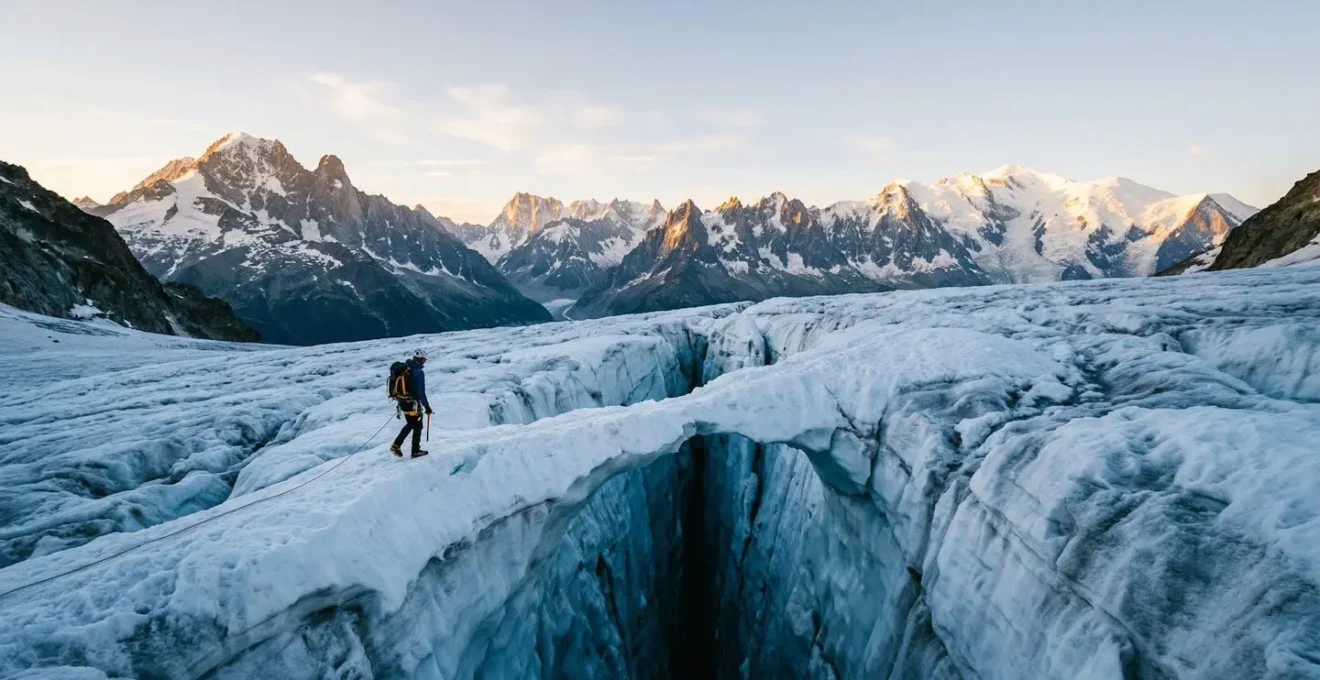
You believe your cardio and strength from the climbing gym have prepared you for the Alps. They haven’t. This guide reveals why alpine survival is less about physical power and more about a brutal, counter-intuitive understanding of ice, weather, and your own physiology. Mastering these skills is the only way to conquer glacial peaks and return safely.
The gritstone edges of the Peak District and the rugged scrambles of Snowdonia build a formidable climber. You’ve honed your strength on indoor walls, your endurance on long fell runs, and your technique on trad routes. You feel fit, competent, and ready for a bigger challenge: the majestic, ice-clad peaks of the Alps. This confidence, however, is your most significant liability. The alpine environment operates under a different set of rules—silent, invisible, and utterly indifferent to your physical prowess.
Standard advice tells you to “rope up” or “check the weather,” but this barely scratches the surface. The real dangers are not the obvious precipices but the subtle shifts in the environment that your UK experience has not prepared you to see. It’s the gentle warmth of an afternoon sun, the deceptive feeling of fitness at altitude, or the almost imperceptible slack in a rope. These are the details that distinguish a successful summit from a rescue operation.
But what if the key to survival wasn’t just reacting to a fall with a Z-pulley, but preventing the fall by understanding the glacier’s language? This guide is built on that principle. We will dissect the objective hazards of glacial travel, moving beyond basic technique to instil the environmental intelligence and proactive risk mitigation that define a true alpinist. We will explore why the mountain punishes assumptions and rewards a deep, almost paranoid, respect for its forces. This isn’t just about crevasse rescue; it’s about developing the judgment to make it unnecessary.
This comprehensive guide is structured to build your expertise from the ground up, moving from environmental awareness to the specific technical skills required for safe glacier travel in the Alps. Below is a summary of the critical knowledge areas we will cover.
Summary: A Guide to Essential Alpine Crevasse and Glacier Skills
- Why Mild Afternoon Sun Makes Glacier Crossings Incredibly Dangerous?
- How to Properly Fit Crampons to Your B3 Mountaineering Boots?
- Guided Roped Travel vs Solo Ascents: When Is It Safe to Unclip?
- The Rope Slack Mistake That Makes Crevasse Falls Fatal
- When Is the Exact Window to Summit Before the Afternoon Whiteout?
- How to Layer Merino Wool Clothing for Sub-Zero Mountain Mornings?
- Why Your Peak District Fitness Won’t Prevent Andean Altitude Sickness?
- How to Safely Explore Landscapes Off the Grid Without Getting Lost?
Why Mild Afternoon Sun Makes Glacier Crossings Incredibly Dangerous?
In the mind of a climber conditioned by British weather, sunshine equals ideal conditions. In the high Alps, this assumption is a fatal error. The most immediate threat on a glacier is not the biting cold of the morning, but the gentle warmth of the afternoon sun. This warmth acts as a silent saboteur, dramatically weakening the very snow bridges you rely on to cross hidden crevasses. The seemingly solid highway of snow you crossed at dawn can become a minefield by lunchtime.
The science is unforgiving. Solar radiation penetrates the snowpack, melting the crystalline bonds that give a snow bridge its structural integrity. This process is insidious because it often happens from within, with little outward sign of the danger beneath your feet. Research confirms the alarming speed of this decay; a seemingly robust snow bridge can suffer a 75% loss in structural integrity in just a few hours of direct sun. A bridge that could support a vehicle in the morning might not support a single climber by mid-afternoon.
As the image above illustrates, the difference is stark. The crisp, frozen structure of the morning gives way to sagging, water-logged snow that has lost its cohesion. Reading these signs is a non-negotiable survival skill. Your timetable should be dictated not by your energy levels, but by the sun’s position in the sky. To navigate this invisible danger, you must learn to spot the subtle warning signs:
- A noticeable sheen on the snow surface, indicating melting.
- Audible sounds of running water beneath the snowpack.
- Visible sagging or discoloration around the edges of known or suspected crevasse lines.
Ultimately, treating the afternoon sun as an objective hazard, just like an avalanche or a rockfall, is a fundamental shift in mindset. It means setting and adhering to strict turnaround times, regardless of how close the summit appears.
How to Properly Fit Crampons to Your B3 Mountaineering Boots?
Your connection to the ice is only as good as the interface between your boots and crampons. An improperly fitted crampon is not a minor inconvenience; it’s a critical failure waiting to happen. On steep, unforgiving ice, a crampon that wobbles, shifts, or detaches can be catastrophic. The transition from flexible UK walking boots to rigid B3 mountaineering boots requires a new level of precision and understanding of this essential system.
A B3 boot is a completely rigid platform designed for technical ice and mixed climbing. Its rigidity is its key feature, allowing for front-pointing on vertical ice without the boot flexing and popping the crampon off. These boots feature both heel and toe welts—hard plastic or metal ledges—specifically designed to accept a C3 “step-in” or “automatic” crampon. This system provides the most secure and rigid connection possible.
The fit must be perfect. Before you ever step on a glacier, you must fit your crampons to your boots at home. The process involves adjusting the linking bar so the crampon sits flush against the boot sole with zero gaps. The heel lever should snap shut with a firm, reassuring ‘thwack’—not so loose that it can be closed with one finger, and not so tight that you need a tool to force it. The front bails must engage securely with the toe welt. When fitted correctly, you should be able to pick up the boot and crampon as a single, solid unit with absolutely no movement or rattling.
Understanding the compatibility between different boot and crampon ratings is non-negotiable for safety and performance. This table, based on established mountaineering principles, outlines the system.
| Boot Type | Compatible Crampons | Best Alpine Use | Key Features |
|---|---|---|---|
| B3 Fully Rigid | C1, C2, C3 (all types) | Technical ice, mixed routes | Heel & toe welts for step-in system |
| B2 Semi-Rigid | C1, C2 only | Alpine mountaineering, easier ice | Heel ledge only, some toe flex |
| B1 Flexible | C1 strap-on only | Winter walking, easy snow | No welts, requires full strap system |
Failure to respect this system—for example, by trying to fit a C3 crampon on a B1 boot—will lead to equipment failure. Your gear is a system, and every component must be perfectly matched and meticulously maintained.
Guided Roped Travel vs Solo Ascents: When Is It Safe to Unclip?
On a glacier, the rope is more than a piece of gear; it’s a lifeline. The decision to unclip from your partners is one of the most serious you can make, yet climbers often treat it with a dangerous casualness. The question isn’t just “When is it safe to unclip?” but rather, “What are the overwhelming and undeniable signs that the objective hazard of a hidden crevasse has dropped to zero?” For most alpine glacier travel, the answer is almost never.
The temptation to unclip stems from psychological traps: summit fever, the desire for faster movement, or seeing other teams travelling un-roped. This “herd mentality” is incredibly dangerous, as you have no knowledge of the other team’s experience, risk assessment, or destination. Analysis of Alpine incidents shows a grim reality: an unroped fall into a crevasse is almost always fatal. In one documented case, two separate guided ski-mountaineering parties in the Alps lost a member to a fatal crevasse fall while travelling un-roped, highlighting that even professional oversight doesn’t grant immunity from a bad decision.
As one ALPSinsight Alpine Safety Expert notes, this risk must be actively managed. As they put it:
No one is immune to hazards on a glacier, but with training and experience you can minimize the risk. And you must minimize this risk, for yourself and for the partners you go to the mountains with.
– ALPSinsight Alpine Safety Expert, Learning the basics of glacier travel and crevasse rescue
Certain situations are non-negotiable. You must remain roped whenever snow covers the glacier (hiding crevasses), when visibility is poor, or when crossing any area marked as a known crevasse zone on a map. In fact, rescue services like the PGHM in France designate specific glacier routes as ‘mandatory rope travel’ zones. Travelling un-roped in these areas can not only be fatal but may also void your rescue insurance and create legal liability in the event of an accident.
The only time to even consider unclipping is when you are definitively off the glacier ice and on solid rock (e.g., a final summit ridge) or on a clearly marked and secured path at a low-altitude “ice palace” tourist attraction. For genuine alpine travel, the rope stays on.
The Rope Slack Mistake That Makes Crevasse Falls Fatal
Being roped together is meaningless if the rope is not managed correctly. The single most common and deadly mistake in glacier travel is allowing slack to develop in the rope between climbers. A slack rope does not just fail to arrest a fall; it actively multiplies the forces involved, making a rescue exponentially harder and a fall far more likely to be fatal for both the faller and their partners.
The physics are brutal and non-negotiable. When a climber falls into a crevasse, any slack in the system allows them to build momentum. By the time the rope comes tight, the force exerted on the remaining team members is not just the climber’s body weight, but a massive shock load. Even one metre of slack can be devastating. As physics calculations demonstrate, a fall with minimal slack can generate forces of 3kN or more, easily pulling other climbers off their feet if they are not perfectly braced to arrest it. A taut rope, by contrast, allows for an immediate transfer of weight, preventing momentum build-up and making an arrest possible.
Maintaining a ‘zero-slack’ system is an active, constant process. The rope should be just tight enough to form a gentle catenary curve between climbers, without pulling on anyone’s harness. This requires continuous adjustment as the team navigates undulating terrain. The most effective method for this is using coils, such as the ‘Kiwi’ coil, which allows a climber to quickly shorten or lengthen the rope without re-tying knots. This technique, shown above, is a fundamental skill, not an advanced one.
Action Plan: Achieving a Zero-Slack Rope System
- Mastering the Kiwi Coil: Practice taking in and letting out coils with gloves on, while walking, until it becomes second nature. Aim to adjust rope length in under 60 seconds.
- Constant Monitoring: The last person on the rope team has the primary responsibility of watching the rope, ensuring it doesn’t snag on rocks or ice and that tension remains correct. This is their main job, not sightseeing.
- Non-Verbal Communication: Develop clear, simple hand signals with your team for “more tension” or “give slack.” Shouting is often impossible in high winds.
- Secure Tie-Offs: When shortening the rope significantly for steeper terrain, the excess coils must be tied off securely to your harness, not just held.
- Terrain Awareness: Use natural features like small rises or rock outcrops as friction points to help manage the rope, but be vigilant about preventing snags.
Treating the rope as a dynamic system that requires constant attention is the hallmark of an experienced alpinist. A sloppy rope is a sign of a team that does not understand the forces they are dealing with.
When Is the Exact Window to Summit Before the Afternoon Whiteout?
In the Alps, time is not measured by the clock on your wrist, but by the mountain’s own atmospheric timetable. The clear, stable skies of dawn are often a fleeting gift. As the sun heats the valleys, moist air rises, condenses, and forms convective clouds that can rapidly engulf the high peaks in a disorienting whiteout. Getting caught in one on a complex glacier is a life-threatening situation. Your primary strategic goal is to be on your way down long before this process begins.
There is no single “exact window” that applies to every mountain, but there is a universal principle: plan your day around a non-negotiable turnaround time. This is a pre-determined time by which you will turn back, regardless of whether you have reached the summit. For most high alpine routes above 3,000 metres, this is typically between 11 a.m. and noon. This isn’t a sign of failure; it’s a mark of professional discipline. It acknowledges that the descent is the most dangerous part of the day, and you must save ample time, energy, and daylight for it.
The famous Matterhorn provides a classic example. Climbers aiming for the summit almost exclusively start in the pre-dawn hours. This is not just for the Instagram-worthy sunrise; it’s because the mountain has a well-known tendency to build afternoon clouds. As documented in many trip reports, morning slots offer the best chance of clear views and stable weather, while afternoon attempts are frequently thwarted by cloud and deteriorating conditions. This pattern is repeated across the Alps.
Reading the sky is as important as reading a map. You must become a student of mountain meteorology, constantly looking for the early warning signs of a developing weather system. These include:
- Lenticular clouds: Lens-shaped clouds forming over peaks are a classic indicator of high winds and approaching weather fronts.
- Rapidly rising cumulus: Puffy “cauliflower” clouds boiling up from the valleys by 10 a.m. are a sure sign of afternoon convection and potential thunderstorms.
- Wind direction shifts: A change in wind speed or direction can signal the arrival of a new weather system.
Your goal is not just to reach the summit. Your goal is to get up and down safely. The summit is optional; the descent is mandatory. A disciplined and early turnaround is the ultimate expression of this understanding.
How to Layer Merino Wool Clothing for Sub-Zero Mountain Mornings?
Dressing for a pre-dawn start in the Alps is a masterclass in thermal regulation. Temperatures can be well below -10°C, but within an hour of strenuous uphill hiking, your body will be generating immense heat and sweat. Mismanaging this phase can leave you soaked in sweat, which will freeze the moment you stop, leading to rapid and dangerous heat loss. The key is not to dress warmly, but to layer intelligently, starting with a high-performance merino wool base layer.
Merino wool is an exceptional material for this environment. It provides excellent insulation even when damp, it is naturally odour-resistant, and it feels comfortable against the skin. However, not all merino is created equal. It is graded by fabric weight (grams per square metre, or g/m²), and using the correct weight for each phase of your climb is critical.
The golden rule for an active start is: “Be bold, start cold.” You should feel uncomfortably chilly at the trailhead. This means starting your high-exertion approach in only a single, lightweight (e.g., 150g/m²) merino base layer, even in sub-zero temperatures. You will warm up within ten minutes. Packing on insulating layers at the start is a rookie mistake that guarantees you will be drenched in sweat. Layers are added during static periods (like a break or a belay) and removed the second you start moving again.
This strategic approach to layering can be summarized by activity phase.
| Activity Phase | Merino Weight | Layer Configuration | Key Consideration |
|---|---|---|---|
| Pre-dawn high exertion approach | 150g/m² | Single base layer only | Start cold to prevent sweat saturation |
| Static belay/summit break | 250g/m² | Base + mid merino + shell | Maximum insulation when stopped |
| Active climbing 0°C to -10°C | 150g/m² + synthetic mid | Merino base + Polartec Alpha | Moisture management priority |
| Extreme cold below -15°C | 200g/m² + 250g/m² | Double merino layers | Warmth over moisture transport |
It’s also crucial to recognise merino’s limitations. As AMGA Guide Derek DeBruin notes in the Wilderness Medical Society’s guidance, “In the typically damp conditions of the Western Alps, synthetic layers like Polartec Alpha can outperform merino for moisture management during high-output activities.” This expert insight highlights the importance of a hybrid system: a merino base for comfort and warmth-when-wet, combined with a synthetic active insulation mid-layer that excels at actively moving moisture away from your body.
Your clothing is not just for comfort; it is life-support equipment. Managing your moisture and temperature is as critical as any rope manoeuvre.
Why Your Peak District Fitness Won’t Prevent Andean Altitude Sickness?
This is the most dangerous misconception for a fit, sea-level athlete. You can have the VO2 max of a Tour de France cyclist and be able to run up Ben Nevis without breaking a sweat, but this has virtually zero correlation with how your body will perform at 4,000 metres. Altitude sickness, or Acute Mountain Sickness (AMS), is a physiological response to a lower partial pressure of oxygen. It is not a test of fitness; it is a test of acclimatization, and the only way to pass is with time.
Your powerful cardiovascular system is efficient at using oxygen, but it cannot function if the oxygen simply isn’t there. Acclimatization is the process by which the body compensates for this deficit by producing more red blood cells to carry oxygen more effectively. This process is slow, and it cannot be rushed by physical fitness. In fact, fit individuals are often at higher risk because they can ascend too quickly, pushing their bodies into a state of severe hypoxia before the warning signs of AMS become debilitating.
The absolute, unbreakable rule of acclimatization is managing your rate of ascent. Once above 2,500 metres, evidence-based guidelines recommend no more than a 300-500m increase in sleeping elevation per night. Following the “climb high, sleep low” mantra is mandatory. A stark analysis of performance differences between the Alps and the Andes illustrates this perfectly. Many climbers who successfully summit Mont Blanc (4,808m) from a low base elevation are completely incapacitated in the Andes, where expeditions often start at a base of 4,000m and ascend to over 6,000m. The starting altitude itself requires a completely different acclimatization protocol that fitness cannot bypass.
High-fitness individuals often misinterpret the early symptoms of AMS—headache, nausea, unusual fatigue—as normal exhaustion from a hard day. This is a critical error. These are not signs to be pushed through; they are alarm bells from your body indicating that you need to stop ascending, or even descend, immediately. Ignoring them can lead to life-threatening High-Altitude Cerebral Edema (HACE) or High-Altitude Pulmonary Edema (HAPE).
Respecting the mountain means respecting your own body’s limits. At altitude, the slow and steady climber will always outperform the fast and fit one who ignores the rules of acclimatization.
Key Takeaways
- The sun is a bigger enemy than the cold on glaciers; its warmth silently destroys the integrity of snow bridges you rely on.
- Zero rope slack isn’t a suggestion, it’s a law of physics. Even a metre of slack can multiply fall forces to an un-arrestable level.
- Your sea-level fitness is a poor predictor of high-altitude performance. The only variable that defeats altitude sickness is a slow rate of ascent.
How to Safely Explore Landscapes Off the Grid Without Getting Lost?
In the vast, monochromatic world of a glacier, especially in deteriorating weather, all sense of scale and direction can vanish in an instant. Your smartphone’s GPS, your primary navigation tool in the UK hills, is a fragile and often unreliable single point of failure in the high mountains. Safe off-grid navigation in the Alps relies not on a single device, but on a robust, redundant system and, most importantly, a continuously engaged brain.
The core of this approach is the “Navigation Trinity,” a three-layered system that ensures you always have a functioning tool. This consists of an analog, a digital, and a satellite layer. The analog layer is your non-negotiable backup: a physical, waterproof map of the area and a reliable baseplate compass. You must have the skills to use them. The digital layer is a dedicated GPS device or a GPS watch with pre-downloaded offline maps. The satellite layer is an emergency communication device like an InReach or Zoleo, which allows for two-way messaging and SOS calls when you are far beyond mobile phone coverage. Relying on just one of these is courting disaster.
Even with these tools, a terrifying navigation emergency can unfold with shocking speed. A classic case study involves an experienced team skiing off a summit in clear weather. Once on the broad, featureless glacier, a cloud suddenly engulfed them, reducing visibility to near zero. They had a GPS and a paper map, but as soon as they took the map out, a gust of wind tore it precisely along the crease they needed to navigate from. This real-world incident underscores a critical point: your tools are useless without the mental skill to use them under extreme pressure and the foresight to protect them.
This “mental mapping” is the most crucial skill of all. It is the continuous process of associating what you see on the map with the real terrain around you. It means “handrailing” a ridge, “catching” a stream, and constantly being aware of your position relative to major features. It transforms you from a passive follower of a GPS dot to an active, thinking navigator. This system includes:
- Layer 1 – Analog: Always carry a waterproof map and baseplate compass.
- Layer 2 – Digital: Use a GPS watch or device with downloaded offline maps and manage power with a 20,000mAh power bank.
- Layer 3 – Satellite: Carry an InReach or Zoleo for emergency communication beyond cell service.
- Pre-trip planning: Define a clear plan for what to do if you get lost, a hard turnaround time, and key decision points before you even start.
Ultimately, safe navigation is a mindset. It is a state of constant, low-level paranoia where you are always asking “Where am I?” and “What if?”. This is the mental framework that will bring you home safely when the technology fails and the whiteout descends.
Frequently Asked Questions about Alpine Glacier Safety
When should teams absolutely stay roped on Alpine glaciers?
Always remain roped when snow bridges are present, visibility is poor, or when crossing known crevasse zones. The PGHM in France considers certain areas ‘mandatory rope travel’ zones.
What are the psychological traps that lead to premature unclipping?
Summit fever, herd mentality following other unroped teams, and end-of-day fatigue all contribute to poor decision-making about rope use.
How does unroping affect rescue insurance in the Alps?
Being un-roped in zones considered mandatory rope travel by local guides or rescue services can void rescue insurance and create legal liability.
Why doesn’t cardiovascular fitness prevent altitude sickness?
While VO2 max helps with exertion, it has zero impact on the physiological process of creating more red blood cells needed for acclimatization.
What early AMS symptoms do fit individuals often ignore?
High-fitness individuals often mistake mild headaches, nausea, and unusual fatigue for normal exhaustion, but these are critical early warning signs.
What’s the only variable that truly matters for preventing AMS?
Rate of ascent is the key factor – maintaining no more than 300-500m of increased sleeping elevation per night above 2,500m.