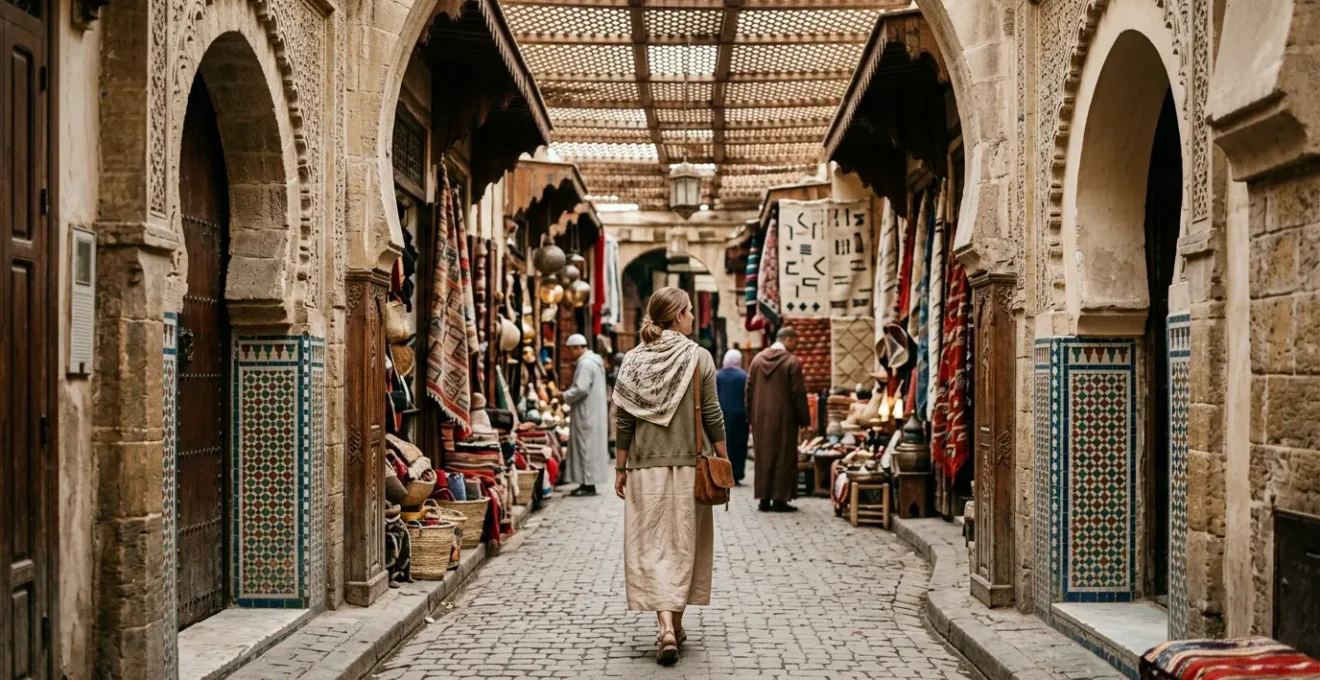
Dressing for conservative countries isn’t about hiding your style; it’s a strategic art of adaptation that transforms your existing wardrobe into something elegant and appropriate.
- Layering breathable fabrics is the secret to managing the shock between intense outdoor heat and frigid indoor air-conditioning.
- A single, high-quality pashmina or large scarf is your most versatile tool for instant modesty at religious sites.
Recommendation: Master the ‘bellows effect’ of a flowing maxi skirt for superior cooling and elegance, proving that more coverage can mean more comfort.
The familiar packing dilemma: on one side, your favourite linen summer dresses and sleeveless tops; on the other, a daunting list of dress-code requirements for your upcoming trip to the Middle East. For the fashion-conscious British traveller, the fear is twofold: looking frumpy and out of place, or worse, causing unintentional offence. The internet is full of generic advice to “cover your shoulders and knees” or “bring a scarf,” but this often leads to overpacking a separate, uninspired wardrobe that feels more like a costume than an expression of personal style.
But what if the secret wasn’t a separate wardrobe, but a system of strategic transformation? What if you could adapt your favourite summer pieces to be perfectly respectful, comfortable in 40-degree heat, and undeniably chic? This guide moves beyond the basic rules to offer the perspective of an intercultural fashion consultant. We will explore the art of wardrobe adaptation, focusing not on what you can’t wear, but on how to elegantly modify what you already own. It’s about understanding the ‘why’ behind the dress codes and using fabric, layering, and strategic accessorising to navigate any situation with confidence and grace.
This article will provide a complete framework for dressing smartly and stylishly in conservative environments. We will deconstruct the common mistakes travellers make, offer practical comparisons of climate-appropriate fabrics, and provide a system for layering that will become your go-to travel strategy. You’ll learn not just to follow the rules, but to master the art of intercultural style.
Contents: A Guide to Respectful and Stylish Travel
- Why Wearing Yoga Pants in Traditional Markets Attracts Aggressive Harassment?
- How to Drape a Pashmina to Instantly Convert a Summer Dress for Mosque Entry?
- Linen Trousers vs Maxi Skirts: Which Breathes Better in 40-Degree Heat?
- The Sleeveless Mistake That Gets You Turned Away From the Vatican
- When Should You Layer Clothing for Rapid Transitions Between Heat and Air Conditioning?
- Why Wearing Expensive Designer Clothes to Holi Is a £200 Mistake?
- The Casual Dress Code Mistake That Gets You Turned Away
- How to Engage With Indigenous Customs Respectfully Without Being Intrusive?
Why Wearing Yoga Pants in Traditional Markets Attracts Aggressive Harassment?
The impulse to wear comfortable, tight-fitting athletic wear like yoga pants while exploring a bustling souq is understandable, but it’s a significant cultural misstep. The issue extends far beyond simply appearing disrespectful. In many traditional public spaces, this style of dress, which is associated with private or gym activities in Western cultures, is contextually jarring. This can unintentionally signal a lack of cultural awareness, marking you as a naive tourist.
According to an analysis of tourist clothing choices and their impact on safety, this perceived naivety can unfortunately make you an easier target for scams, aggressive vendors, or even theft. It’s not just about unwanted male attention; it’s about personal security. Dressing in a way that is out of sync with the local environment can make you stand out in a way that compromises your safety and the quality of your interactions.
The solution is to opt for clothing that blends respect with comfort. Choose loose-fitting trousers or long skirts made from breathable fabrics. Ensure your arms and legs are covered, not just for modesty but for sun protection. By demonstrating a clear respect for local traditions through your attire, you not only avoid negative attention but actively foster goodwill and more positive, authentic interactions with local people. It’s the first step in moving from a conspicuous tourist to a respected visitor.
How to Drape a Pashmina to Instantly Convert a Summer Dress for Mosque Entry?
A high-quality, lightweight pashmina or large scarf is the single most powerful tool in your travel wardrobe. It’s the key to the ‘wardrobe transformation’ system, allowing you to instantly adapt a standard summer outfit for entry into a mosque or any other conservative religious site. Forget packing a separate ‘modest’ outfit; mastering a few simple draping techniques is all you need. This is your one-minute mosque conversion kit.
The primary requirements for mosque entry are covering your hair, shoulders, and knees. A large, opaque scarf accomplishes two of these in seconds. Here are the essential techniques:
- The Simple Head and Shoulder Drape: Open the scarf fully. Centre it over the top of your head, allowing it to hang down evenly on both sides. Take one end and gracefully throw it over the opposite shoulder. This creates a secure, elegant hood that covers your hair and drapes naturally over your shoulders and chest.
- The Secure Wrap for Shoulders: If you are wearing a sleeveless dress but your hair is already tied back, simply wrap the pashmina around your shoulders like a shawl. For more security, you can tie the ends loosely in front of you or tuck them in.
- The Makeshift Skirt: If your dress or skirt is above the knee, you can wrap a larger pashmina or a sarong around your waist to instantly add length and coverage.
This demonstrates the incredible versatility of a single accessory. Your pashmina serves as a head covering, a shoulder wrap, sun protection on a hot day, and even a light blanket against aggressive air conditioning. Always keep one in your daypack.
As you can see, the goal is elegance and respect, not concealment. A soft, neutral-coloured scarf can enhance your outfit while meeting all cultural requirements. It’s the ultimate blend of practicality and style, ensuring you’re prepared for any spontaneous visit to a place of worship.
Linen Trousers vs Maxi Skirts: Which Breathes Better in 40-Degree Heat?
When the temperature soars, the choice between trousers and a skirt becomes a matter of thermal dynamics. While both wide-leg linen trousers and flowing maxi skirts offer excellent sun protection and modesty, they manage heat in fundamentally different ways. The common assumption is that trousers are more practical, but for pure cooling power, the maxi skirt is often the superior choice.
The key difference is airflow. A maxi skirt creates a ‘bellows effect’ with every step you take, actively pumping hot air out and drawing cooler air in. Trousers, even loose ones, restrict airflow between the legs. As travel experts confirm, wearing loose, covering clothes is counter-intuitively more comfortable in extreme heat than shorts, and the maxi skirt is a prime example of this principle in action. The flowing movement also helps in reflecting radiant heat away from the body.
However, the choice depends on your itinerary for the day. This table breaks down the pros and cons to help you decide what to wear and when.
| Factor | Linen Trousers | Maxi Skirts |
|---|---|---|
| Airflow | Restricted between legs | Superior ‘bellows effect’ with each step |
| Activity Suitability | Better for extensive walking, prevents chafing | Ideal for sedentary days, cars and cafes |
| Heat Reflection | Good with light colors | Excellent with flowing movement |
| Practicality | More versatile for activities | Can be impractical when stepping on hem |
| Modern Options | Technical fabrics outperform pure linen | Midi length more practical than maxi |
For a day involving extensive walking, climbing stairs, or getting in and out of vehicles, linen trousers offer better mobility and prevent chafing. For more relaxed days involving cafe visits or museum strolls, a midi or maxi skirt will keep you significantly cooler. The modern fashion-conscious traveller might even consider technical fabrics designed for hot climates, which can outperform traditional linen in moisture-wicking and wrinkle resistance.
The Sleeveless Mistake That Gets You Turned Away From the Vatican
The requirement to cover shoulders isn’t exclusive to the Middle East; it’s a standard rule at major Christian sites as well, most famously at the Vatican. Many travellers are caught out by the strict interpretation of this rule, leading to disappointment and a frantic search for an overpriced scarf from a street vendor. The key is understanding the definition of ‘sleeveless’.
As The Planet D travel experts clarify in their guide to etiquette, there is a simple but critical rule of thumb.
If the ball of the shoulder is visible, it’s considered sleeveless.
– The Planet D Travel Experts, Etiquette in the Middle East – Travel Guide
This means that many cap-sleeve T-shirts or tops that would be considered modest in a casual setting will not pass the test. To avoid this common mistake, every fashion-conscious traveller should have a “Vatican-Ready Pocket Kit” in their daypack. This isn’t a separate outfit, but a small collection of lightweight accessories to adapt on the fly. Your kit should include a lightweight shawl or pashmina of a breathable fabric. This can be instantly draped over the shoulders to ensure full coverage.
While major religious sites like mosques often provide loaner abeyyas and shaylas, relying on these can be a hassle. Having your own lightweight cover-up ensures you are always prepared, whether for a planned visit to St. Peter’s Basilica or a spontaneous decision to enter a beautiful local mosque. It’s a small preparation that guarantees you’ll never be turned away.
When Should You Layer Clothing for Rapid Transitions Between Heat and Air Conditioning?
One of the biggest physical shocks of travelling in a modern desert city like Dubai or Doha isn’t just the heat—it’s the brutal transition from 40°C outdoor humidity to the arctic-level air-conditioning of a shopping mall, hotel, or taxi. This is where a strategic layering system becomes not just a matter of modesty, but of comfort and health. You should be thinking about layering any time your day involves moving between outdoor and indoor environments.
The “Urban Desert 3-Layer System” is a simple but effective framework for managing these temperature swings. It consists of a base layer, a mid-layer, and an ‘AC-shock’ layer.
- Base Layer: This is your primary outfit, which should consist of loose-fitting, breathable fabrics. A cotton T-shirt or a camisole under a main top works well. The goal is comfort in the heat.
- Mid-Layer: This is your primary style and coverage piece. A lightweight, white linen button-down shirt is a perfect example. Worn open, it allows airflow; buttoned up, it provides sun protection and modesty. It reflects sunlight to keep you cool.
- AC-Shock Layer: This is your defence against the cold. A lightweight cardigan or a zip-up hoodie that you can easily take on and off is essential. It also provides an extra layer of coverage if you feel you need it in more conservative spaces or as temperatures drop in the evening.
This system allows you to peel off or add layers in seconds, adapting your personal climate to your surroundings. It’s counter-intuitive, but wearing more, lighter layers offers far more flexibility and comfort than a single, minimal layer. It’s the most practical way to stay comfortable and appropriately dressed throughout a varied day of exploring.
Why Wearing Expensive Designer Clothes to Holi Is a £200 Mistake?
While Holi is a joyous and fantastically photogenic festival of colours, it is not the place for your favourite designer pieces. Participating in the celebrations means being covered head-to-toe in coloured powders and water, many of which contain harsh chemicals. This can cause irreparable damage to delicate or expensive fabrics. In fact, studies show festival colours can cause an average of over £200 in damage to a single designer outfit, a costly and entirely avoidable mistake.
The smart and respectful way to participate is to adopt the “Holi Uniform Strategy”. This involves embracing the local culture by purchasing a very cheap outfit specifically for the event. The perfect choice is a simple, white cotton kurta-pajama set, which can be found in any local market for a few pounds. White is the traditional colour for Holi as it provides the most vibrant canvas for the coloured powders.
This approach has multiple benefits. Firstly, you protect your valuable clothing. Secondly, you show immense cultural respect by dressing in a manner similar to locals. Finally, the colour-stained outfit becomes a unique and personal souvenir from your trip, far more meaningful than a standard trinket. It’s a prime example of where ‘dressing down’ and going local is the most intelligent and stylish choice you can make. Reading up on the specifics of a cultural event before you attend is the key to avoiding costly errors and engaging respectfully.
Key takeaways
- Strategic Layering: The key to comfort is not wearing less, but layering breathable fabrics to manage transitions between heat and air conditioning.
- The Power of the Pashmina: A single large, lightweight scarf is your non-negotiable accessory for instantly adapting any outfit for religious sites.
- Fabric and Fit Dictate Comfort: In extreme heat, the ‘bellows effect’ of a flowing maxi skirt provides superior cooling to even loose-fitting trousers.
The Casual Dress Code Mistake That Gets You Turned Away
After a day of respectful exploration, you might want to enjoy a drink at an upscale rooftop bar or a meal in a fine-dining restaurant. This is where another common dress code mistake occurs: misinterpreting “smart casual”. In many premium venues across the Middle East and even Europe, the Western interpretation of casual (including designer jeans, shorts, or sandals) is often not acceptable.
As travel experts from Matador Network note, even in modern public spaces, certain standards apply. They state that “in shopping malls, souqs, and waterfront promenades, bare shoulders and skirts above the knee are a big no-no.” This standard is elevated further in upscale establishments, particularly in the evenings. Open-toed shoes for men are almost universally disallowed, and athletic wear or beachwear (like flip-flops) will get you turned away at the door.
The definition of smart casual varies significantly by city, and being aware of these nuances is the mark of a savvy global traveller.
| City/Region | Acceptable | Not Acceptable |
|---|---|---|
| Dubai Rooftop Bars | Chinos, collared shirts, elegant trousers | Shorts, sandals, gym clothes |
| Paris Restaurants | Smart trousers, midi skirts, blouses | Designer jeans (risky), athletic wear |
| LA Venues | Dark designer jeans, smart casual | Beach flip-flops, tank tops |
| Middle East Upscale | Closed-toe shoes, modest elegant wear | Open-toed shoes for men, flip-flops |
For a woman, the safest and most stylish bet is a pair of elegant, wide-leg trousers or a midi skirt paired with a sophisticated blouse and closed-toe flats or heels. This ensures you will always be welcomed, projecting an image of polished, respectful elegance that fits the sophisticated atmosphere of these venues.
How to Engage With Indigenous Customs Respectfully Without Being Intrusive?
True cultural respect goes beyond your wardrobe. Your clothing choices open the door to positive interactions, but it’s your behaviour that builds genuine connections. A 2021 study by the Travel Research Association found that tourists who follow local dress codes and customs not only foster goodwill but also report having significantly more positive and meaningful interactions with local communities. Your effort to dress appropriately is seen as a sign of respect, making people more open and welcoming.
One of the best ways to build on this foundation is through small commercial interactions conducted with warmth and politeness. When admiring the work of an artisan in a souq, complimenting their craft before asking about the price can transform a simple transaction into a human connection. Making an effort to use a few words in the local language, even imperfectly, is immensely appreciated and shows a depth of respect that transcends appearance.
To help you connect, here are a few essential phrases in Arabic that can be used throughout much of the Middle East. Learning them is a small investment that yields a huge return in goodwill.
Your action plan: Five Essential Phrases for Cultural Connection
- Greeting: Start any interaction with ‘As-salāmu ʿalaykum’ (Peace be upon you). It is the universal and most respectful greeting.
- Thank you: Use ‘Shukran’ (Thank you). Accompanying the word with a hand placed over your heart is a beautiful gesture of sincerity.
- Expressing Appreciation for Food: When offered a taste or dining, saying ‘Hatha ladhidh’ (This is delicious) is a wonderful compliment.
- Complimenting Craftsmanship: When looking at local crafts, saying ‘Amalek jameel’ (Your work is beautiful) shows appreciation beyond a simple purchase.
- Asking Permission: Before asking a personal question or taking a photo, inquire with ‘Hal yumkinuni an as’al?’ (May I ask a question?).
By pairing a respectful appearance with respectful engagement, you move from being a passive observer to an active, welcome participant in the local culture. It’s the final and most important step in a truly stylish and enriching journey.
Armed with this framework, you are now equipped to curate a travel wardrobe that is not only respectful and comfortable but a true expression of your personal style, ready for any adventure.